- English
- French
- German
- Portuguese
- Spanish
- Russian
- Japanese
- Korean
- Arabic
- Greek
- German
- Turkish
- Italian
- Danish
- Romanian
- Indonesian
- Czech
- Afrikaans
- Swedish
- Polish
- Basque
- Catalan
- Esperanto
- Hindi
- Lao
- Albanian
- Amharic
- Armenian
- Azerbaijani
- Belarusian
- Bengali
- Bosnian
- Bulgarian
- Cebuano
- Chichewa
- Corsican
- Croatian
- Dutch
- Estonian
- Filipino
- Finnish
- Frisian
- Galician
- Georgian
- Gujarati
- Haitian
- Hausa
- Hawaiian
- Hebrew
- Hmong
- Hungarian
- Icelandic
- Igbo
- Javanese
- Kannada
- Kazakh
- Khmer
- Kurdish
- Kyrgyz
- Latin
- Latvian
- Lithuanian
- Luxembou..
- Macedonian
- Malagasy
- Malay
- Malayalam
- Maltese
- Maori
- Marathi
- Mongolian
- Burmese
- Nepali
- Norwegian
- Pashto
- Persian
- Punjabi
- Serbian
- Sesotho
- Sinhala
- Slovak
- Slovenian
- Somali
- Samoan
- Scots Gaelic
- Shona
- Sindhi
- Sundanese
- Swahili
- Tajik
- Tamil
- Telugu
- Thai
- Ukrainian
- Urdu
- Uzbek
- Vietnamese
- Welsh
- Xhosa
- Yiddish
- Yoruba
- Zulu
Where to buy NFC anti metal epoxy tags
When sourcing reliable NFC anti metal epoxy tags for your industrial operations, the answer lies with specialized manufacturers who understand the unique challenges of metal-surface identification. These advanced tags—designed with ferrite shielding layers and industrial-grade epoxy encapsulation—are available through certified RFID hardware suppliers like WS-RFID Technology, which combines 15 years of manufacturing expertise with ISO-certified production facilities. Direct engagement with experienced manufacturers ensures you receive tags engineered for consistent performance on steel, aluminum, and copper surfaces across demanding environments.
Understanding NFC Anti-Metal Epoxy Tags: Technology & Benefits
Place standard NFC tags on metal, and they will no longer work. Most tags are useless because the conductive surface creates eddy currents that mess up electromagnetic fields. This problem caused businesses a lot of trouble for years until anti-metal technology came along.
How Anti-Metal Technology Solves Signal Interference
The breakthrough was made possible by layers of ferrite protection. This high-permeability material moves magnetic fields away from the metallic base when it is put between the antenna and the metal surface. Instead of signal cancellation, the 13.56 MHz frequency gives you stable talk time. NFC anti-metal epoxy tags have this shielding built into a small package, so they can still be read from up to 10 cm away when they're attached to steel equipment or aluminum containers.
The encapsulation with epoxy resin adds another level. In addition to protecting the internal parts, it also makes an RF-transparent shield that keeps the signal's integrity and is waterproof up to IP68 standards. These tags will still work even if you soak them, clean them with chemicals, or expose them to temperature changes from -25°C to +85°C.
Industrial Advantages That Drive ROI
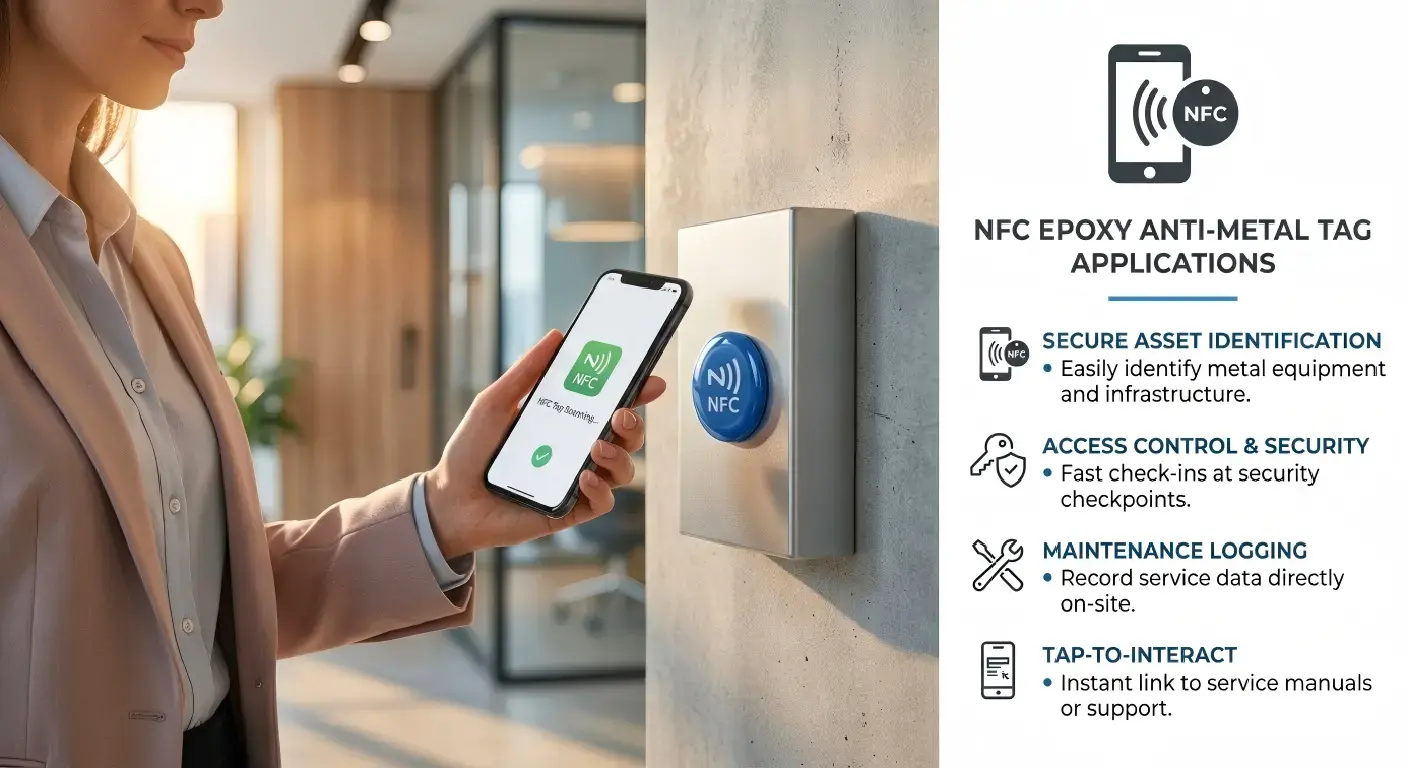
When your tags actually work on metal surfaces, asset tracking changes. Hospitals handling surgical tools, manufacturing facilities keeping an eye on precision molds, and shipping companies keeping an eye on steel containers all need reliable identification that doesn't require any human action. This dependability is provided by these epoxy-coated options in three main ways.
Durability greatly increases the useful life of something. The industrial-grade design can resist impacts, UV light, and corrosive conditions that would destroy regular labels in months. Your investment pays off over years of ongoing use instead of needing to be replaced all the time.
Smartphone compatibility gets rid of the need for a proprietary reader. Using ISO/IEC 14443 protocols, these tags can be read right away by any device that has NFC capability, which is almost all modern smartphones. This makes it easier for everyone to use, which cuts down on training needs and gear costs while also speeding up rollout times.
Data that is flexible can be used to meet changing business needs. You can store anything from 144 bytes to 888 bytes on different types of NTAG and DESFire chips, so you can write anything from simple identification codes to detailed maintenance records. The NFC Forum Type 2/4/5 compliance makes sure that your systems will work well even as they change.
Key Factors to Consider When Buying NFC Anti-Metal Epoxy Tags
When making choices about purchases, it's important to look at more than just the basic requirements. Making the wrong choice for an NFC anti metal epoxy tag can cause problems with merging, poor performance, and costs that were not planned for replacements.
Technical Specifications That Matter
The choice of chip has a direct effect on how it works. For simple identification tasks, the NTAG series chips are a cost-effective option. For settings where security is very important, the DESFire versions offer advanced encryption. This basic choice is based on how much data you need and what security protocols you are using.
Dimensions have an effect on both efficiency and integration. While smaller tags can fit in tight spaces, they may not have as long a read range. On the other hand, larger formats allow for longer detection ranges but make mounting more difficult. WS-RFID has normal sizes as well as smaller designs that are only 8 mm in diameter, so you can find choices that meet both your performance and space needs.
The difference between good solutions and real industrial-grade products is the temperature ranges they can work in. Most production and logistics settings can handle tags that are rated for -25°C to +85°C, but some uses may need even wider tolerances. By matching the specifications to the worst conditions you expect, you can keep things from breaking down too soon.
Environmental Resilience and Durability Standards
The IP68 grade isn't just fancy marketing speak; it actually describes how resistant something is to being submerged in water. This approval proves that the tag can work continuously underwater and without any dust getting in. This rating is a must for applications that will be used outside or that need to be cleaned often.
Chemical resistance varies a lot from one manufacturer to the next. Premium epoxy formulas don't delaminate or lose their performance when exposed to alcohol, industrial oils, and many solvents. If certain chemicals are present in your surroundings, you should ask for special chemical compatibility data.
Long-term dependability depends on the strength of the ferrite layer. Poor protective materials might work at first, but they break down when exposed to changes in temperature or moisture. Reputable makers say exactly what the ferrite is made of and how thick it is, which gives you more information than cheap options.
Customization Capabilities and Lead Times
Color printing, laser engraving, and changing the serial number are all ways that useful tags can be turned into unique assets. These choices help fight fake efforts and strengthen brand recognition along supply lines. Learning about how customization works and the minimum order quantity can help make sure that procurement and release plans are in sync.
Using encoding services makes deployment easier. Instead of needing extra steps to be processed, pre-programmed tags come ready to be used right away. This all-in-one method cuts down on work costs and gets rid of the encoding mistakes that happen during field programming.
Production lead times have a big effect on project schedules. Standard products that ship in 5 to 7 days can be used for quick pilots and replacements, but custom versions that take 10 to 12 days need to be planned for ahead of time. When suppliers keep stock on hand, they offer freedom that made-to-order businesses can't match.
Comparing NFC Anti Metal Epoxy Tags with Other Tag Types
Knowing your options makes it clear when NFC anti metal epoxy tags are the best choice and when other technologies would work better in those cases.
Performance Against Standard NFC Tags
Regular NFC stickers are cheaper up front, but they don't work at all on metal surfaces. The initial savings are lost when you find that it doesn't work after installation. These standard tags should only be used on plastic, wood, or paper, not metal, because metal can cause interference.
Anti-metal tags cost more than regular tags because they require special tech. The ferrite protection layer, precise radio tuning, and ruggedized design all work together to solve problems that regular designs can't. This high-end technology adds features where other options don't add any value.
Distinctions from UHF RFID Metal Tags
UHF systems that work at 860-960MHz can read signals from up to several meters away, which makes them perfect for automating warehouses and keeping track of large amounts of logistics. However, these methods need special readers and don't work with smartphones as NFC does.
Our 13.56MHz solutions work great for close-range tasks that need user input. Maintenance workers scanning equipment, healthcare workers keeping track of instruments, and store employees checking for authenticity can all benefit from using smartphones for tasks that UHF systems can't do. Which technology you choose depends on whether you care more about read distance or gadget support.
Advantages Over Ceramic and PCB-Based Designs
Ceramic anti-metal tags are very strong and don't break down at high temperatures. This makes them perfect for harsh industrial settings like steel mills or paint shops for cars. Because they are rigid and cost more, they are more specialized solutions than all-purpose ones.
With integrated circuits and sensors, PCB-based designs give you a lot of freedom to make changes. These built-in solutions are good for situations where temperature tracking or tamper detection is needed along with identification. When your application needs these advanced features, the extra work and cost make sense.
Tags made of epoxy that don't stick to metal are a good compromise. They offer stronger protection than standard labels while still being affordable in a way that ceramic and PCB alternatives can't match. Because of this balance, they are the best choice for most industry metal-surface identity needs.
Top Places and Trusted Suppliers to Buy NFC Anti-Metal Epoxy Tags
Decisions about where to get things have long-term effects. The choice of supplier for your NFC anti-metal epoxy tags affects the level of technical assistance, the ability to customize products, the consistency of products, and the total cost of ownership.
Direct Manufacturer Advantages
When you work directly with manufacturers like WS-RFID Technology, you avoid the markups that distributors add on and get access to engineering expertise. Our 10,000㎡ automated factory makes 500 million units a year with a failure rate of less than 0.3%. This level of uniformity is important when putting thousands of tags on important assets.
When you work directly with a factory, you can make changes that wholesalers can't. When you talk to manufacturing experts instead of salespeople, you can get custom antenna tuning for certain types of metal, unique form factors that meet odd mounting needs, and custom encoding protocols.
The quality of technical support is what sets manufacturers who care about their customers' success apart from vendors who are only interested in making sales. Instead of just sending products out and hoping for the best, our field application engineers make sure your implementation works by doing integration audits, providing SDK documentation, and giving installation instructions.
Certification and Quality Verification
The ISO 9001:2015 approval stands for systematic quality control, not just checking one product at a time. This process-level certification makes sure that all production batches are the same, which is very important when tracking assets and needing thousands of similar tags to work the same way.
RoHS, REACH, and CE compliance show more than just marketing promises of regulatory dedication. These certifications prove that the materials are safe and don't interfere with electromagnetic waves. This keeps your business safe from supply chain risks and regulatory problems. Requesting proof documents during the buying process makes sure that what suppliers say is true.
Customer examples and case studies show success that goes above and beyond what was promised. Suppliers that work with Fortune 500 companies in tough industries like healthcare, engineering, and the making of cars have shown that they can do what they say they can do. Ask potential sellers for names of people they can talk to for references in your business.
Evaluating Supplier Capabilities
Scalability is based on production capacity. Suppliers that make millions of units every month can help your business grow from trial programs to enterprise-wide deployments without lowering quality or delaying deliveries. Smaller businesses might give more personalized service, but they don't have the tools to handle large sales.
Response times are greatly affected by the availability of inventory. Manufacturers who keep standard goods in stock can send them within days, which helps with pressing replacement needs and quick test launches. When something is made to order, it takes time that isn't available in an emergency.
Your investment is protected by warranties and help after the sale. The 1-2 year warranty from WS-RFID shows that they are confident in the product's durability and gives customers a way to get help if they have any problems. When important assets depend on tag reliability, it's important to have clear warranty terms and quick support channels.
How to Order and Install NFC Anti-Metal Epoxy Tags Efficiently
For implementation to go well, procurement, deployment, and maintenance of NFC anti metal epoxy tags must all be done in a planned way.
Procurement Best Practices
Costly mistakes can be avoided by using sample assessment. Ask for samples of tags that are the right size and shape for your chips, and then test them on real metal surfaces in real-world settings. Before agreeing to large sales, this validation checks for compatibility problems.
All costs should be included in detailed quotes, such as customization, encoding, shipping, and any tool fees that apply. Clear pricing keeps budgets from being surprised and lets you compare suppliers' total costs accurately.
Negotiating bulk prices saves you money per unit when you make a bigger commitment. But you should weigh bulk prices against the costs of keeping inventory and the risk of items going out of style. Starting with moderate amounts lets you test the performance before deploying more.
Installation Guidelines for Maximum Performance
Surface preparation has a big effect on how well things stick and how well signals work. Isopropyl alcohol can be used to clean metal surfaces well by getting rid of oils, dust, and oxidation. Surfaces that are rough or rusted may need a little friction to bond well.
Where you put a tag affects its read range and trustworthiness. Place tags away from edges, seams, and mounting hardware that could block signals. To speed up the scanning process, keep the direction of similar goods the same.
The choice of adhesive meets the needs of the application. Standard 3M glue works well in controlled environments, while high-strength VHB versions can handle vibrations and changes in temperature in tough conditions. Screw-mount choices that offer mechanical protection are useful in some situations.
Maintenance and Lifecycle Management
Problems can be caught early on by inspecting things on a regular basis. Check for physical harm, adhesive decay, or changes in signal behavior on tags as part of regular maintenance. Early detection lets you replace things before they break instead of fixing problems after they happen.
Abrasive cleaners should not be used on epoxy surfaces because they could scratch them. Mild cleansers and soft cloths keep things looking nice without lowering their safety. Most industrial cleaners won't damage the epoxy coating, but testing new chemicals on sample tags is the only way to be sure they won't do any harm.
Trends of decline can be seen by keeping an eye on performance through your asset management system. By keeping an eye on read success rates and signal strength over time, tags that are getting close to their end-of-life can be found before they stop working completely. This data-driven method finds the best time and amount of money to spend on replacements.
Conclusion
To find high-quality NFC anti metal epoxy tags, you need to pay close attention to the technical details, the supplier's abilities, and the best ways to install them. These specialized identification solutions work reliably on metal surfaces where regular tags don't. They can be used in a wide range of industrial sectors for tracking assets, managing goods, and authenticating people. Directly working with qualified makers gives you cost savings, more customization options, and better technical help than working with a distributor. Tags will meet your specific operating needs if you carefully consider chip types, environmental grades, and physical measurements. With the right surface preparation and placement, signal performance and adhesive longevity are maximized over longer service lives.
FAQ
1. Can I reprogram these tags after initial encoding?
The NTAG series chips support multiple write cycles, allowing you to update stored data as asset information changes. DESFire variants offer advanced memory management with sectored storage and access controls. This reprogrammability extends NFC anti-metal epoxy tag utility across asset lifecycles, though write cycles eventually deplete—typically after 100,000 operations. Most applications never approach these limits during normal use.
2. What lifespan should I expect in harsh industrial conditions?
Properly installed tags in industrial environments typically function for 5-10 years depending on exposure severity. The epoxy encapsulation protects against moisture and chemicals, while the ferrite layer maintains signal integrity despite temperature cycling. Harsh conditions like continuous vibration, extreme temperature swings, or aggressive chemical exposure may reduce lifespan to 3-5 years. Regular inspection identifies degradation before complete failure.
3. Do custom-printed tags cost significantly more than standard versions?
Custom printing adds moderate per-unit costs offset by volume discounts. Simple logo printing might increase prices by 10-15%, while complex multicolor designs or laser engraving command higher premiums. Serial number customization involves minimal incremental costs since encoding equipment handles numbering automatically. The branding value and anti-counterfeiting benefits typically justify these investments, especially for high-value assets or consumer-facing applications requiring professional appearance.
Partner with WS-RFID for Industrial-Grade NFC Anti-Metal Epoxy Tag Solutions
WS-RFID Technology delivers proven anti-metal tagging solutions backed by 15 years of RFID manufacturing expertise. As a leading NFC anti metal epoxy tag manufacturer, we maintain ISO-certified production facilities spanning 10,000㎡ with automated quality controls ensuring defect rates below 0.3%. Our engineering team provides complete customization from antenna tuning through encoding services, supporting miniaturized 8mm designs to large-format industrial tags. Standard products ship within 5-7 days, with custom orders ready in 10-12 days. Every tag carries RoHS, REACH, and CE certifications alongside 1-2 year warranty protection. Contact kenny@w-srfid.com to discuss your requirements and receive sample tags for validation testing.
References
1. International Organization for Standardization. (2016). ISO/IEC 14443: Identification cards — Contactless integrated circuit cards — Proximity cards. Geneva: ISO.
2. NFC Forum. (2019). NFC Forum Technical Specifications: Type 2, Type 4, and Type 5 Tag Operation. Wakefield, MA: NFC Forum, Inc.
3. Finkenzeller, K. (2010). RFID Handbook: Fundamentals and Applications in Contactless Smart Cards, Radio Frequency Identification and Near-Field Communication (3rd ed.). Chichester: John Wiley & Sons.
4. Dobkin, D. M. (2012). The RF in RFID: UHF RFID in Practice (2nd ed.). Amsterdam: Elsevier.
5. Want, R. (2006). An introduction to RFID technology. IEEE Pervasive Computing, 5(1), 25-33.
6. Hodges, S., & McFarlane, D. (2005). Radio frequency identification: Technology, applications, and impact. Auto-ID Centre White Paper, Cambridge University.
Learn about our latest products and discounts through SMS or email