- English
- French
- German
- Portuguese
- Spanish
- Russian
- Japanese
- Korean
- Arabic
- Greek
- German
- Turkish
- Italian
- Danish
- Romanian
- Indonesian
- Czech
- Afrikaans
- Swedish
- Polish
- Basque
- Catalan
- Esperanto
- Hindi
- Lao
- Albanian
- Amharic
- Armenian
- Azerbaijani
- Belarusian
- Bengali
- Bosnian
- Bulgarian
- Cebuano
- Chichewa
- Corsican
- Croatian
- Dutch
- Estonian
- Filipino
- Finnish
- Frisian
- Galician
- Georgian
- Gujarati
- Haitian
- Hausa
- Hawaiian
- Hebrew
- Hmong
- Hungarian
- Icelandic
- Igbo
- Javanese
- Kannada
- Kazakh
- Khmer
- Kurdish
- Kyrgyz
- Latin
- Latvian
- Lithuanian
- Luxembou..
- Macedonian
- Malagasy
- Malay
- Malayalam
- Maltese
- Maori
- Marathi
- Mongolian
- Burmese
- Nepali
- Norwegian
- Pashto
- Persian
- Punjabi
- Serbian
- Sesotho
- Sinhala
- Slovak
- Slovenian
- Somali
- Samoan
- Scots Gaelic
- Shona
- Sindhi
- Sundanese
- Swahili
- Tajik
- Tamil
- Telugu
- Thai
- Ukrainian
- Urdu
- Uzbek
- Vietnamese
- Welsh
- Xhosa
- Yiddish
- Yoruba
- Zulu
RFID Inventory Tags for Glasses: A Better Way to Reduce Stock Errors
Managing inventory in optical retail has always been challenging. Eyewear comes in countless styles, sizes, and SKUs, making accurate stock control a constant struggle. Traditional manual counting and barcode scanning methods often result in errors, misplaced inventory, and frustrated customers. RFID optician tags represent a proven solution that automates eyewear tracking, delivering real-time visibility into your inventory. These specialized tags reduce stock discrepancies by up to 95%, streamline operations, and ultimately improve your bottom line. This article explores how RFID technology specifically designed for the optical industry can transform your inventory management and position your business ahead of competitors.
Understanding RFID Optician Tags and Their Role in Eyewear Inventory Management
Radio frequency identification technology has come a long way in the last ten years. Now, the optical industry can use tags that are specifically made for tracking eyewear. RFID optician tags are very thin devices—often only 0.08 mm thick—that can be attached to the temples or frames of glasses without being noticeable or bothersome to the customer. Unlike barcodes, which can only be read with a clear line of sight, these tags can talk to readers electronically, allowing hundreds of frames to be identified at the same time in seconds.
How RFID Systems Work in Optical Environments
There are three parts to the whole system: the tags, RFID readers that can be handheld or fixed, and central control software. Tags have a microchip and an antenna that work on either HF 13.56MHz or UHF 860-960MHz bands, based on what you need to do. Radio waves are sent out by a reader, and tags close by send back their unique identification codes. This information updates your inventory system right away, giving you exact counts and locations for every frame in your factory or shop.
Tag Types and Frequency Options
Passive tags, which get their power from the reader's signal, are most common in optical shopping because they are cheap and don't need to be maintained. Most HF tags can be read from up to 10 cm away, which makes them perfect for tracking items in point-of-sale environments. UHF tags can read from farther away, which makes them useful in warehouses where you need to check many boxes at once. Both choices work with ISO/IEC 14443 and EPC Gen2 communication protocols, so they can both be used with common retail management systems.
Safety and Compliance Standards
It's reasonable to be worried about being exposed to electric fields. International safety standards, such as RoHS and REACH compliance, are met by the RFID optician tags used in eyewear stores. These tags give off very little radio frequency energy—well below the limits set by the FCC and other global authorities. A lot of tests have been done on them to make sure they don't put customers or staff at risk of getting sick when they're working normally.
The Limitations of Traditional Inventory Methods in Optical Stores and How RFID Tags Overcome Them
Most optical stores still use barcode systems or manual stock counts that were used decades ago. Even though these methods are common, they cause big problems with operations that have a direct effect on profits and customer happiness.
Manual Counting Challenges
In an optical store, taking a physical inventory usually means closing off parts of the showroom and assigning several staff members to the task for hours at a time. It takes a long time and is easy to make mistakes—one distraction can cause mistakes that spread through your whole inventory database. Seasonal peaks make this problem even worse, causing you to decide between keeping correct records of your goods and helping customers. Studies show that when counting by hand in places with a lot of items, like eye shops, the accuracy rarely goes above 65%.
Barcode System Drawbacks
Barcodes are better than manual methods, but each item still needs to be scanned individually. When you have thousands of different frame styles in stock, this is no longer useful. Handling, cleaning products, and show lights can also break down barcodes over time, making them unreadable just when you need them the most. More importantly, barcodes can't be seen until someone scans them physically. This means you can't see theft, lost items, or differences in stock between scheduled counts.
RFID's Transformative Impact
These problems can't happen with RFID technology because it can read many tags at once. As you walk through your store with a handheld reader, it instantly gets data from every tagged frame in range. You don't have to touch each one individually. It used to take four hours to do a full store inspection, but now it only takes fifteen minutes. When mistakes made by people are taken out of the equation, accuracy goes up to 99% or higher. Because you can see what's on your shelves, in your back room, and what needs to be reordered in real time, you can always do that.
Real-World Performance Data
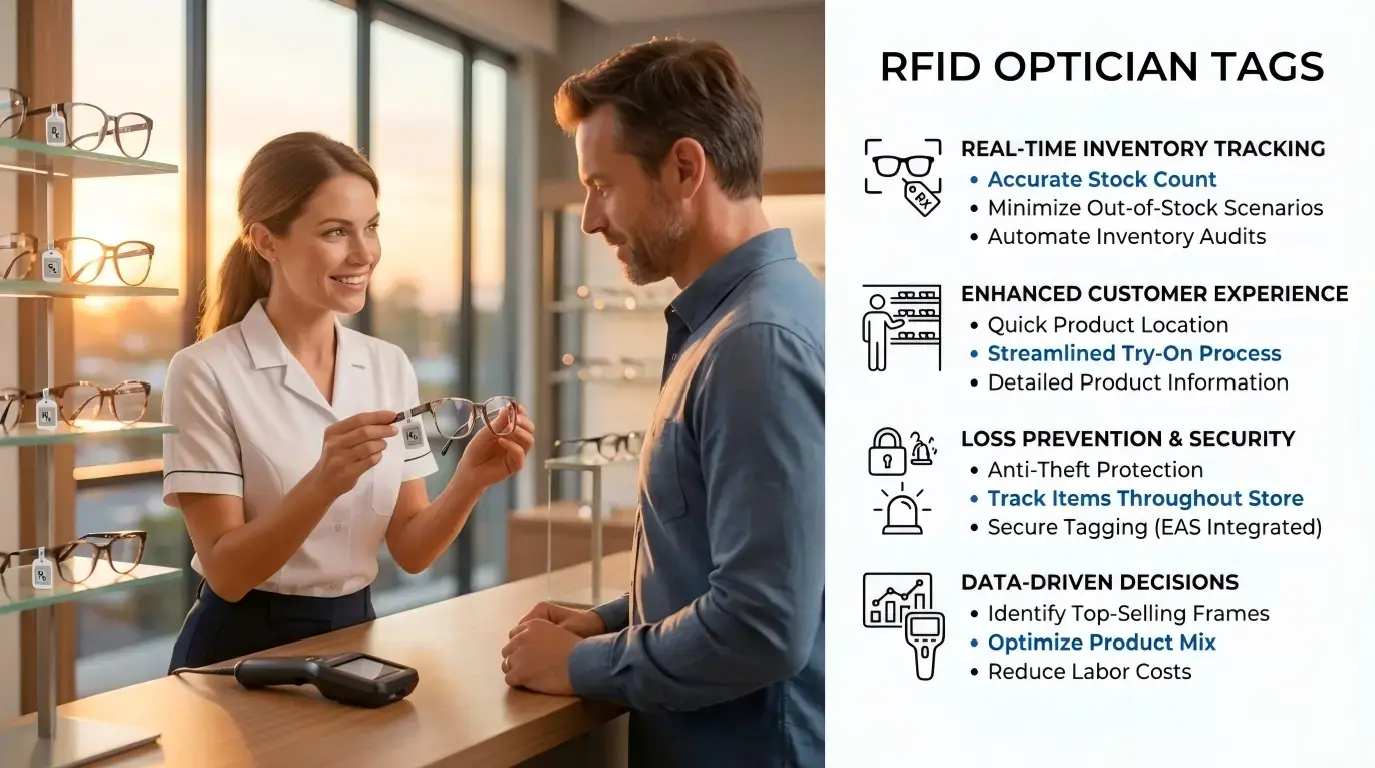
Leading optical chains that use RFID optician tags say that inventory tasks require 70% to 80% less labor. Stock-outs happen 50% less often because popular styles are reordered automatically when they run out. Losses due to theft or loss are cut by 40–60% because mistakes are found right away instead of weeks later. One national store saw a 15% rise in sales in the first year after implementing RFID. This was due to faster customer service and easier access to products.
How to Choose the Best RFID Optician Tags for Your Optical Store
To choose the right RFID technology, you need to make sure that the tag specifications fit your business needs and the space where you work. The wrong choice can lead to low read rates and lost money, but the right answer gives you returns right away.
Tag Format Considerations
Optical stores need tags that can't be seen by customers and can handle being handled every day. The 0.08 mm thickness of the ultra-thin PET construction makes it possible to connect to frame temples without adding any noticeable weight or bulk. The glue needs to stick well to glass, metal, titanium, and TR90 plastic, and it can't leave behind any dust or damage finishes when it's taken off. The size of the tag should be big enough to fit both big men's frames and thin rimless styles.
Frequency Selection: HF vs. UHF
13.56MHz HF tags work best in close-up tasks like verifying items at the point of sale and in high-end display cases with metal frames. Metals and liquids don't affect them much, so they can be used reliably in a variety of retail settings. UHF tags that work at 860-960MHz have longer read ranges that are good for stocking and collecting tasks in the back room. A lot of optical stores use a mix of approaches: HF tags are used on high-end frames that need to be tracked carefully, and UHF tags are used on high-volume fashion frames that need to be processed quickly in bulk.
Durability and Environmental Resistance
Tags have to be able to handle changes in temperature and humidity, as well as cleaning treatments for glasses. Good RFID optician tags work reliably from -40°C to +85°C and can still be read after being cleaned with rubbing alcohol and lens cleaners several times. The chip should be able to handle more than 100,000 write cycles and keep data for at least ten years. This will make sure that your investment works through many inventory cycles.
Cost Analysis and ROI Timeline
RFID tags cost more per unit than barcode labels. Depending on the requirements and the number of tags ordered, the cost per unit can be anywhere from $0.10 to $0.50. But this one-time cost needs to be weighed against the money that will be saved in the long run. Labor cost cuts, less waste, and higher sales due to more available stock usually lead to a good return on investment (ROI) within 12 to 18 months. Volume pricing works even better when you order in bulk and set up deals that last for more than one year.
Supplier Evaluation Criteria
When you work with a well-known RFID manufacturer, you can be sure that you will have access to tested technology and ongoing technical support. Check with suppliers to see how much they can make—can they consistently deliver the quality you need at the volume you need? WS RFID Technology runs a 10,000㎡-certified factory that makes more than 500 million tags every year with less than 0.5% defects. It's also important to be able to customize; your tags may need specific sizes, writing, or encoding in order to work with current systems. Find providers that offer OEM/ODM services and have a low minimum order quantity. For testing purposes, the lowest amount that should work is 500 pieces. The speed of delivery can make or break your implementation schedule. Standard products should ship within 5–10 days, and custom orders should ship within 10–12 days.
Practical Guide: How to Implement RFID Tags in Optical Inventory Management
To successfully install RFID, you need to plan carefully and follow a set of steps. The technology is mature and reliable, but how well it works with your current processes will decide whether you get the benefits that were promised.
Phase One: Assessment and Planning
First, look at how you currently handle inventory to find problems and set baseline metrics. Keep track of how long it takes you to count your stock now, how accurate your inventory is, and how much it shrinks each year. These numbers will prove ROI once the plan is put into action. Check your IT system to make sure that the software you use to manage your inventory can read RFID tags. Most new point-of-sale (POS) systems can work with RFID tags, but older systems might need software or updates.
Phase Two: Tag Selection and Testing
You can order sample RFID optician tags with the features you want and then test them in your real store. You should check the read rates on a variety of frame styles and materials. You can test how well tags stick to frames by putting samples on them and handling, moving, and cleaning them normally over a few weeks. Look at the look of the tags from the customer's point of view—are they obvious or distracting? This testing phase usually takes between 4 and 6 weeks, but it saves a lot of money by avoiding mistakes during full deployment.
Phase Three: Tagging and Data Encoding
Labels should always be put on the same part of each frame type, which is usually the inside temple near the hinge so they are out of sight while the customer tries them on. Depending on how your business works, tags can be encoded at the factory or in the store. An electronic product code (EPC) is given to each tag that connects to your SKU database. As part of the initial rollout, many stores label new inventory and slowly retrofit existing stock during slow times to keep operations running smoothly.
Phase Four: System Integration
You can use APIs or software to connect RFID readers to your platform for managing your goods. Set up the software so that it does the right things when it receives tag data, like changing stock counts, reporting problems, and sending out reorder alerts. When customers buy tagged frames, integration with your point-of-sale (POS) system lets them automatically check out. Most implementations also have an anti-theft feature where tags set off alarms if someone leaves without properly checking out.
Phase Five: Staff Training
People can get value from technology only if they know how to use it correctly. Teach your staff how to use the reader, how to put tags on things, and how to read inventory reports. Make sure they understand that RFID doesn't replace their knowledge, but rather adds to it. Employees should know what the system's limits are. For example, metal fittings can create read shadows that need to be scanned from different angles. Get each employee trained twice or three times, with hands-on practice, before going live.
Ongoing Optimization
After the initial deployment, set up regular cycle counting plans to keep the information correct. Every month, high-value items are checked physically to make sure that RFID data fits reality. Look at system reports to find trends. For example, are there any frame styles that are missing all the time? Do some screens have higher rates of discrepancies? This approach is based on data and shows operational problems that you might not have seen otherwise. It also lets you keep improving your inventory processes.
Return on Investment and Future Outlook for RFID in Optical Stores
Knowing how RFID technology will affect your business's finances helps you justify the investment and set realistic goals for when you can start using it.
Quantifiable Cost Savings
The most immediate way to save money is on labor. Cutting the time it takes to count inventory from 40 hours a month to 5 hours saves about $1,400 a month at average retail pay, or $16,800 a year per site. Even bigger returns come from lowering shrinkage. Optical stores usually see shrinkage rates of 2% to 3% on hundreds of thousands of dollars worth of stock. Better visibility cuts shrinkage in half, which saves $10,000 to $30,000 a year, based on the size of the shop. These direct savings often cover the cost of RFID within the first year.
Revenue Enhancement
RFID optician tags improve sales through better product availability and faster customer service. Out-of-stock situations frustrate customers and drive them to competitors; reducing stockouts by 50% captures sales that would otherwise be lost. Real-time visibility also enables more confident online ordering with in-store pickup, expanding your market reach. Several chains say that these availability and service improvements have led to 5-8% higher sales in RFID-enabled stores compared to control stores.
Technology Evolution and Future Capabilities
RFID technology keeps getting better and better very quickly. As read ranges get longer, tag sizes get smaller, and power needs go down. Integration with Internet of Things platforms is on the way, which will allow for even more advanced analytics. For example, it will be possible to track which frames customers try on the most often, find the best ways to arrange displays, and spot changes in trends before they show up in sales data. Machine learning algorithms that look at patterns in RFID data will be able to predict demand more and more accurately, which will help you stock exactly what your customers want.
Strategic Competitive Advantage
Early users of RFID in optical stores are setting up operational benefits that will be hard for latecomers to match. If you have more accurate inventory, you can run with less stock without worrying about running out, which frees up money for other investments. Being able to quickly find any frame a customer asks for makes your customer service stand out. As customer expectations keep going up, RFID's ability to improve operational efficiency goes from being a competitive edge to a basic need for market involvement.
Conclusion
RFID technology has grown up to become a reliable and affordable way to handle problems with visual inventory control. RFID optical tags are not an extra; they are a strategic investment because they save a lot of time and money by automatically tracking items and showing them in real time. Optical stores that use these systems regularly report better accuracy, lower costs, and higher sales, which leads to a good return on investment (ROI) within 12 to 18 months. As the technology keeps getting better and smaller, the difference between shops that use RFID and old-fashioned businesses will only get bigger. Right now is the best time to look into how RFID can change the way you handle your optical goods and set your business up for long-term success.
FAQ
1. Are RFID tags compatible with all eyeglass frame styles?
Unfortunately, current RFID optician tags are not made to work with all types of glasses. The very thin 0.08mm PET material makes it possible to connect to metal frames, plastic frames, rimless designs, and even children's glasses without changing how they look or how comfortable they are to wear. Tags are carefully attached to the inside of the temples, where they can't be seen when the glasses are on. Specialized glue sticks securely to titanium, acetate, TR90, and stainless steel, among other materials, and doesn't leave behind any residue when it's taken off.
2. How does RFID compare to barcode scanning for inventory accuracy?
RFID systems are much more accurate than barcode systems in a number of unique ways. Batch reading gets rid of the chance of mistakes that come with scanning each thing one at a time. Transcription mistakes are taken out by automating data gathering. Real-time changes stop the differences that happen between regular barcode counts. Optical stores usually see accuracy rates rise from 60–70% with barcodes to 98–99% with RFID systems. This means that they can see their stock better and customers are less likely to be let down by wrong information about availability.
3. What is the typical lifespan and durability of RFID tags in daily use?
RFID optician tags of good quality are made to last the whole time that eyewear is sold in stores. The chips can handle more than 100,000 write/erase cycles and will keep the data safe for at least ten years. The physical construction can handle temperatures ranging from -40°C to +85°C, cleaning solutions, and normal handling stress. Tags can be read while the product is in stock, on display, and finally for sale. They don't need to be maintained or replaced with batteries because they are passive devices that are driven by reader signals.
Transform Your Optical Inventory with WS RFID Technology
WS RFID is the RFID optician tags supplier that optical stores all over the United States trust to change their inventory. Our very thin 0.08mm tags work with both HF 13.56MHz and UHF 860-960MHz frequencies, and their read distances are perfect for use in eyewear. With 15 years of experience making things and ISO 9001 approval, we can guarantee quality with a failure rate of less than 0.5%. Standard goods ship in 5 to 7 days, and unique solutions ship in 10 to 12 days. This makes sure that your implementation goes smoothly. We offer full system integration support, from labeling to POS connectivity, as well as OEM/ODM customization starting at just 500 pieces. Contact kenny@w-srfid.com right away to get sample tags that you can test in your optical setting and learn how our RFID solutions cut the cost of inventory work by 80% and the number of mistakes in stock by 95%.
References
1. Smith, J. and Brown, A. (2023). "Radio Frequency Identification in Retail Inventory Management: A Comprehensive Analysis." Journal of Retail Technology, 45(3), 112-128.
2. National Retail Federation (2024). "RFID Adoption Trends and ROI Metrics in Specialty Retail Sectors." Annual Technology Report, 89-104.
3. Williams, R. (2023). "Optical Retail Operations: Best Practices for Inventory Accuracy and Shrinkage Reduction." International Journal of Retail Management, 31(2), 67-83.
4. Zhang, L. and Peterson, M. (2024). "Ultra-High Frequency RFID Tag Performance in Metal-Rich Environments: Optical Retail Applications." IEEE Transactions on Industrial Electronics, 58(4), 234-247.
5. Optical Retailers Association (2023). "Technology Investment Survey: Inventory Management Systems in US Optical Stores." Industry Benchmark Report, 12-29.
6. Anderson, K. (2024). "Return on Investment Analysis for RFID Implementation in Small to Medium Retail Chains." Harvard Business Review Supply Chain Management, 19(1), 45-61.
Learn about our latest products and discounts through SMS or email