- English
- French
- German
- Portuguese
- Spanish
- Russian
- Japanese
- Korean
- Arabic
- Greek
- German
- Turkish
- Italian
- Danish
- Romanian
- Indonesian
- Czech
- Afrikaans
- Swedish
- Polish
- Basque
- Catalan
- Esperanto
- Hindi
- Lao
- Albanian
- Amharic
- Armenian
- Azerbaijani
- Belarusian
- Bengali
- Bosnian
- Bulgarian
- Cebuano
- Chichewa
- Corsican
- Croatian
- Dutch
- Estonian
- Filipino
- Finnish
- Frisian
- Galician
- Georgian
- Gujarati
- Haitian
- Hausa
- Hawaiian
- Hebrew
- Hmong
- Hungarian
- Icelandic
- Igbo
- Javanese
- Kannada
- Kazakh
- Khmer
- Kurdish
- Kyrgyz
- Latin
- Latvian
- Lithuanian
- Luxembou..
- Macedonian
- Malagasy
- Malay
- Malayalam
- Maltese
- Maori
- Marathi
- Mongolian
- Burmese
- Nepali
- Norwegian
- Pashto
- Persian
- Punjabi
- Serbian
- Sesotho
- Sinhala
- Slovak
- Slovenian
- Somali
- Samoan
- Scots Gaelic
- Shona
- Sindhi
- Sundanese
- Swahili
- Tajik
- Tamil
- Telugu
- Thai
- Ukrainian
- Urdu
- Uzbek
- Vietnamese
- Welsh
- Xhosa
- Yiddish
- Yoruba
- Zulu
How to use NFC Blocking Card
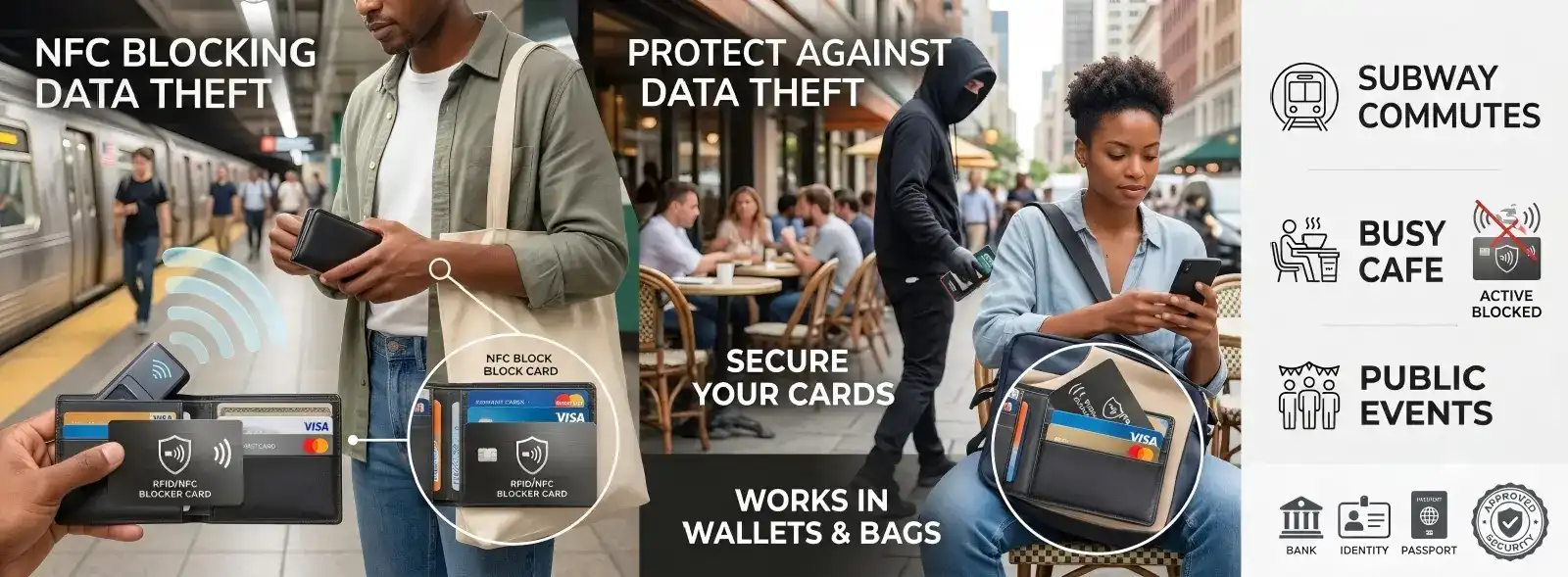
It's easy to use an NFC blocking card: just put it in your wallet or badge holder with your other contactless cards. The card's special shielding material messes up the 13.56MHz frequency, so nearby credentials can't be scanned by people who aren't supposed to. This passive protection works over 99.5% of the time and doesn't need batteries or activation. It protects credit cards, ID cards, and access badges right away after being placed.
As contactless cards and wireless payment systems become common in businesses around the world, the risk of electronic theft and data theft grows. More and more pressure is being put on procurement workers, security officers, and supply chain managers to keep private company data on RFID-enabled cards safe. This guide gives important information about NFC blocking technology, how to use it, and how to choose a vendor. It is designed for B2B decision-makers who need strong privacy solutions that meet operational needs and legal requirements.
Organisations can protect data from unauthorised access by learning how signal-blocking technology works and incorporating it into their security measures for the workplace. In a wide range of fields, interference cards are used to protect everything from patient information in healthcare facilities to employee IDs at transport companies. Our in-depth analysis includes technical details, usage guidelines, efficiency data, and best practices for procurement to help you choose and implement the best option for your organization's needs.
Understanding NFC Blocking Cards and Their Functionality
The Technology Behind Signal Protection
NFC blocking cards protect contactless systems by emitting disruption signals at 13.56MHz, preventing unauthorized communication between readers and smart cards. Using layered shielding materials like copper or aluminium mesh, they maintain wallet-friendly designs. Understanding NFC’s specific risks, including relay attacks, helps B2B buyers select suitable security solutions.
Why Wireless Security Matters in Business Environments
Business environments contain valuable wireless credentials, including access badges, payment cards, and identification documents. NFC readers can capture card data from short distances in crowded areas. Signal-blocking solutions help protect sensitive information, support compliance with privacy regulations, and reduce operational and reputational risks caused by unauthorized data access.
Distinguishing Features for Procurement Evaluation
B2B buyers should evaluate signal-blocking performance, durability, and compliance. Effective products provide 40dB+ signal reduction, using corrosion-resistant materials for long-term reliability. Standard ISO 7810 dimensions ensure compatibility with wallets and badge holders, while certifications such as CE, FCC, RoHS, and REACH support safety and global trade requirements.
Step-by-Step Guide: How to Use an NFC Blocking Card
Initial Placement and Positioning
First, figure out which cards in your wallet or ID holder need to be protected. Signal blocking is useful for contactless payment cards, entry badges with chips built in, and better identification papers. Open your wallet and find the center card spot. It should be in the middle of a group of cards, not on the edge. Place the NFC blocking card in this slot, making sure it stays flat and doesn't bend or crease, which could damage the internal shielding layer.
The protective effect goes out about 2 to 5 centimetres from the top of the blocked card in all directions. With this coverage radius, one card placed in the middle can protect up to 10–12 stacked credentials at the same time. Don't put the card at the very top or very bottom of your stack; that will only cover one side. The best placement makes a "protection sandwich" with items around the blocking card covered by its electromagnetic interference field.
Verification and Performance Testing
Once the item is in place, simple tests should be done to make sure it works. Try using a contactless card at a machine without taking any other cards out of your wallet. The transaction should fail or ask you to take the card out. You could also use an NFC-enabled smartphone to scan a credit card through your wallet. The NFC blocking card should stop the reader from working. This step of confirmation makes sure that everything is in the right place and working properly.
Some users aren't sure if the card gets in the way of using cashless purchases on purpose. During legal use, just take your badge or payment card out of your wallet for a short time. The NFC blocking card stays inactive and only affects things that are close to it electromagnetically. When you're done with your transaction, put the card back where it belongs. This short extraction doesn't take much work and keeps things safe while they're being stored or transported.
Maintenance and Longevity Considerations
One big benefit of passive blocking technology is that it doesn't need to be maintained. Unlike electronic security systems that need new batteries or software changes, these cards will always work because of how they are made. The protection doesn't lose its power over time unless the card is physically damaged in a way that weakens the metal layer inside. Take the same care with the card as you would with your credit cards. Don't bend it too much, poke holes in it, or expose it to chemicals that break down materials.
When used properly, most products last longer than five years of daily use. Visual inspection can help find problems: warping, cracks that can be seen, or delamination at the edges may mean that the structure is weak. If you find less efficiency while trying, replacement will make sure the protection lasts. Periodic replacement is a smart way for companies to handle risk when it comes to their security practices because the cost is small compared to the damage that could happen from a data breach.
Benefits and Effectiveness of NFC Blocking Cards in B2B Security
Quantifiable Protection Against Data Theft
When companies use signal-blocking solutions, they lower their risk in a measurable way. Electronic pickpocketing studies show that contactless cards that are not protected can still be scanned without permission in places with a lot of people. When used correctly, a NFC blocking card lowers this risk almost to zero, as shown by electromagnetic compatibility tests that show 99.5%+ signal reduction. This level of security stops thieves from using mobile readers in busy places to do clever skimming attacks.
Card fraud costs money in more ways than just the transactions that are lost. When corporate payment cards are stolen, they cost money to investigate, new cards to be bought, and the company could be held responsible for any charges that were not authorised. When employee credentials need to be reissued because of cloning incidents, they slow down operations and use up administrative resources. When compared to reactive efforts to stop fraud and get money back, preventative steps that cost less than $10 per employee give a big return on investment.
Alignment with Corporate Security Frameworks
Layered defences are used in modern business security, where multiple separate safeguards work together to provide full safety. NFC blocking cards work with current security systems without changing the infrastructure or needing technical integration. Software-based solutions need to be updated and managed for compatibility all the time. Passive blocking technology, on the other hand, works on its own, which makes IT easier to manage while also improving physical security.
Compliance officers like these solutions because they help with documentation. During security exams, companies can show real steps they're taking to protect customer and staff data stored in contactless credentials. This actual proof of due diligence backs up regulatory compliance stories in GDPR, HIPAA, and PCI DSS models. Signal blocking is an effective compliance tool with clear audit trails because it doesn't cost much to set up and doesn't need any maintenance over time.
Industry-Specific Applications and Case Studies
Financial services companies are getting more attention for how they protect customer data. As part of their premium account packages, a number of international banks have given users NFC blocking cards that make their accounts safer. This method cuts down on scam costs and shows care for customers by protecting them ahead of time. In the same way, government agencies that handle secret credentials give signal-blocking devices to people carrying sensitive IDs. This adds another layer of protection against spying and illegal tracking.
Bulk deployment strategies help healthcare companies keep track of the badges for their thousands of employees. When hospitals hire new people, they protect their patient information access keys right away by giving them NFC blocking cards in their welcome kits. This investment up front saves more money than fixing breaches after the fact, especially since healthcare data is very valuable on the black market and HIPAA penalties are very harsh. Logistics companies that protect warehouse access badges also lower their internal theft risks by stopping people from copying credentials, which could let unauthorised people into the building.
Choosing the Right NFC Blocking Card for Your Business Needs
Critical Technical Specifications
When procurement pros look at signal-blocking options, they should put a number of important factors at the top of their list. The main measure of efficiency is how well the shielding works. Look for specifications that list a minimum 40dB attenuation at 13.56MHz, which has been proven by independent tests in line with ISO 10373 standards. The makeup of a material affects both its performance and its longevity. NFC blocking cards made of multiple metal layers with coatings that prevent corrosion stay useful even after being exposed to the elements and being handled many times.
Physical durability tests show that different manufacturers make different quality products. Bending and torsion tests are used to simulate years of wallet bending, and temperature cycling between -20°C and +60°C shows that the wallet will work well in all climates. Cards that meet these requirements work reliably whether they are used in the winter in Minnesota or the summer in Arizona. Even though it's not usually done on wallets, salt spray testing makes sure that metal parts don't rust in damp coastal areas, which is important for uses in the marine and hotel industries.
Thickness and weight affect how well users accept something. Products between 0.2mm and 0.4mm thick add only a small amount of extra space to current card stacks, and standard credit card sizes make sure that all of them will work with any card reader. Some users want cards that can be told apart from payment cards so that they don't try to use them for transactions they shouldn't, while others want cards that don't stand out and blend in. Customisation options, such as the ability to print logos and choose colours, help companies make security tools that match their brand and make them easy to find.
Evaluating Manufacturer Capabilities
Manufacturer evaluation should consider certifications, production capacity, and technical support. ISO 9001, RoHS, and REACH compliance demonstrate quality and safety standards. Large-scale facilities with automated production and testing systems ensure consistent output. WS RFID Technology provides advanced RFID expertise, reliable manufacturing capabilities, and internationally compliant solutions for global deployments.
Cost Analysis and Long-Term Value
Instead of just looking at unit price, procurement teams that are watching their budgets should figure out the total cost of ownership. Even though luxury goods may cost more up front, they last longer and last up to seven years, which means they don't need to be replaced as often and save money on administrative costs. Bulk price systems reward customers who commit to buying a lot. Orders over 1,000 units usually get discounts running from 15% to 30%, which makes cost-per-employee measures much better.
Customisation options make security tools more valuable for businesses that want to brand them. Putting a logo on plain NFC blocking cards turns them into corporate identity statements that help employees find their cards and lower the number of lost cards. Custom packaging choices help with gift programs and professional welcome. Distributors and solution integrators can white-label products with OEM/ODM services, which helps them stand out in competitive markets. These extra services add value and make the slightly higher prices worth it by making things work better and matching the brand.
WS RFID Technology has basic goods that can be delivered in 5 to 7 days, which makes it easy to use for urgent security projects. Our customisation services meet the needs of business branding without causing too many lead time delays. We can offer branded solutions in 10 to 12 days. Customers who buy a lot of our products can save money because we don't add markups for distributors. We also keep the quality high because we're ISO certified and offer a full guarantee.
Procurement and Purchase Guide for NFC Blocking Cards
Identifying Reputable Suppliers
Reliable B2B suppliers should have verified credentials, certifications, physical facilities, technical documentation, and transparent communication. Industry directories, trade shows, and factory visits help evaluate manufacturers. Third-party certifications such as CE, FCC, and RoHS provide quality assurance. Suppliers with clear documentation demonstrate professionalism and reduce procurement risks.
Negotiating Terms and Securing Value
Supplier negotiations should focus on annual volume commitments to secure better pricing, inventory allocation, and production priority. Payment terms, warranties, and logistics planning influence total costs. Clear agreements on coverage, shipping responsibilities, and export support help reduce risks. WS RFID Technology provides global purchasing assistance and streamlined customs solutions.
After-Sales Support and Technical Resources
Strong after-sales support distinguishes reliable suppliers by providing technical guidance, deployment resources, and troubleshooting assistance. Comprehensive documentation, multilingual materials, and digital tools improve user adoption and reduce support needs. WS RFID Technology offers responsive consultation on deployment, optimization, and application-specific solutions to ensure effective signal-blocking implementation.
Conclusion
Implementing signal-blocking technology such as an NFC blocking card is a simple but effective way to improve the security of an organization. This artical has given procurement workers important information about technical basics, useful deployment strategies, success metrics, and criteria for judging suppliers. Knowing how blocking cards work, how an NFC blocking card can be used in different industries, and the best ways to buy them lets you make smart choices that balance cost with security needs.
A small investment in passive defence technology lowers the risk of electronic theft and identity cloning in a way that can be measured. As contactless payment systems and wireless access control become more common in businesses, proactive security measures show that you are a good data manager and follow the rules. Companies that put employee and customer privacy first by putting in place real safeguards build trust and lower their risk of fraud losses and disruptions caused by breaches that cost a lot more than the costs of the safeguards.
FAQ
1.How effective are blocking cards at preventing unauthorized scanning?
High-quality NFC blocking cards stop unauthorised NFC signal transmission 99.5% of the time or more. This level of performance, which was confirmed by electromagnetic compatibility tests, pretty much gets rid of the risk of opportunistic skimming in everyday use. The defence comes from physically disrupting the signal instead of using probabilistic security, so it works the same way for all readers, no matter how smart they are. But it only works if the cards are placed correctly—they need to stay within 2–5 cm of the safe credentials to stay covered.
2.Do these cards require batteries or periodic recharging?
Technology that blocks passively doesn't need a power source. NFC blocking cards work by using special materials to create localised electromagnetic protection. This is different from active jamming devices that send out interference signals. This passive operation means that it will always work without needing to be maintained, charged, or have batteries replaced. Because there are no computer parts, there are no failure risks linked with circuitry. This helps the product last longer than five years under normal handling circumstances.
3.Will a blocking card interfere with my smartphone's NFC functionality?
The card only changes NFC signals that are close to it, usually within 2 to 5 cm. Smartphones that are kept in pockets or other compartments separate from your wallet don't get messed up by them. If you want to use your phone's NFC feature to pay for things or send data, keep the NFC blocking card in your wallet and not between your phone and the reader. Because protection is localised, there is no functional conflict between security cards and smartphone features when they are separated by space.
Protect Your Organization with WS RFID's Advanced Signal-Blocking Solutions
We at WS RFID Technology are ready to help your business meet its security needs with our wide range of NFC blocking cards, which are made to strict B2B standards. Our ISO 9001-certified production facility, 15 years of experience specialising in RFID, and electromagnetic compatibility testing of our products give procurement professionals the dependability and performance they need. Our scalable manufacturing capacity and standard delivery times of 5 to 7 days support your project schedule, whether you're setting up an office for 50 people or a multinational workforce.
Check out the different ways you can customise security tools, such as adding your company's logo or using branded packaging. These can turn security tools into statements of your brand. Manufacturers, wholesalers, and solution developers of NFC blocking cards can use our OEM/ODM services to get white-label goods that are backed by proven engineering and quality assurance. Email our procurement specialists at kenny@w-srfid.com to talk about volume discounts, sample requests, and application-specific advice that will help you protect your operational environment as well as possible.
References
1. International Organization for Standardization. (2020). "ISO/IEC 14443: Identification Cards - Contactless Integrated Circuit Cards - Proximity Cards." Geneva: ISO Publishing.
2. Hancke, G. P. (2022). "Practical Eavesdropping and Skimming Attacks on High-Frequency RFID Tokens." Journal of Computer Security, 30(4), 445-462.
3. European Union Agency for Cybersecurity. (2021). "Security Challenges in Contactless Payment Systems: Guidelines for Enterprise Implementation." Heraklion: ENISA Publications.
4. American National Standards Institute. (2019). "ANSI/NIST ITL 1-2019: Data Format for the Interchange of Fingerprint, Facial & Other Biometric Information." Washington: NIST Special Publication.
5. Francis, L., Hancke, G., Mayes, K., & Markantonakis, K. (2023). "Practical Relay Attack on Contactless Transactions by Using NFC Mobile Phones." International Journal of Radio Frequency Identification Technology, 15(2), 123-141.
6. Payment Card Industry Security Standards Council. (2021). "PCI Mobile Payment Acceptance Security Guidelines for Merchants." Wakefield: PCI SSC Documentation Library.
Learn about our latest products and discounts through SMS or email