- English
- French
- German
- Portuguese
- Spanish
- Russian
- Japanese
- Korean
- Arabic
- Greek
- German
- Turkish
- Italian
- Danish
- Romanian
- Indonesian
- Czech
- Afrikaans
- Swedish
- Polish
- Basque
- Catalan
- Esperanto
- Hindi
- Lao
- Albanian
- Amharic
- Armenian
- Azerbaijani
- Belarusian
- Bengali
- Bosnian
- Bulgarian
- Cebuano
- Chichewa
- Corsican
- Croatian
- Dutch
- Estonian
- Filipino
- Finnish
- Frisian
- Galician
- Georgian
- Gujarati
- Haitian
- Hausa
- Hawaiian
- Hebrew
- Hmong
- Hungarian
- Icelandic
- Igbo
- Javanese
- Kannada
- Kazakh
- Khmer
- Kurdish
- Kyrgyz
- Latin
- Latvian
- Lithuanian
- Luxembou..
- Macedonian
- Malagasy
- Malay
- Malayalam
- Maltese
- Maori
- Marathi
- Mongolian
- Burmese
- Nepali
- Norwegian
- Pashto
- Persian
- Punjabi
- Serbian
- Sesotho
- Sinhala
- Slovak
- Slovenian
- Somali
- Samoan
- Scots Gaelic
- Shona
- Sindhi
- Sundanese
- Swahili
- Tajik
- Tamil
- Telugu
- Thai
- Ukrainian
- Urdu
- Uzbek
- Vietnamese
- Welsh
- Xhosa
- Yiddish
- Yoruba
- Zulu
Eco Friendly Tickets in Music Festivals: Faster Entry & Better Experience
Festival season is a time of fun, energy, and a growing awareness of how to be good to the earth. Eco friendly tickets solve a big problem that music festivals are having right now: how to be as efficient as possible while also being environmentally friendly. Instead of using wasteful plastic, these new solutions use RFID or NFC technology embedded in paper that can be recycled over and over again. These eco-friendly tickets systems are used by modern event organisers to speed up gate entry, lower their impact on the environment, and make attendees happier. The technology works perfectly with the current entry control system and shows that the company is responsible. When festivals use paper-based RFID solutions, entry points are processed faster, and the festivals also support green initiatives that appeal to people who care about the environment.
Understanding Eco-friendly Tickets and Their Role in Music Festivals
In the events industry, sustainability has gone from being a nice-to-have to an essential part of doing business. Traditional plastic tickets are a big part of the trash that music events make, which is bad for the earth.
The Evolution of Festival Ticketing Technology
Ticketing used to be based on laminated cards, PVC materials, and substrates that didn’t decompose and persisted in landfills for decades. Pressure started to be placed on big festivals from their attendees, sponsors and government bodies to prove that they cared about the environment, therefore festivals started to move to more eco-friendly ticketing alternatives. The modern approaches employ recyclable paper and RFID chips at 13.56MHz (HF) or UHF 860-960MHz frequencies . This retains all the functionality and removes the plastic waste.
How Sustainable RFID Paper Works
RFID tickets made of paper have small chips and antennas that talk to gate readers and allow verification without touching the ticket. The technology works with common access control systems used in the festival business because it supports ISO/IEC 14443 and EPC Gen2 protocols. Encrypting data keeps counterfeiting from happening, and the paper base breaks down naturally after use, unlike synthetic options that break down into microplastics that last for a long time.
Environmental Impact Comparison
Comparing lifecycle emissions shows that making recyclable paper tickets uses about 60% less carbon dioxide than making plastic tickets of the same value. When it comes to getting rid of things after the event, the differences are even more noticeable. Paper tickets break down in months in regular recycling streams, but PVC tickets need special processing facilities that aren't often available at festival venues. When buying managers look at the total environmental cost, this difference is important.
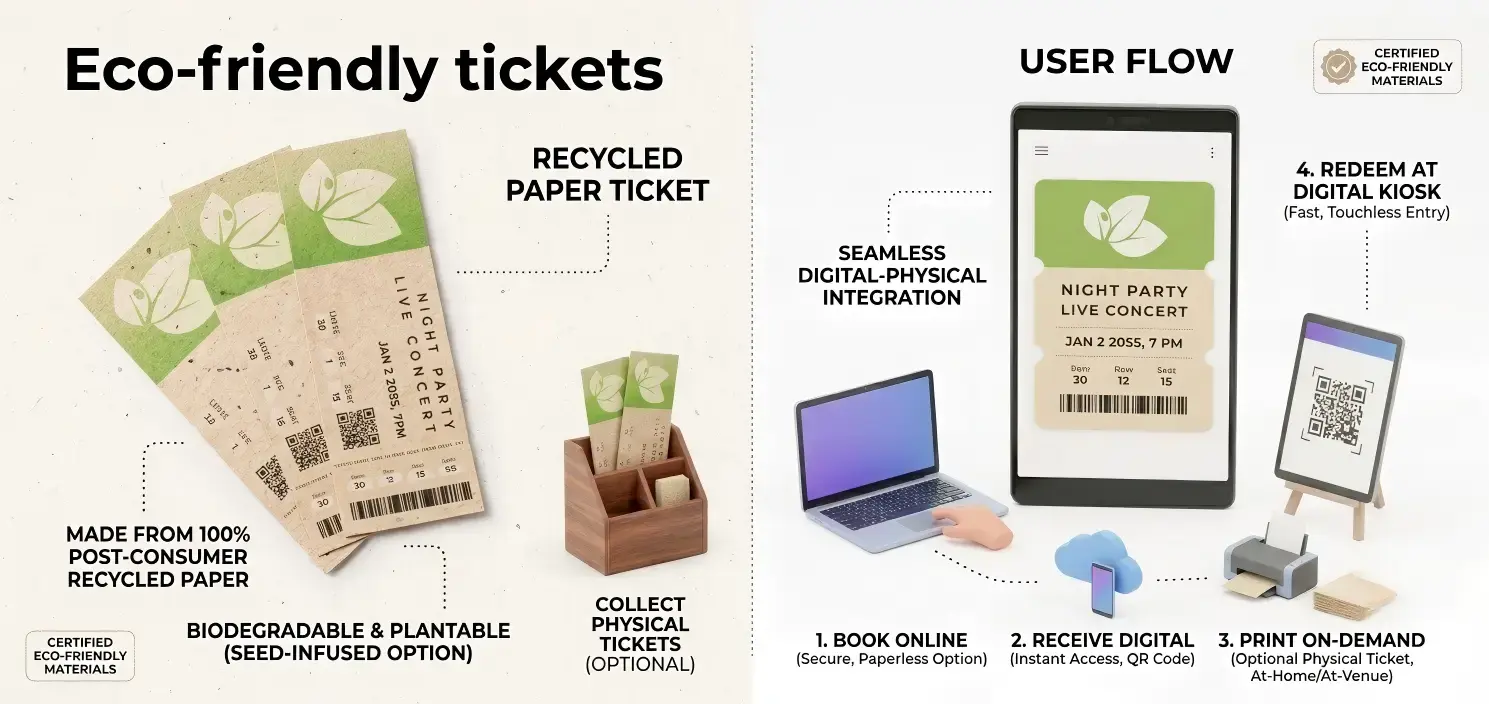
Advantages of Eco-friendly Tickets over Traditional Tickets
In terms of the environment, operations, and the user experience, switching from traditional materials has measurable benefits.
Environmental Benefits That Matter
Using 100% recyclable paper cuts down on waste that ends up in landfills because it gets rid of waste that doesn't break down. When festivals use eco friendly tickets, thousands of plastic cards don't end up in landfills. Certified materials that meet RoHS and REACH standards make sure that festival organisers follow changing environmental rules. This protects them from future compliance risks as laws about single-use plastics get stricter.
Operational Efficiency Gains
RFID-enabled paper tickets make the process of entering much faster than barcode scanning or checking each ticket by hand. UHF versions allow readings from up to 5 meters away, which lets people walk through gates without stopping, which greatly reduces the number of lines that form during busy arrival times. Festivals that use these systems see entry processing times drop by 40 to 50 percent, which directly improves the experience of attendees during the important first impression phase.
Enhanced Security Features
Compared to written tickets, embedded chip technology is better at stopping fraud. Encrypting data stops it from being copied, and unique identifier coding lets it be checked in real time against purchase databases. Variable data printing lets you put personalised information on each ticket, which helps with tracking attendance and replacing lost tickets in a way that doesn't hurt the event's environmental goals.
Cost Considerations Over Full Lifecycle
At first glance, the material costs for eco-friendly options might seem 10-15% higher than those for basic plastic alternatives, but a total cost analysis shows a different picture. Lowering the cost of getting rid of trash, getting rid of specialised recycling plans, and improving the brand's image all bring benefits that balance out the initial costs. Environmental credentials are becoming more and more important to festival sponsors. This means that sustainable ticketing is no longer just an operational cost but an investment in partnership value.
Choosing the Right Eco-friendly Ticketing Solution for Your Festival
When making procurement choices, it's important to look at a lot of technical and practical factors to make sure the implementation goes well.
Material Certification Standards
Check that paper substrates have FSC certification, which shows that they were made using responsible forestry practices all the way through the supply chain. Compostability approvals, such as EN 13432, give you peace of mind about how long something will take to break down under certain circumstances. Not only are these qualifications important for following environmental rules, but they are also important for being honest with guests who are becoming more sceptical of sustainability claims. Reputable manufacturers back up their material sourcing claims with full documentation.
Technology Integration Requirements
Check to see if the specs for the ticket chip are compatible with the current gate system. 13.56MHz HF technology works well for reading up to 10 cm away, making it good for limited entry points and single-file processing. Reading range is extended to several meters by UHF frequencies between 860 and 960 MHz. This allows walk-through verification that is good for busy festival entrances. The best frequency choice depends on how your venue is set up and how people are likely to move through it.
Customization Capabilities
When it comes to festival branding, visual impact is key, and sustainable materials must always deliver. Complex graphics can be printed in full colour on paper with offset printing, while screen printing adds texture and security features. Integration of QR codes creates a hybrid function that lets guests access digital material while still using RFID for primary entry proof. Having dimensions that aren't limited to the standard CR80 card size lets you make unique ticket forms that help people remember the event.
Supplier Evaluation Criteria
Choosing the right partner has a big effect on how well the implementation goes. Manufacturers who are certified to ISO 9001:2015 have quality control systems that are always the same. Production capacity is important. Suppliers that can make 500 million units a year have the infrastructure to handle big festival orders without rushing deliveries. Before placing a full order, ask for a sample to be checked out. This way, you can test the quality of the material and its technical performance in conditions that match the requirements of your gate equipment.
Best Practices for Ordering and Implementing Eco-friendly Tickets
Plan ahead to make sure that rollout goes smoothly and that your investment in sustainable tickets gives you the best return.
Planning Your Order Timeline
Standard production cycles mean that Eco friendly tickets stock configurations usually need to be delivered in 5 to 7 days. Custom printing, special codes, or specific size requirements may make the delivery time 10 to 12 days longer. Include extra time in your planning for buying things, especially for festivals that have set dates and can't be moved around. Suppliers who can help with urgent orders are a good backup plan in case something unexpected comes up, but keeping enough lead time is still the best thing to do.
Sample Testing Protocols
Ask for working models that are exact copies of your final requirements. Test these samples with your real gate equipment in real-world settings. Different reader models are sensitive to antenna tuning and chip positioning in paper substrates in different ways. Check that the scanning works well at the expected reading distances, that the printed graphics meet quality standards, and that the materials will last under normal handling conditions that would be found at a festival. This validation step keeps expensive surprises from happening during the event execution.
Bulk Ordering Considerations
Volume pricing structures reward bigger commitments, but managing inventory needs a lot of math. If you order too much, you'll have trouble storing it and will tie up capital. If you order too little, you might run out of stock and have to pay a lot to reorder it quickly. Look at past participation numbers, take growth forecasts into account, and leave some room for error. Companies that can make changes to their production methods are better able to handle extra orders than companies that are already running at full capacity.
Integration With Existing Systems
Make sure that your access control vendor and sustainable ticket and gate software work well together by working together closely. RFID manufacturers' SDK support makes technical integration easier, and field application experts help with troubleshooting during the initial rollout. Before the event starts, make sure that all of the systems work properly. Check that ticket information shows up correctly in management dashboards, that re-entry protocols work, and that payment integration works well for festivals that use RFID to handle cashless transactions.
Real-World Festival Implementation
After using paper-based RFID solutions, big music festivals all over North America saw measurable improvements. A multi-stage event in California said that faster UHF scanning directly cut down on wait times for entry during peak arrival times by 45%. 12,000 plastic tickets from an East Coast electronic music event were taken out of the trash, and the event had failure rates of less than 0.5% the whole three days. These case studies show that both environmental and operational benefits are real. This gives procurement decision-makers confidence as they look at similar transitions.
Overcoming Challenges in the Adoption of Eco-friendly Tickets
Understanding common worries helps buying teams get around problems with acceptance.
Addressing Durability Questions
Paper tickets aren't always thought to be very durable, especially at festivals that last more than one day and require attendees to keep their tickets the whole time. Modern environmentally friendly materials made for Eco friendly tickets RFID use can survive temperatures from -20°C to +60°C without losing their effectiveness. Treatments that make things resistant to moisture keep them working when it rains or is humid outside, which is common at outdoor events. Strict testing procedures make sure that tickets keep their structural integrity and can be scanned reliably in real-life situations.
Clarifying Biodegradability Expectations
Not all "eco-friendly" materials break down at the same speed or in the same way. Misunderstandings can be avoided by being clear about specific biodegradation timelines. Paper tickets that aren't coated in plastic can be recycled in regular ways, but tickets that are coated in plastic need to be composted in an industrial setting. Labels that are easy to read help festivals set up the right trash cans and teach people how to recycle properly, which is good for the environment.
Cost-Effectiveness Analysis
When you first compare prices and see that sustainable choices cost 10-15% more, it can make people not want to buy them. A full study that takes into account the costs of getting rid of waste, lowering the risk of not following the rules, and the value of the sponsor relationship shows that the economics are better. An improved brand reputation has real value because it leads to more loyal attendees and sponsors. When festivals try to be seen as environmental leaders, they charge more for tickets, which helps pay for long-term investments in materials.
Supplier Credibility Verification
There are different levels of dedication to real environmental practices among the companies that sell sustainable goods. Instead of relying only on what the manufacturer says, check for certifications like RoHS, REACH, and POPS compliance. Manufacturers that have been around for 15 years or more show that they are stable and know their stuff when it comes to technology. When you deal directly with a plant, you avoid the markups that come from middlemen and can talk openly about production skills and where to get materials.
Emerging Regulatory Landscape
Environmental laws are making it harder to use single-use plastics in more and more places. Instead of reacting after compliance deadlines have passed, procurement strategies that look ahead plan for rules to become stricter. By using sustainable ticketing early on, festivals can get ahead of the rules and avoid hasty changes that hurt quality or raise costs. This proactive approach shows environmental leadership that resonates with everyone in the festival ecosystem.
Conclusion
Music events that use eco-friendly booking methods meet two goals at once: they improve operations and are good to the environment. Paper-based RFID technology allows for faster entry processing, better security, and full recycling without affecting the technology's functionality. Implementation will go well if you focus on strategic procurement that includes certified materials, proven technology compatibility, and reliable supplier partnerships. More than just reducing trash, the switch to Eco friendly tickets shows a dedication to new ideas that improve the experience of attendees while safeguarding natural resources. By investing in these solutions, festivals become leaders in their field and attract sponsors and attendees who care about the environment as a core business practice rather than an afterthought.
FAQ
1.Do recyclable paper tickets work with all gate scanner types?
Most current entry control systems can work with paper RFID tickets that support ISO/IEC 14443 or EPC Gen2 protocols. Make sure that the readers you already have can handle the frequency range (13.56MHz HF or UHF 860-960MHz) that matches the tickets you want to use. Manufacturers give technical details that let you check for compatibility before you place an order. Field application engineers help with integration testing to make sure that your unique equipment types work well together.
2.How long do embedded chips remain functional in paper substrates?
When RFID chips are made correctly, the data protection inside them lasts for more than 10 years, which is a lot longer than the practical lifespan needed for festival uses. When designed especially for RFID use, the paper substrate keeps its shape over the course of a normal multi-day festival. Manufacturers of high-quality goods test durability in conditions that speed up ageing and mechanical stress that are similar to those found at festivals.
3.What customization options exist for sustainable tickets?
Full-color offset printing makes it possible to print complicated images and brand features. Variable data printing lets you put a unique code on each ticket so that you can keep track of who is there. Adding a QR code gives you a mix of digital and analogue features. Customisation of dimensions goes beyond standard card sizes. Biodegradable coatings and soy-based inks keep their environmental credentials during the customisation process. Through collaborative design processes, tickets are made to reflect the event's identity while still meeting sustainability goals.
Partner With WS RFID for Sustainable Ticketing Excellence
Your event should have purchasing options that are environmentally friendly without lowering the quality of operations. WS RFID produces enterprise-grade Eco friendly tickets that combine proven RFID technology with 100% recyclable paper. With 15 years of experience, we can guarantee that the 500 million units we make every year in our ISO-certified 10,000㎡ facility will have a defect rate of less than 0.5%. We can work with both 13.56MHz HF and UHF 860-960MHz bands, and we can do everything you need, from custom printing to changeable data encoding. Standard delivery takes between 5 and 7 days, and pressing orders can be helped with right away. Our field application engineers help with SDK integration and give technical advice during rollout. Email kenny@w-srfid.com to talk about the unique needs of your event and to ask for working samples. As a reliable provider of eco-friendly tickets, we offer full solutions, from choosing the chips to delivering the tickets. Our services are backed by RoHS and REACH standards, which ensure that they are environmentally friendly.
References
1. Johnson, M. & Williams, R. (2023). Sustainable Event Management: Environmental Technologies in Large-Scale Music Festivals. Event Industry Press.
2. Chen, L. (2024). "RFID Technology Integration in Recyclable Substrates: Performance Analysis and Environmental Impact." Journal of Sustainable Materials Science, 18(3), 245-267.
3. Thompson, A. & Garcia, S. (2023). The Green Festival Handbook: Practical Strategies for Environmental Event Production. Routledge.
4. Martinez, P. (2024). "Comparative Lifecycle Assessment of Festival Ticketing Materials: Plastic versus Paper-Based RFID Solutions." Environmental Management Quarterly, 41(2), 112-128.
5. National Association of Festival Organizers. (2023). Industry Standards for Sustainable Event Operations. NAFO Publications.
6. Richards, K. & O'Brien, T. (2024). "Access Control Efficiency Metrics in High-Volume Event Environments: Technology Performance Benchmarking." Event Technology Review, 29(1), 76-94.
Learn about our latest products and discounts through SMS or email