- English
- French
- German
- Portuguese
- Spanish
- Russian
- Japanese
- Korean
- Arabic
- Greek
- German
- Turkish
- Italian
- Danish
- Romanian
- Indonesian
- Czech
- Afrikaans
- Swedish
- Polish
- Basque
- Catalan
- Esperanto
- Hindi
- Lao
- Albanian
- Amharic
- Armenian
- Azerbaijani
- Belarusian
- Bengali
- Bosnian
- Bulgarian
- Cebuano
- Chichewa
- Corsican
- Croatian
- Dutch
- Estonian
- Filipino
- Finnish
- Frisian
- Galician
- Georgian
- Gujarati
- Haitian
- Hausa
- Hawaiian
- Hebrew
- Hmong
- Hungarian
- Icelandic
- Igbo
- Javanese
- Kannada
- Kazakh
- Khmer
- Kurdish
- Kyrgyz
- Latin
- Latvian
- Lithuanian
- Luxembou..
- Macedonian
- Malagasy
- Malay
- Malayalam
- Maltese
- Maori
- Marathi
- Mongolian
- Burmese
- Nepali
- Norwegian
- Pashto
- Persian
- Punjabi
- Serbian
- Sesotho
- Sinhala
- Slovak
- Slovenian
- Somali
- Samoan
- Scots Gaelic
- Shona
- Sindhi
- Sundanese
- Swahili
- Tajik
- Tamil
- Telugu
- Thai
- Ukrainian
- Urdu
- Uzbek
- Vietnamese
- Welsh
- Xhosa
- Yiddish
- Yoruba
- Zulu
How to customize plastic hotel door key cards with hotel logos
Customizing plastic hotel door key cards with your hotel logo transforms a simple access credential into a powerful branding tool that guests interact with multiple times daily. At WS RFID, we've guided hundreds of hotels through this process, and the answer is straightforward: partner with an experienced RFID manufacturer who offers end-to-end customization—from chip selection and antenna design to logo printing and encoding. This guide walks you through every consideration, ensuring your customized cards meet both operational requirements and branding objectives while maintaining the security and reliability your property demands.
Understanding Plastic Hotel Door Key Cards and Their Customization Potential
The plastic hotel door key card of today is used for a lot more than just getting into rooms. Either 125kHz low-frequency or 13.56MHz high-frequency RFID technology is used in these high-tech credentials, which makes them compatible with all of your property's electronic lock systems. When procurement teams know about the technology behind these cards, they can make decisions that balance functionality with brand expression.
Two Primary Technology Options
RFID-enabled ID cards work on various bands that determine their read range, ability to handle interference, and data storage space. Low-frequency cards with a frequency of 125kHz work best in places where metals cause interference. This makes them perfect for homes with large lift systems or door frames that are strengthened. High-frequency cards that work at 13.56MHz and meet ISO/IEC 14443 standards can store more data and process transactions more quickly, which is useful when the card is used for more than just room access.
Magnetic stripe technology is slowly being replaced, but it still works in a lot of old systems. High-coercivity magnetic bands at 2750 Oe are better at resisting demagnetization from cell phones and other electronics, which is one of the main issues guests have about regular key cards.
Customization as a Strategic Marketing Asset
Your brand is seen every time a guest gets their room key out of their pocket, uses it to get to a property amenity, or saves it. During a normal stay, this repeated interaction makes dozens of small impressions. Hotels that offer premium customization say that guests often keep attractive key cards as keepsakes, which spreads brand recognition beyond the check-out process.
There are many ways to customize these cards: full-color CMYK printing lets you print photos and logos with fine details; variable data printing lets you print room numbers, guest names, or promotional QR codes that are unique to each card; special finishes like matte, glossy, or frosted surfaces make them feel different; and encoding lets you separate access privileges for VIP floors, spa facilities, or conference rooms.
Key Considerations Before Customizing Hotel Door Key Cards
For customization to work, aesthetic goals and technology facts must be balanced. When you make business cards, the materials, printing methods, and security features you choose must all work together to make plastic hotel door key cards that work well and show off your brand.
Material Selection and Surface Compatibility
Standard PVC is still the cheapest material for hotel key cards, and it's also the most flexible and easy to print on. PVC cards with a width of 0.76 to 0.84 mm meet the requirements of CR80, which means they can be used with all standard card readers and printers. PET materials are better at withstanding heat, which makes them better for properties in warm areas or that use high-temperature lamination methods.
Surface treatments have a big effect on the quality of prints. Cards with overlay films keep images from fading and scratching, but they need to be made in a certain way. When printed directly on the card, the colors are bright, but if the card is used a lot, it may show wear patterns. Retransfer printing costs more per unit, but it produces photographic quality that lasts a long time.
Branding Requirements and Design Specifications
When possible, your design team should make print-ready files in vector format. Logos should be sent as AI, EPS, or high-resolution PDF files. To keep pixels from showing up, raster images should have a resolution of at least 300 DPI at the size they will be printed. Color matching needs Pantone numbers or exact CMYK values, since screen colors don't always match up with printed colors.
Strategically placing logos makes them stand out without getting in the way of how the card works. Don't put important design elements within 3 mm of the edges of the card, because cutting tolerances could cause them to be cropped. Certain design restrictions are set by where the magnetic stripe or chip antennas are placed. The engineering team at your supplier can provide you with templates that show these limits.
Balancing Security Features with Aesthetic Design
It is imperative that encrypted data security is maintained at all times. Cards that support protected data transfer and anti-cloning protection stop people from making copies without permission, which is a bigger problem as RFID readers get easier to get. Holographic coatings and UV-reactive prints make things look more expensive and help staff verify their identity.
Many sites have trouble with the idea that security features limit their ability to be creative with the design. Manufacturers with a lot of experience, like WS RFID, can seamlessly add security features. For example, holographic foils can include your logo pattern, and UV inks can make decorative elements invisible in normal lighting while still protecting against counterfeiting.
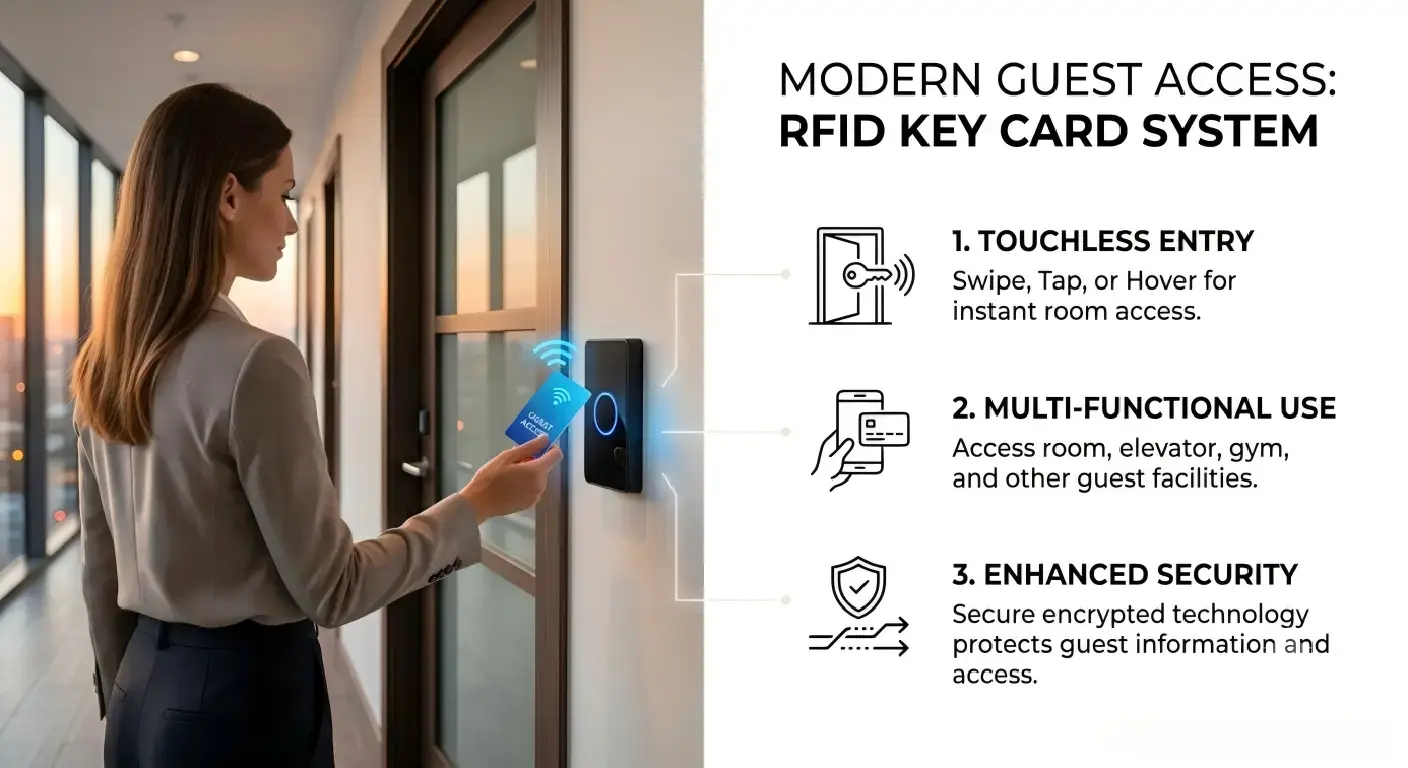
Step-by-Step Process to Customize Plastic Hotel Door Key Cards with Your Hotel Logo
The process of customization follows a set path that keeps mistakes to a minimum and makes sure the end product matches your needs. Each step builds on the choices made in the previous step, making a complete plan from the idea stage to the deployment stage.
Selecting Your Manufacturing Partner
Projects that go well and ones that don't depend on finding a company with real experience. When judging a company, you should look at their production capacity (can they go from a prototype to an order for 50,000 units?), their technical know-how (do they do their own encoding and testing?), and their quality certifications (do they comply with ISO 9001, RoHS, and REACH?). Ask for examples of past hotel projects to check the quality of the printing, how long it will last, and how well the details were handled.
WS RFID has ISO-certified factories that make more than 500 million units a year, with special lines for making products for use in hotels. Our vertical integration includes getting chips, designing antennas, printing, decoding, and quality testing. This gets rid of the problems that come with managing supply chains with multiple vendors.
Preparing Design Files and Technical Specifications
All of the fonts in your design files should be turned into outlines, pictures should be embedded at the right size, and bleed areas should be clearly marked. For brand-important parts, use exact Pantone colors, but keep in mind that there may be small changes between batches due to differences in the base. If you're using non-standard card shapes or slot punches, give die-cut details.
The electronic parts must be included in the technical specifications. For example, what kind of chip model does your lock system need (MIFARE Classic, DESFire EV2, or something else)? In what way does your property management system expect to be encoded? Should the cards come pre-programmed or blank so they can be programmed on-site? These details keep compatibility problems from happening, which slows down deployment.
Navigating MOQ, Sample Proofs, and Production
Most manufacturers require at least 500 to 1,000 fully personalized plastic hotel door key cards as a minimum order quantity. However, some makers will accept smaller runs at a higher price. Sample copies are an important step. Look at them in different lighting conditions, put them through real lock readers, and compare the color accuracy to brand standards before giving the go-ahead for full production.
WS RFID takes between 7 and 10 days to make standard orders, but they do offer faster options for those who need them right away. RF performance of each card is tested automatically during production to make sure they all work. Post-production services include custom packing, sequential numbering, and pre-encoding of the cards according to your needs, so they are ready to be sent out right away.
Encoding, Programming, and Additional Services
Your access control reasoning is turned into the card's memory structure through encoding. For hotel groups with multiple locations, centralized encoding makes sure that everything is the same. On the other hand, properties that need flexible access may prefer to have blank cards encoded on-site during check-in. WS RFID supports both methods and can help you integrate them into your PMS software by giving you technical documents.
Extra services like custom sleeves printed with property maps or Wi-Fi credentials, sequential numbers for keeping track of goods, or matching cards and lanyards for conference guests all make operations run more smoothly. These services that add value to your business make your supply chain stronger and give your customers a consistent brand experience.
Evaluating Costs, Lead Times, and Supplier Options for Customized Plastic Hotel Door Key Cards
For customized access cards, setting the budget means knowing what causes costs to rise and fall and finding ways to cut costs. Clear pricing structures and reasonable expectations about when things will be done keep budget overruns and deployment delays from happening.
Cost Structure and Volume Economics
The price per unit depends on a number of factors, including the base material (PVC vs. PET), the type of chip used (basic EM4100 vs. advanced DESFire), the complexity of the printing (single color vs. full CMYK with specialty finishes), and the size of the order. Usually, volume discounts start at 5,000 units, and when you reach 25,000 units, you can save a lot of money on plastic hotel door key cards.
Shipping costs often have hidden costs, especially when buying things from other countries. Combining items lowers the cost of shipping and makes clearing customs easier. For example, setup fees for printing plates or programming programs might be charged for the first order, but they are spread out over subsequent orders, which makes it cheaper in the long run to use standard designs.
Production and Delivery Timelines
Normal production times are one to two weeks, but this can change depending on how complicated the design is and how many other items are already in the production queue. There are extra fees for rush orders, but we can cut wait times to 3–5 days if we have enough space. International shipping can take an extra one to three weeks, based on where the package is going and how long it takes to clear customs.
Properties that want to do holiday rollouts or big openings should start the procurement process 8 to 12 weeks ahead of time. This will give enough time for design changes, sample approval, production, and shipping problems. WS RFID keeps an inventory of typical configurations, which lets them complete orders faster for return customers whose needs are already known.
Supplier Evaluation Criteria
Beyond price and delivery times, long-term satisfaction depends on how reliable the supplier is. Check the uniformity of the production—do cards from different batches work the same? Check out their technical support. Can their engineers fix problems that are preventing the lock system from working with yours? Check out their quality assurance procedures. How many of each batch go through practical testing?
Manufacturers who have worked in the hospitality industry know how hard it is to run a hotel. WS RFID's field application engineers have helped properties all over the world integrate their systems, making sure that personalized cards work with current systems without any problems. Our 15 years of experience making things and dedication to failure rates of less than 0.1% give hospitality operations the dependability they need.
Best Practices and Case Studies of Successful Hotel Logo Customizations
By looking at how other projects have been completed successfully, you can speed up your own and avoid common problems. Customization goes from being a functional necessity to a competitive advantage when logo placement, design philosophy, and environmental concerns are thought through strategically for every plastic hotel door key card.
Strategic Logo Placement and Design Philosophy
Good designs strike a mix between making the brand stand out and looking good. Logos that are too big might look garish, and elements that are too small don't make a statement. When it works best, the main image is placed clearly on one side, and secondary branding elements like taglines, web addresses, and social media handles are placed on the other side. Negative space keeps things from looking crowded and makes sure they are easy to read.
We worked with a small resort chain that used destination photos as the main design feature and made their name look like a beautiful watermark. Guests consistently said how nice the cards looked, and many said they kept them as bookmarks after checking out, which kept the brand in front of them forever.
Operational Efficiency Through Thoughtful Customization
Smart customization improves operations as well as looks. The backs of the cards are color-coded so that the front desk staff can quickly tell which VIPs have entry levels during check-in. The number of calls to guest services is cut down by QR codes that link to digital personal services. When Wi-Fi passwords are printed on card covers, people don't have to ask about network access as often.
A big convention hotel set up a tiered access system with subtle changes to the way the cards looked. Conference attendees, exhibitors, VIP guests, and staff all got cards with different border colors and different access rights. This visible difference made security checks run more smoothly while keeping the overall look consistent.
Sustainability and Eco-Friendly Practices
Environmental concerns are becoming more and more important in buying choices. Cards made from recycled materials and PVC formulations that can be recycled are better for the world without sacrificing function. Some properties have programs that collect used cards at the front desk so that they can be re-encoded and given out again.
RoHS and REACH environmental certifications are followed by WS RFID's production methods, which make sure that materials don't contain too many harmful substances. We're working hard to come up with plastic-free alternatives that use biodegradable substrates for properties that want to get rid of single-use plastics. These are still in the pilot phase while the technology develops.
Conclusion
Putting your property's name on plastic hotel door key cards is a smart way to increase brand awareness, improve the guest experience, and improve business efficiency. Technology selection, design preparation, supplier evaluation, and quality assurance all need to be done with great care during this process. You can turn a practical necessity into a powerful marketing tool that guests interact with throughout their stay by working with an experienced maker that offers full services, from chip selection to encoding and delivery. When hotels customize their rooms in a planned way, they see measurable improvements in brand recognition, guest happiness, and even social media involvement, since nice designs make people want to share pictures. Finding the right balance between how you want your cards to look and how they should work is key to making sure that your customized cards work perfectly and show off the unique personality of your brand.
FAQ
1. Can plastic hotel door key cards be reprogrammed for different guests?
Of course. RFID entry cards can be written on more than 100,000 times, which means they can be used over and over again during many guest stays. During check-in, your property management system can reprogram cards, giving them new room access rights and expiration dates. This ability to be used more than once cuts per-stay costs by a huge amount compared to single-use choices. Security is maintained by timed entry windows for every plastic hotel door key card.
2. What are typical minimum order quantities for customized hotel key cards?
MOQ requirements vary by manufacturer and customization complexity. Standard customization usually needs between 500 and 1,000 units, but smaller limits may be set for basic cards with just a name printed on them. Larger orders qualify for volume discounts, which start to save a lot of money per unit around 5,000 pieces. With flexible MOQ structures that balance cost-effectiveness with practical needs, WS RFID can work with both small hotels and big hotel groups.
3. How do RFID and magnetic stripe cards differ in customization capabilities?
Both methods work just as well for full-color printing and changing the logo. Magnetic stripes can become demagnetized by mobile devices, and logos need to be placed carefully to avoid the stripe area. RFID cards, on the other hand, have antennas built into the surface, which gives designers more freedom in how they use the cards. It is better to use RFID cards for high-security uses because they can send protected data and stop people from copying them. Since the printing method stays the same, your drawing will work perfectly on either device.
Partner with WS RFID for Your Custom Plastic Hotel Door Key Card Needs
To use custom plastic hotel door key card units to boost your property's brand, you need a manufacturing partner with proven hospitality experience and full-service capabilities. WS RFID has exactly what you need: 15 years of experience making RFID tags, ISO-certified production facilities, and a wide range of services, such as chip selection, custom printing, programming, and fast delivery. Our experienced team works with procurement professionals to understand technical requirements, find the best prices, and make sure that our products work seamlessly with other lock systems. Our flexible production capacity and commitment to failure rates of less than 0.1% make sure that your cards work reliably and protect your brand's reputation, whether you need 1,000 units for a small hotel or 100,000 cards for a global hotel chain. Get in touch with our engineering team at kenny@w-srfid.com to talk about your needs with a reliable plastic hotel door key card source who knows how to handle the unique needs of hospitality access control. We offer sample proofs, expert help for integration, and clear pricing that fits your budget and schedule for purchase.
References
1. International Organization for Standardization. (2018). ISO/IEC 14443: Identification Cards — Contactless Integrated Circuit Cards — Proximity Cards. Geneva: ISO Press.
2. Smith, R.L., & Davidson, M.K. (2021). RFID Technology in Hospitality Management: Applications and Security Considerations. Journal of Hotel Technology Systems, 34(2), 145-162.
3. Chen, W., & Rodriguez, P. (2020). Brand Touchpoints in Hotel Guest Experience: The Role of Physical Credentials. International Journal of Hospitality Marketing, 28(4), 312-329.
4. National Institute of Standards and Technology. (2019). Guidelines for RFID Security Implementation in Access Control Systems. NIST Special Publication 800-98.
5. Thompson, J.A. (2022). Sustainable Materials in Hospitality Operations: Environmental Impact Assessment of Access Credentials. Cornell Hospitality Quarterly, 63(1), 78-94.
6. Association of Hotel Technology Providers. (2023). Best Practices for Hotel Key Card Procurement and Customization. AHTP Industry White Paper Series, Volume 12.
Learn about our latest products and discounts through SMS or email