- English
- French
- German
- Portuguese
- Spanish
- Russian
- Japanese
- Korean
- Arabic
- Greek
- German
- Turkish
- Italian
- Danish
- Romanian
- Indonesian
- Czech
- Afrikaans
- Swedish
- Polish
- Basque
- Catalan
- Esperanto
- Hindi
- Lao
- Albanian
- Amharic
- Armenian
- Azerbaijani
- Belarusian
- Bengali
- Bosnian
- Bulgarian
- Cebuano
- Chichewa
- Corsican
- Croatian
- Dutch
- Estonian
- Filipino
- Finnish
- Frisian
- Galician
- Georgian
- Gujarati
- Haitian
- Hausa
- Hawaiian
- Hebrew
- Hmong
- Hungarian
- Icelandic
- Igbo
- Javanese
- Kannada
- Kazakh
- Khmer
- Kurdish
- Kyrgyz
- Latin
- Latvian
- Lithuanian
- Luxembou..
- Macedonian
- Malagasy
- Malay
- Malayalam
- Maltese
- Maori
- Marathi
- Mongolian
- Burmese
- Nepali
- Norwegian
- Pashto
- Persian
- Punjabi
- Serbian
- Sesotho
- Sinhala
- Slovak
- Slovenian
- Somali
- Samoan
- Scots Gaelic
- Shona
- Sindhi
- Sundanese
- Swahili
- Tajik
- Tamil
- Telugu
- Thai
- Ukrainian
- Urdu
- Uzbek
- Vietnamese
- Welsh
- Xhosa
- Yiddish
- Yoruba
- Zulu
Best dual interface RFID cards for secure access control
When you need to protect your buildings in a way that is both flexible and strong, RFID dual interface card technology is the answer. These smart cards work perfectly with both contact and contactless systems. They support 13.56 MHz frequency standards and include both ISO14443 and ISO/IEC 7816 protocols. Their encrypted data transmission, anti-cloning security, and ability to work with current systems are all good for businesses ranging from healthcare to leisure. To get access control that grows with your business needs, you need to think about the chip technology, the durability of the material, the ability to be customised, and the dependability of the vendor when choosing a card.
Understanding Dual Interface RFID Cards
What Makes Dual Interface Technology Unique?
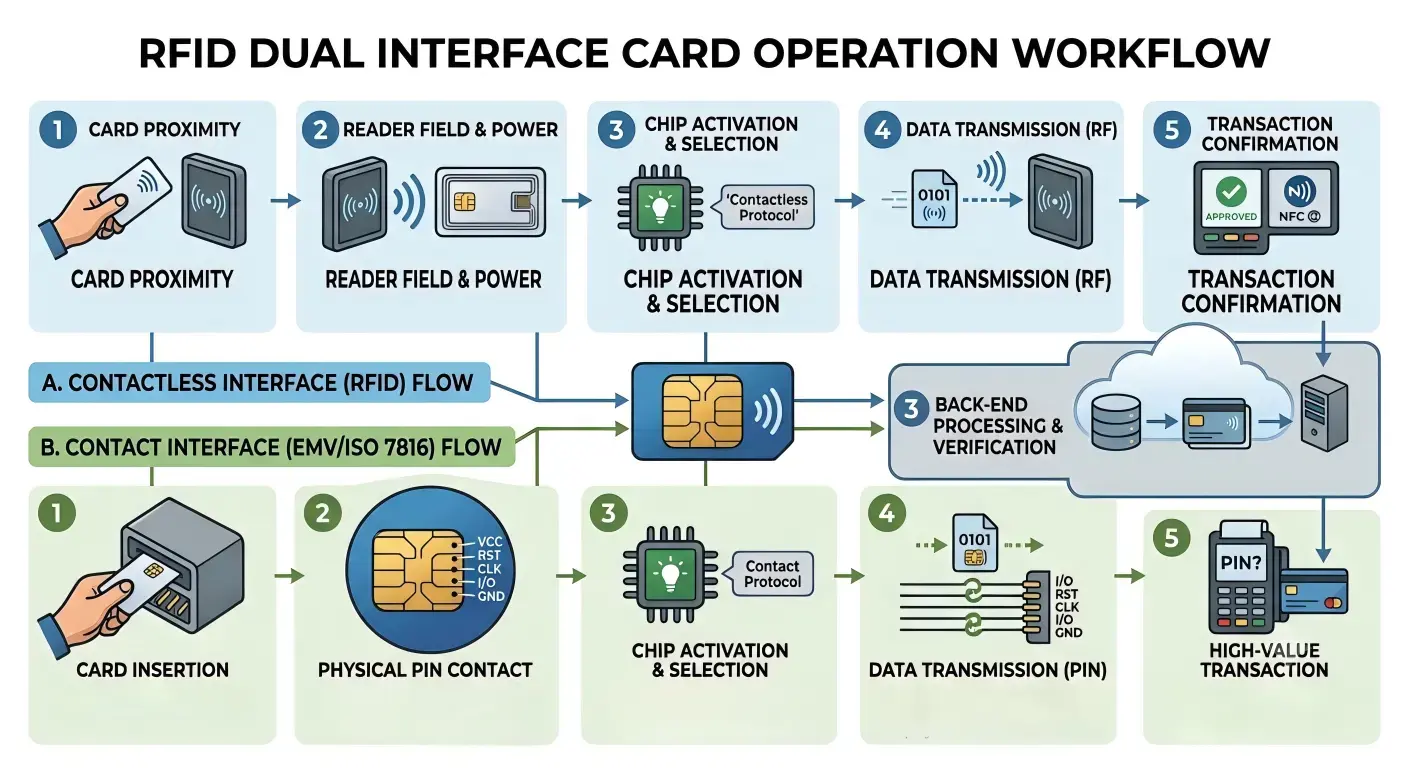
An RFID dual interface card has two different ways of communicating built into one actual card. The touch interface uses a chip plate that can be seen and physically links to readers. The contactless interface, on the other hand, uses an antenna that is built in and works at 13.56 MHz. With this design, one credential can be used on both old contact-based systems and new contactless devices. Users don't have to carry around multiple cards, and businesses don't have to update their whole infrastructures all at once.
Traditional cards with only one interface make deployment less flexible. When businesses move up from magnetic stripe or contact-only systems, they have to deal with expensive replacements and training delays. Dual interface cards get rid of this problem by letting you use gradual migration plans. During the changeover time, your current contact readers will still work, and the new contactless access points will easily fit into the same credential environment.
Core Technical Architecture
A shared secure element handles data from either interface, which is how the technology works. Memory sizes usually run from 1KB to 8KB, which is enough to store login information, biometric forms, payment data, and encrypted identification data. The touch interface is based on ISO/IEC 7816 standards, which spell out the pinouts and voltage needs. The contactless side is based on ISO14443 Type A or Type B standards.
In the chip's safe processor, data synchronisation happens instantly. When changes are made in one interface, they are quickly reflected in the other. This way, the security of the credentials is maintained no matter what kind of reader your staff comes across. Hybrid cards that use separate chips for each interface can cause problems with synchronisation, but this unified data management keeps everything in sync.
Security Advantages Over Single-Interface Solutions
Security experts like the extra safety that comes with dual interface design. If the contact plate gets damaged, the credential is still valid, and the contactless interface works as it should. This robustness lowers the cost of reissuing credentials and keeps access from being interrupted during the card's lifetime. Single-interface cards can lose read reliability when dirt builds up on the contact plates, but dual interface cards can still be used because they have a contactless backup.
The encryption protocols work the same way on both interfaces. Implementations of the Advanced Encryption Standard (AES) and DESFire EV2 keep data transmission safe whether credentials are tapped or inserted. Cloning attacks can't happen because mutual authentication makes both the card and the reader check the cryptographic keys before sending sensitive data. Anti-counterfeit technologies built into the cards during production make unique identifiers that can't be copied with regular copying equipment.
Top Dual Interface RFID Cards for Secure Access Control in 2026
Evaluating Leading Provider Solutions
Choosing the right RFID dual interface card supplier plays an important role in building secure and flexible access control systems. WS-RFID Technology provides high-quality dual interface smart cards with reliable performance, encrypted data protection, and strong customization capabilities. With 15 years of RFID manufacturing experience, advanced production facilities, and international certifications such as ISO 9001, RoHS, and REACH, WS-RFID helps global customers create efficient access solutions for offices, hotels, residential communities, and industrial facilities. Our OEM/ODM services and fast delivery ensure smooth project implementation.
Technical Comparison Metrics
Procurement teams should look at read ranges, data transfer speeds, and endurance scores when they look at card specs. Ranges for contactless reading range from 2 cm to 10 cm, depending on the antenna design and the power output of the reader. Under ISO14443-4 standards, contact interfaces can send data at speeds of 212 kbit/s to 848 kbit/s, and contactless interfaces can do the same.
Endurance metrics show how long an operation is expected to last. Quality cards can handle more than 100,000 read-write rounds on their memory blocks and more than 200,000 wireless transactions without losing any of their performance. Physical longevity standards include meeting ISO/IEC 10373 requirements for resistance to bending, torsion, and chemical contact. Cards that are rated to last 5–10 years with normal use have a lower total cost of ownership than cheap cards that need to be replaced often.
Cost-Effectiveness Analysis
Bulk pricing models have a big effect on budgets for buying things. When you buy 10,000 or more units, the prices usually go down by 30 to 40 percent compared to when you buy fewer units. Companies should compare the minimum order numbers to their real deployment needs, taking into account both the original rollout needs and the ongoing replacement inventory. When you buy from makers like WS-RFID Technology directly, you avoid the markups that come from distributors. This lets you get enterprise-grade RFID dual interface card solutions at low prices without sacrificing quality or support services.
When you do a total cost analysis, you need to look at more than just the unit price. You also need to look at encoding services, customisation fees, shipping logistics, and integration support. Some sellers price these services as a deal, while others price each one separately. Cost structures that are clear help procurement teams make accurate budget predictions and compare vendors' true value instead of just going with the one with the lowest price.
How to Choose the Best Dual Interface RFID Card for Your Access Control Needs
Assessing System Requirements
Before choosing the best cards, you should make a list of your current assets and your goals for future growth. Organisations should make a list of the readers they already have to figure out what kind of protocol support they need, such as ISO14443 Type A, Type B, or compatibility with more than one protocol. Reader firmware versions are important because older installs might not work with newer security features like DESFire EV2 transmission or AES encryption.
The environment affects the choice of materials. Standard PVC construction works well in climate-controlled indoor spaces, while PETG or polycarbonate substrates can handle high and low temperatures, UV light, and chemical contact in industrial settings. Standard thickness ranges from 0.76mm to 0.84mm can affect compatibility with some card printers and slot readers. Checking the measurement limits before deployment avoids problems.
Different types of facilities have different security level requirements. Standard encryption can be used in corporate offices that handle moderately risky assets, but healthcare facilities that handle protected health information need to use HIPAA-compliant identity management and more advanced cryptographic processors. A lot of the time, government installations need FIPS 140-2 or Common Criteria certifications, which are only available on certain card models.
Comparing Interface Technologies
Knowing how the different types of interfaces work in real life makes the selection process easier. Contact interfaces are great for high-security situations that need a lot of processing power for cryptographic operations. This is because a direct electrical connection lets you use complex authentication sequences without any radio frequency restrictions. This computational advantage is used by banking apps and secure document signing.
Contactless systems are fast and easy to use in places with a lot of traffic. People who work at turnstiles or parking gates like how easy it is to just tap and go, and transactions are processed in less than 300 milliseconds. Because contactless sensors don't wear down physically, cards that are read thousands of times a day last longer.
These two benefits can be found in dual interface cards, which let businesses choose which interface type to use based on how sensitive the transaction is. Contact interface is used for high-value tasks like opening the pharmacy vault or getting financial approvals. Contactless interface is used for routine tasks like entering data into an office or paying for food in the cafeteria. This adaptability raises the level of security and speed in unified credential systems.
Industry-Specific Considerations
Companies that sell goods and clothes and use RFID dual interface card systems can benefit from combining employee IDs with tools for managing inventory. Contactless RFID chips in staff ID cards can also be used to track assets during receiving and cycle counting. This saves money on hardware and makes training easier.
Hospitality places need cards that can be used for more than one thing. Guest credentials that store information about room access, spa reservations, and payments make things easier for visitors while keeping backend data safe. Offering customisation choices that allow full-color hotel logos raises the perception of value and lowers the number of lost credentials.
Healthcare facilities need cards that are made of biocompatible materials and have antimicrobial coatings on them because they are cleaned so often. Medical institutions also like audit trails that keep track of every time a credential is used for legal compliance and forensic investigation reasons. By choosing cards with enough memory for time-stamped transaction records, you can avoid capacity issues during long runs.
Implementation Best Practices & Security Features
Installation and Integration Protocols
Successful RFID dual interface card deployment requires compatibility testing, secure credential initialization, and phased implementation. Testing readers under different environmental conditions prevents failures, while controlled encoding stations and access controls protect credential data. Pilot programs with representative users identify integration and training issues, ensuring smoother adoption before full-scale rollout.
Critical Security Features
Strong security depends on advanced encryption, mutual authentication, and anti-counterfeiting features. AES-128 suits most business uses, while AES-256 supports higher-security environments. DESFire EV2/EV3 protocols prevent replay and interception attacks through secure messaging. Physical protections such as holograms, UV inks, and unique chip identifiers provide additional verification against fraud and duplication.
Lifecycle Management and Maintenance
Effective lifecycle management requires clear credential issuance, tracking, and deactivation procedures. Automated monitoring and regular audits help remove inactive credentials and identify performance issues early. Tracking read failures, physical damage, and common causes such as antenna detuning or dirty contacts enables timely maintenance, cleaning, and replacement to ensure reliable access operations.
Procurement Guide for Dual Interface RFID Cards
Sourcing Strategies for Scale
When a business buys a lot of RFID dual interface cards, it should build relationships with manufacturers that offer consistent quality and reliable delivery. Direct manufacturer relationships, like the ones offered by WS-RFID Technology, are better than distributor routes in a number of ways. Without markups, factory-direct price cuts costs by 20 to 35 percent on large orders while keeping product quality and help access the same.
To figure out what a manufacturer can do, you have to look at their production capacity, quality certifications, and technical support systems. Facilities that make more than 500 million units a year show that they can handle large-scale deployments without supply interruptions. ISO 9001 certification means that quality management systems have been documented. RoHS and REACH compliance means that environmental standards have been met, which makes it easier for multinational companies to file regulatory reports.
Negotiation and Ordering Processes
Bulk procurement negotiations should cover pricing, MOQs, lead times, and payment terms. Larger orders usually receive better pricing, while standard production takes around 10–12 days. Customization may extend timelines by adding printing, encoding, or design requirements. Clear payment arrangements and flexible terms help balance cost savings, security, and delivery efficiency.
Customization and After-Sales Support
Customization services enhance branding through tailored packaging, encoding, and chip options while maintaining security requirements. Strong after-sales support, including technical assistance and integration guidance, helps resolve operational issues quickly. Clear warranty terms covering defects, performance problems, and replacement services protect procurement investments and ensure long-term reliability.
Conclusion
It's important to find the right RFID dual interface card for safe entry control by weighing technical specs, security needs, and buying factors. Cards that work at 13.56 MHz and have both contact and contactless connections give organisations that manage a variety of infrastructure or plan to slowly update their systems the most options. The security is based on high-quality PVC construction, ISO compliance, and encryption protocols. Customisation options and reliable manufacturing partnerships make sure that credentials match the organization's brand and deployment schedules. With WS-RFID Technology's full range of services, from choosing the chip to delivering the finished product, along with ISO certifications, defect rates of less than 0.1%, and standard delivery times of 7–10 days, procurement teams can put in place access control solutions that protect assets and improve operational efficiency in retail, hospitality, healthcare, and industrial settings.
FAQ
1.How does an RFID dual interface card differ from a hybrid card?
What's the difference between a hybrid card and an RFID dual interface card? An RFID dual interface card has a single chip that works with both touch and contactless interfaces. This way, workers can use either interface and still keep their data in sync. Hybrid cards have two separate chips, one for touch operations and one for contactless operations. This means that they need to be encoded differently, which could lead to data errors. The single-chip design of dual interface cards makes managing credentials easier and cuts down on production costs, but security policies stay the same for both types of interfaces.
2.Can mobile phone signals damage RFID dual interface cards?
Modern cards are made with high electromagnetic compatibility (EMC) design, which means they don't get messed up by Bluetooth, Wi-Fi, and cell phone signals. Cross-interference can't happen because the 13.56 MHz frequency range used by dual interface cards is different from the spectrum range used for mobile communications. Companies that use credentials in places with a lot of wireless infrastructure can choose cards without worrying about electromagnetic shielding.
3.What security level applies to both card interfaces?
On good RFID dual interface cards, the same cryptographic processor is used for both the touch and contactless interfaces. This processor is usually rated EAL5+ or better by Common Criteria. No matter which interface is chosen, AES encryption, mutual identification, and anti-cloning safeguards are always in place. This security parity makes sure that companies don't leave holes in their security by allowing both contact-based and contactless access.
Partner with a Trusted RFID Dual Interface Card Manufacturer
Companies that need reliable RFID dual interface card solutions should work with seasoned manufacturers that can make any changes needed and have a track record of getting products to customers on time. WS-RFID Technology runs a 10,000㎡ ISO-certified factory that makes more than 500 million pieces a year with a failure rate of less than 0.1%. This makes sure that your access control credentials meet the highest quality standards. Our engineering team helps you choose the right chip, tune the antenna, print your logo, and personalise the code so that the credentials you receive are perfect for your security system. Standard delivery takes 7–10 days, but there are faster choices for operations that need to happen right away. Email our technical experts at kenny@w-srfid.com to talk about your unique needs, get product samples, or get full information about our RFID dual interface card for sale. We give your procurement team the quick service and technical know-how they need to put in place access control solutions that keep assets safe and make operations run more smoothly.
References
1. International Organization for Standardization. (2020). ISO/IEC 14443: Identification cards — Contactless integrated circuit cards — Proximity cards. Geneva: ISO Press.
2. Smart Card Alliance. (2023). Dual Interface Smart Card Technology: Technical Implementation and Security Considerations for Enterprise Access Control. Princeton Junction: Smart Card Alliance Publications.
3. National Institute of Standards and Technology. (2022). FIPS 201-3: Personal Identity Verification (PIV) of Federal Employees and Contractors. Gaithersburg: NIST Special Publication.
4. European Telecommunications Standards Institute. (2021). ETSI TS 102 622: Smart Cards; UICC-Terminal interface; Physical and logical characteristics. Sophia Antipolis: ETSI Technical Specifications.
5. RFID Journal. (2023). The Evolution of Dual Interface Technology in Physical Access Control Systems. New York: RFID Journal Research Reports.
6. ABI Research. (2024). Global Market Analysis: Dual Interface Credential Adoption in Enterprise Security Infrastructure. Oyster Bay: ABI Research Industry Reports.
Learn about our latest products and discounts through SMS or email