- English
- French
- German
- Portuguese
- Spanish
- Russian
- Japanese
- Korean
- Arabic
- Greek
- German
- Turkish
- Italian
- Danish
- Romanian
- Indonesian
- Czech
- Afrikaans
- Swedish
- Polish
- Basque
- Catalan
- Esperanto
- Hindi
- Lao
- Albanian
- Amharic
- Armenian
- Azerbaijani
- Belarusian
- Bengali
- Bosnian
- Bulgarian
- Cebuano
- Chichewa
- Corsican
- Croatian
- Dutch
- Estonian
- Filipino
- Finnish
- Frisian
- Galician
- Georgian
- Gujarati
- Haitian
- Hausa
- Hawaiian
- Hebrew
- Hmong
- Hungarian
- Icelandic
- Igbo
- Javanese
- Kannada
- Kazakh
- Khmer
- Kurdish
- Kyrgyz
- Latin
- Latvian
- Lithuanian
- Luxembou..
- Macedonian
- Malagasy
- Malay
- Malayalam
- Maltese
- Maori
- Marathi
- Mongolian
- Burmese
- Nepali
- Norwegian
- Pashto
- Persian
- Punjabi
- Serbian
- Sesotho
- Sinhala
- Slovak
- Slovenian
- Somali
- Samoan
- Scots Gaelic
- Shona
- Sindhi
- Sundanese
- Swahili
- Tajik
- Tamil
- Telugu
- Thai
- Ukrainian
- Urdu
- Uzbek
- Vietnamese
- Welsh
- Xhosa
- Yiddish
- Yoruba
- Zulu
What's anti-metal RFID tag? What's the functions?
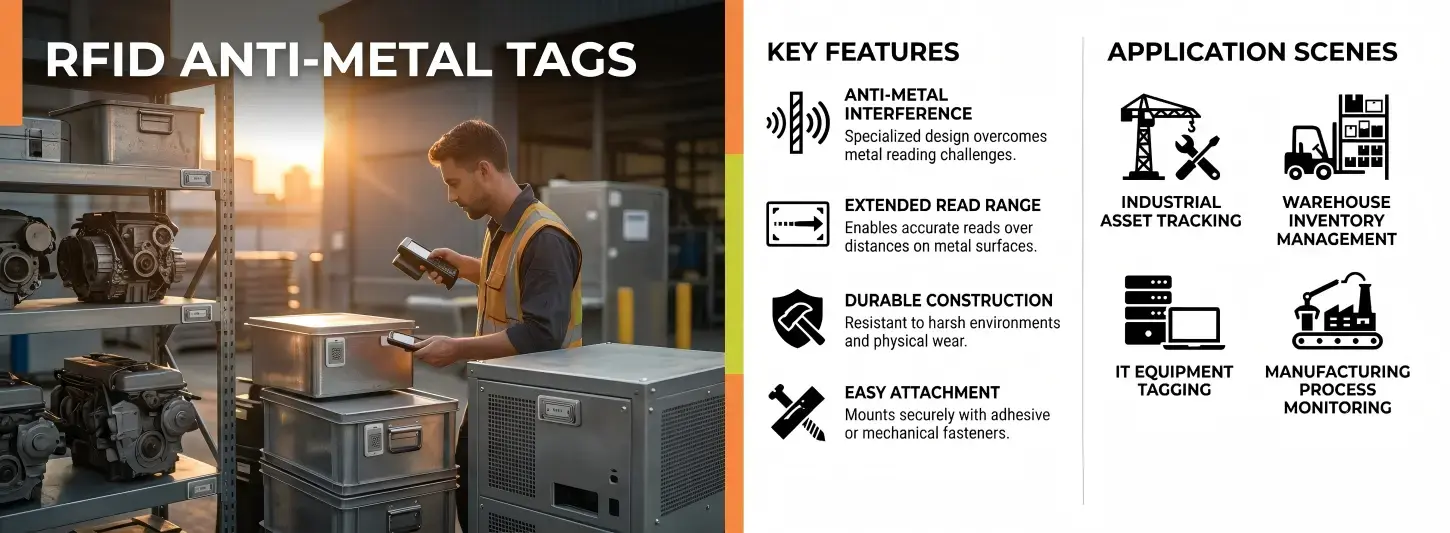
RFID anti metal tags represent a breakthrough in automated identification for industrial environments where standard tags fail. These specialized devices feature integrated electromagnetic isolation layers—typically crafted from ferrite materials or high-dielectric spacers—that prevent signal detuning caused by metallic surfaces. Metal naturally reflects radio frequency energy and induces eddy currents that disrupt antenna resonance. Anti-metal tags overcome this physical limitation through engineered antenna geometries and materials such as ceramics, FR4 substrates, or ruggedized engineering plastics. Operating primarily on UHF frequencies (860-960MHz), these tags enable consistent data transmission with read distances spanning 1-10 meters, even when mounted directly on steel containers, aluminum pallets, or machinery components.
Understanding Anti-Metal RFID Tags
The Core Technology Behind Metal-Surface Compatibility
When traditional RFID stickers are stuck to sensitive materials, they stop working. Because the metal is reflective, it throws off the signal from the tag's receiver, essentially turning it off. RFID anti-metal tags solve this through a critical design element: an isolation layer that creates physical distance between the antenna and the metal surface.
This spacer layer, which is usually made of ferrite material, foam, or special plastics, takes in electromagnetic radiation and sends it in a different direction. This makes the resonance stable and the communication between the tag and reader reliable. At WS RFID, our UHF 860-960MHz solutions come with logistics-optimized chips that support the EPC Gen2 protocol (ISO 18000-6C). This makes sure that all supply chain networks can talk to each other around the world.
Types and Form Factors Available
Various jobs require various tag designs. The reader's signal powers passive anti-metal tags, so they don't require maintenance and can function forever. These are good for most cost-effective stocking and transportation jobs.
Batteries in active tags allow reading from further than 30 metres and adding temperature or shock sensors. Paint shops and industrial ovens use high-temperature resistant varieties that can withstand -40°C to +200°C. Waterproof designs up to IP67 or IP68 may be immersed and pressure cleaned, making them ideal for returnable transit items that require rigorous cleaning.
Numerous physical tags are available, from 10mm x 10mm ceramic squares for IT assets to 80mm × 20mm hard tags for heavy equipment. Flexible anti-metal signs may fit gas tanks and be PCB-mounted directly to equipment housings during manufacture.
Frequency Selection and Performance Implications
Because they can read from far away and scan multiple tags at once, UHF systems are the most common type used in the supply chain. If you put one reader at a warehouse entrance, dozens of tagged pallets can pass through in seconds and give you data. This ability to identify batches changes how sending and receiving work is done.
HF devices that work at 13.56MHz have shorter ranges but are great for security uses that need to be close. For example, libraries use HF anti-metal tags on media storage racks to keep track of each item precisely without reading things in aisles next to it by mistake. The frequency you choose depends on whether speed and distance are more important to you than accuracy and control.
Key Form Factors & Specifications
| Form Factor | Primary Material | Key Advantage | Typical Read Range |
| Flexible / Printable Labels | Synthetic paper / PET + Ferrite layer | Roll-formable, thin, printable via thermal transfer printers | 1.0 m – 4.0 m (UHF) |
| PCB Anti-Metal Tags | FR4 Fiberglass substrate | High durability, heat resistant, precise surface tuning | 2.0 m – 8.0 m (UHF) |
| ABS Hard Shell | ABS Plastic housing | Waterproof (IP68), impact resistant, outdoor rated | 3.0 m – 12.0 m+ (UHF) |
| Ceramic Tags | Engineered Ceramic | Ultra-compact, extreme heat tolerance (up to 200°C+) | 0.5 m – 3.0 m (UHF) |
Key Functions and Benefits of Anti-Metal RFID Tags in Industrial Use
Enhanced Asset Tracking Accuracy
When barcodes are scanned by hand, mistakes like misreadings, missing items, and transcription errors can happen, which can mess up inventory data. Through automatic collection, RFID anti metal tags get rid of these problems. A forklift takes a metal pallet with tags through a stop, and the system records the movement without any help from an operator.
This technology is very important for things with a lot of value. Aerospace companies use anti-metal tags that can withstand being exposed to machining fluid and heat treatment cycles to keep track of titanium engine parts as they are made in multiple steps. Pharmaceutical companies keep an eye on stainless steel mixing vessels to make sure that the validation and maintenance schedules for the equipment are in line with what the government requires. Both practical effectiveness and compliance documents are protected by the correctness of the data.
Durability in Harsh Operating Environments
Every day, logistics environments test the limits of equipment. Tags on shipping containers have to deal with salt spray from the ocean, changes in temperature from tropical ports to cold warehouses, and physical damage from moving heavy machinery. In these situations, normal signs peel off, fade, or break.
Our clay and industrial plastic constructions can handle these problems and last longer than five years when used outside. Even though it is exposed to vibrations, cleaning chemicals, and UV rays, the electromagnetic separation layer stays in place. Protection grades ranging from IP54 to IP68 make sure that water, dust, and high-pressure washing don't break the device's usefulness. No matter what stresses the environment, your tracking system keeps the data safe.
Operational Cost Reduction and ROI
Labor costs make up most of building spending. Counting inventory by hand takes staff hours that increase linearly with the amount of inventory. This equation is drastically changed by the use of RFID anti-metal tags. A warehouse that used to need a team of two to do physical counts every three months can now do the same check in two hours with handheld readers or set ports.
The math is very convincing. Cutting the number of jobs needed by 80% frees up workers to do more valuable tasks, like handling exceptions and making the process better. At the same time, inventory accuracy goes from about 65-75% when done by hand to over 98% when RFID is used. This accuracy cuts down on stock-outs, stops people from buying too much, and lowers the amount of operating capital needed. Most mid-sized businesses get their money back in 12 to 18 months.
How to Choose the Right Anti-Metal RFID Tag for Your Business Needs
Evaluating Application Environment Requirements
The technical requirements depend on your working situation. Start by writing down the temperature ranges, types of metal substrates, and how long you think the tag will last. Antennas need to be tuned differently for steel surfaces than for aluminum ones. Pipes and other curved surfaces need form factors that are flexible, while hard clay tags can be used on flat machinery panels.
Dangers in the environment are important. When chemicals like solvents, acids, or alkalis come into contact with something, they need certain encapsulation materials. Mechanical fastening, like screw mounts or rivets, is better than adhesive backing in places with a lot of vibration, like construction equipment. Our engineering team at WS RFID does application checks to make sure that the features of the tags are exactly right for your needs. Within seven working days, prototypes are sent to you for testing in the field before they are fully deployed.
Comparing Leading Anti-Metal Tag Solutions
There are a lot of choices on the market, and they all work differently. Confidex makes small, high-performance tags for keeping track of IT assets. Zebra specializes in industrial-grade products that can be changed in a lot of ways. Avery Dennison has tags that are designed to work best with transportation processes and their knowledge of the supply chain. Alien Technology has options that are both cheap and good for large-scale deployments.
There are trade-offs between read range, longevity, size, and price for each brand. The selection process is based on what's most important to you: getting the longest read distance, the smallest tag size, or the lowest cost per unit. Voyantic Tagformance testing lets WS RFID show you side-by-side performance comparisons, as well as real-world read ranges on your metal surfaces. This method, which is based on data, takes the guessing out of purchasing choices.
Procurement Considerations for Global B2B Buyers
Price and lead times are both affected by the amount that needs to be ordered. Standard items from a regular stock will be shipped within 5 to 7 days. Custom specifications, like special sizes, printing, or encoding, usually need 10 to 12 days to make. Our annual capacity of more than 500 million units makes sure that we can handle large-scale deployments without any supply problems.
Customization choices go beyond the size of something. We can encode data that fits your data structure, print changeable numbers or QR codes, and tune your antennas so they work best with your reader infrastructure. For special work, the minimum order quantity starts at 500 pieces, which strikes a good balance between production efficiency and freedom. As part of international logistics support, paperwork is prepared to help with customs clearance, and regional distribution centers are contacted to cut down on delivery times to your facilities.
Installation Best Practices for Anti-Metal RFID Tags
Surface Preparation and Placement Strategy
The performance of the tag varies on how it is mounted. The metal surface needs to be dry, clean, and free of paint, oils, or rust. We suggest cleaning with rubbing alcohol and letting it dry in the air before applying RFID anti metal tags. Surface roughness affects the ability of adhesives to stick. Surfaces with a lot of texture or that are powder-coated may need a primer treatment or other mechanical fastening options.
Placement affects how reliable a read is. Metal items' corners and sides can make electromagnetic dead zones. The most consistent performance comes from mounting RFID anti-metal tags on flat central areas. Keep metal items at least 2 cm away from each other to avoid signal interaction that shortens the read range. When you're tagging dense metal racks, move the tags around so they don't get in the way of each other when they're in direct alignment.
Reader Configuration and System Integration
Tags are only one part of the system. Positioning of the reader antenna, output power, and interrogation procedures must all be in line with the features of the tag. When antennas are angled perpendicular to the trip paths of tags, they pick up more signals as things pass through portal readers. For reliable batch reading, handheld readers need to be taught how to scan at the best distances and speeds by the person using them.
Paying close attention to how data is formatted and how middleware is set up is needed for integration with enterprise software systems like WMS, TMS, or ERP platforms. Our technical team helps with implementation by providing SDK documentation and Field Application Engineer support. We do site surveys to find metal structures, machines, or current wireless networks that might cause RF interference. Then, we suggest where to put the readers and how much power to use so that they get the best coverage with the least amount of interference.
Troubleshooting Common Deployment Challenges
Problems can happen with even the best-planned efforts. Inconsistent read rates are often caused by the tag not being oriented correctly or influence from the surroundings. Usually, these issues can be fixed by rotating the tags 90 degrees or changing the polarization of the reading device. Most of the time, tags that fail too soon were installed incorrectly, either because the surface wasn't prepared properly or there was too much mechanical stress during connection.
Other common types of mistakes are reader setup errors. If you don't set the power correctly, tags far away may not get power or tags close by may get too much signal. Frequency rules vary by region, so a reader set up to work on frequencies between 865-868MHz won't be able to read tags properly in 902-928MHz environments in North America. Our technical support team helps with diagnosis by using reader performance logs and tag testing to find the real problems and quickly fix them.
Comparison and Decision Support: Anti-Metal RFID Tags vs Other Technologies
Anti-Metal RFID Tags vs Standard RFID Labels
Standard RFID stickers are less expensive and work great on cardboard, plastic, wood, and other non-metal materials. Trying to use them on metal assets doesn't work at all—the tags just don't respond to readers. RFID anti metal tags are made of special materials and have unique designs. They cost more than regular labels but can do things that regular labels can't.
The choice is easy: you need to use anti-metal tags on any assets that are made of conductive materials, like steel crates, aluminum cases, or metal machinery. The extra cost (usually 2 to 4 times the price of standard labels) covers the electromagnetic isolation layer and the toughened design. If you don't use RFID at all for those assets, you'll lose the benefits of automation across your whole business.
RFID vs NFC for Metal Asset Applications
The HF frequency that NFC works on is 13.56MHz, and the read range is usually less than 10cm. This requirement for closeness works well for access control, authentication, and interactive apps where users tap devices on purpose. Due to their frequency properties, NFC tags naturally work on metal surfaces. This makes them good for tool tracking, where workers scan each item individually at checkout.
When reading from a distance and in groups, UHF RFID anti-metal tags are superior. UHF's long-range and high-speed skills are needed to keep track of containers coming into a warehouse gate, check the inventory of thousands of things, or watch how assets move through automatic portals. The technologies don't compete with each other; many businesses use both, using UHF to track large amounts of assets and NFC to authenticate individual items.
Passive vs Active Anti-Metal RFID Technologies
Reader signals give power to passive tags, so they don't need batteries or maintenance. They can work forever, and the read range is usually between 1 and 10 meters, based on the reader's power and the surroundings. As long as the price per unit stays low, passive tags are a cheap way to keep track of thousands of assets in large deployments.
Active tags have batteries that power the electronics inside, which lets you read them from more than 100 meters away and supports extra sensors for tracking temperature, shock, or position. Because batteries usually last between 3 and 7 years, they need to be maintained more often and cost more per unit. Active options are best for tracking the location of high-value assets in real time or keeping an eye on their surroundings, like aerospace tools or packages for pharmaceutical cold chains. Passive RFID anti-metal tags offer the best mix of functionality and cost for the majority of supply chain uses.
Conclusion
In industrial settings where conventional tracking fails, RFID anti metal tags improve asset exposure. Specialized electromagnetic isolation and ruggedized construction make it possible to reliably track transport items, machines, tools, and metal packages along very complicated supply chains. To choose the right tag, you need to make sure that the technical details—like frequency, form factor, and environmental ratings—fit with how you will be using it. The best performance comes from installing and integrating systems correctly, which cuts down on labor costs by about 80% and improves inventory accuracy by over 98%. Anti-metal RFID technology is the basis for automated data capture that makes operational excellence possible, whether you are managing a warehouse, keeping an eye on manufacturing assets, or keeping an eye on transportation fleets.
FAQ
1. Can Anti-Metal RFID Tags Be Reused on Different Assets?
Most of the time, tags with sticky backing don't move because taking them off damages the antenna or the adhesive. Tags that are mechanically attached with screws or rivets can be moved, but the sealing and security grades may become less reliable after repeated installs. For things that are used a lot, think about tag holders or pockets that can hold different inserts.
2. Which Industries Gain the Most Value from Anti-Metal RFID?
Manufacturing cars, aircraft, transportation companies, healthcare equipment managers, and companies that track industrial tools all see benefits right away. The automation features are life-changing for any business that needs to keep track of metal assets in multiple locations or do regular inventory checks. This technology works especially well in places where counting by hand slows things down or isn't accurate.
3. How Does Frequency Choice Impact Performance on Metal Surfaces?
Longer read ranges and faster data capture are possible with UHF bands (860–960MHz), but antennas need to be carefully designed to work on metal. HF bands (13.56MHz) naturally work better with metal, but they can only read from a few centimeters away. Your choice will depend on whether you need to scan a lot of items at once or each one at a time with great accuracy. Frequency choice should be based on the needs of the application, not just the presence of metal.
Transform Your Metal Asset Tracking with WS RFID Technology
For the stringent needs of modern supply lines, WS RFID provides enterprise-grade RFID anti metal tags. Our logistics-optimized systems work on UHF 860-960MHz and are compliant with the EPC Gen2 protocol. They can read from 1 to 10 meters away, even in tough metal settings. We are a reputable maker of RFID anti-metal tags for Fortune 500 businesses around the world, with over 15 years of manufacturing experience, ISO 9001 certification, and a 500 million unit yearly capacity.
We can make changes to anything, from quick prototypes in 7 days to full OEM/ODM services that can handle different sizes, encoding, and installation needs. Direct factory pricing cuts out the middleman and keeps quality standards high, as shown by RoHS, REACH, and IP protection certifications. Standard inventory ships in 5 to 7 days, and special orders are finished in 10 to 12 days. Strong supply chain management helps meet tight release plans.
Email our engineering team at kenny@w-srfid.com to talk about how to track your metal assets. We'll do an application analysis, suggest tags, and help with integration to make sure that your RFID deployment gives you the most operational value right away.
References
1. Finkenzeller, Klaus. "RFID Handbook: Fundamentals and Applications in Contactless Smart Cards, Radio Frequency Identification and Near-Field Communication." Third Edition, Wiley, 2010.
2. Dobkin, Daniel M. "The RF in RFID: UHF RFID in Practice." Second Edition, Newnes, 2012.
3. Weinstein, Ron. "RFID: A Technical Overview and Its Application to the Enterprise." IT Professional, IEEE Computer Society, Vol. 7, Issue 3, 2005.
4. Sangwan, Ruchi S., et al. "RFID Technology in Manufacturing and Supply Chain Management." Industrial Management & Data Systems, Vol. 108, Issue 5, 2008.
5. Angeles, Rebecca. "RFID Technologies: Supply-Chain Applications and Implementation Issues." Information Systems Management, Vol. 22, Issue 1, 2005.
6. Curtin, John, et al. "Making the 'Most' out of RFID Technology: A Research Agenda for the Study of RFID Adoption Resistance." Information Technology and Management, Vol. 8, Issue 2, 2007.
Learn about our latest products and discounts through SMS or email