- English
- French
- German
- Portuguese
- Spanish
- Russian
- Japanese
- Korean
- Arabic
- Greek
- German
- Turkish
- Italian
- Danish
- Romanian
- Indonesian
- Czech
- Afrikaans
- Swedish
- Polish
- Basque
- Catalan
- Esperanto
- Hindi
- Lao
- Albanian
- Amharic
- Armenian
- Azerbaijani
- Belarusian
- Bengali
- Bosnian
- Bulgarian
- Cebuano
- Chichewa
- Corsican
- Croatian
- Dutch
- Estonian
- Filipino
- Finnish
- Frisian
- Galician
- Georgian
- Gujarati
- Haitian
- Hausa
- Hawaiian
- Hebrew
- Hmong
- Hungarian
- Icelandic
- Igbo
- Javanese
- Kannada
- Kazakh
- Khmer
- Kurdish
- Kyrgyz
- Latin
- Latvian
- Lithuanian
- Luxembou..
- Macedonian
- Malagasy
- Malay
- Malayalam
- Maltese
- Maori
- Marathi
- Mongolian
- Burmese
- Nepali
- Norwegian
- Pashto
- Persian
- Punjabi
- Serbian
- Sesotho
- Sinhala
- Slovak
- Slovenian
- Somali
- Samoan
- Scots Gaelic
- Shona
- Sindhi
- Sundanese
- Swahili
- Tajik
- Tamil
- Telugu
- Thai
- Ukrainian
- Urdu
- Uzbek
- Vietnamese
- Welsh
- Xhosa
- Yiddish
- Yoruba
- Zulu
How Does UHF RFID Technology Work in RFID Medical Wristbands?
UHF RFID technology in medical wristbands operates by embedding passive UHF chips within durable silicone bands that communicate wirelessly with readers using radio frequency waves in the 860–960 MHz range. When a UHF reader emits electromagnetic energy, the chip antenna within the wristband captures this energy, powers the chip momentarily, and transmits stored data back to the reader—all without requiring a battery. UHF silicone wristbands leverage this long-range capability to enable rapid, contactless patient identification from distances of 1–5 meters, significantly improving hospital workflows compared to traditional barcode or proximity-based systems.
Understanding UHF RFID Technology in Medical Wristbands
UHF RFID technology is based on its ability to get around the problems with older ways of identifying people. Medical centers all over the world are under constant pressure to keep hygiene standards high, cut down on mistakes, and speed up the handling of patients.
What Are UHF Silicone Wristbands?
UHF silicone wristbands combine medical-grade, hypoallergenic silicone enclosures with embedded UHF RFID chips that conform to the EPC Global Class 1 Gen 2 and ISO 18000-6C protocols. Unlike barcode wristbands that need to be scanned directly or low-frequency RFID bands that have a short range, these wristbands have special antenna shapes that keep sending signals even when they are worn against the skin. The silicone material is waterproof up to IP67 standards, so it will work reliably even after being exposed to body fluids, repeated cycles of disinfection, and patient showers.
How UHF Frequency Enables Extended Read Ranges
Ultra-high frequency (UHF) signals can be read from a lot farther away than LF (125–134 kHz) or HF (13.56 MHz) signals. When the receiver of a fixed or mobile UHF reader is turned on, it sends out an electromagnetic field. The energy is collected by passive UHF chips inside the wristbands through inductive coupling. These chips then add their own unique identification codes to the signal that is sent back, and the chips send data to the reader. This contactless exchange happens in milliseconds and supports anti-collision algorithms that let multiple wristbands be read at the same time, which is very important for emergency triage or when a lot of patients need to be admitted at once.
Core Benefits for Healthcare Operations
Integrating UHF silicone wristbands into hospital information systems delivers measurable operational improvements. Nurses can verify patient identity while standing several feet away, reducing physical contact and infection transmission risks. To avoid mistakes, pharmacy staff can scan multiple drug carts at once against patient information. Facility managers can automatically track the flow of patients through hallways and doors without having to put up annoying turnstiles. These features lead to faster admissions, fewer medication errors, and better accountability all along the care continuum.
Finding the right balance between speed and accuracy is a big problem in healthcare that this technology solves. The old ways of doing things either make patients less comfortable or slow things down during busy times. UHF RFID Wristbands get rid of these trade-offs by letting people be identified instantly and without using their hands. They also work well across departments.
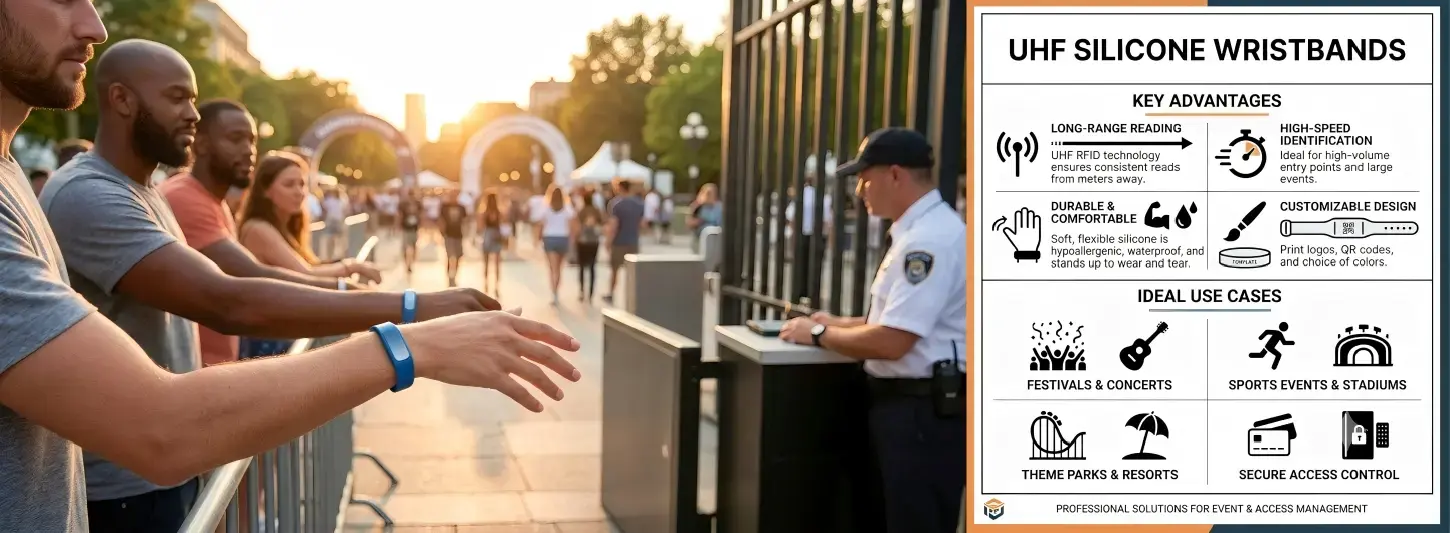
Comparing UHF RFID Wristbands with Other Technologies
Selecting the optimal identification technology requires understanding how different frequency ranges and form factors work in real-life clinical settings. Each technology has its own pros and cons that affect choices about what to buy.
Frequency Ranges and Performance Metrics
LF RFID wristbands work at 125–134 kHz and can usually read from less than 10 centimeters away. This means they can be used for close-quarters tasks like safe area entry but not for quick patient screening. HF/NFC wristbands at 13.56 MHz increase this range to about 30 centimeters and allow encrypted data transfer, making them a good choice for use in hospital cafeterias for payment or to keep track of visitors. UHF silicone wristbands that work at 860–960 MHz can be read from up to 5 meters away. This allows for walk-through identification at entry points, automated inventory of patients in waiting areas, and real-time location updates as people move between departments.
Barcode wristbands are still cheap, but employees have to aim readers physically at certain angles, which takes time and can be hard on their bodies during long shifts. Printed UHF labels are cheaper, but they don't last as long or keep out water like labels that are needed for longer patient stays.
Material Durability and Environmental Resistance
UHF silicone wristbands don't lose their signal when exposed to chemicals like alcohol-based hand sanitizers, chlorine disinfectants, and UV light. When the temperature changes from -30°C to +220°C, the encapsulation prevents the chip-antenna link from being hit, bent, and physically damaged. This toughness is very important in places like neonatal units that need to be autoclaved, psychiatric hospitals that need tamper-evident designs, and rehabilitation centers where patients do water therapy.
There are important changes in data security between RFID chips that are embedded and UHF tags that are written on the surface. When bent or compressed, embedded chips keep their stable resonance frequencies, but printed antennas may separate when put under stress. The embedded chips' 96-bit to 480-bit EPC memory can hold patient names, allergy flags, and treatment routines. It also supports AES encryption to keep data safe from people who shouldn't have access to it.
When buying, teams think about replacement rates, IT integration costs, and compliance needs; these technology differences help them find solutions that balance up front costs with total lifecycle value.
Practical Applications and Usage of UHF Medical Wristbands
Implementation in the real world shows how UHF technology changes the way patient management is done and how it can be used in fields outside of healthcare that need secure identification.
Healthcare Workflow Integration
Patients are given custom UHF silicone wristbands that are embedded with unique identifiers that are tied to their electronic health records as soon as they are admitted. The people who work in registration use PC encoders to put information about the patient, their medical record number, and their care team straight into the chip's user memory. During the care journey, nurses touch mobile UHF readers to tablets to quickly fill out records for giving medications, checking blood transfusion fits, and writing down vital sign measures. Anesthesiologists scan patients' wristbands before surgery to make sure they have the correct surgical site and process numbers. This makes auditable records that regulatory bodies are happy with.
Fixed UHF readers are put in triage booths in emergency rooms so that they can automatically record when patients arrive and where they are in line, so no one has to enter the information by hand. Psychiatric units set up geo-fencing systems that send out alerts when patients wearing UHF wristbands get close to limited exits or walk into areas they aren't supposed to be in. Place readers near equipment stations in rehabilitation centers to keep track of who shows up for therapy sessions. This automatically updates insurance billing systems.
Event Management and Access Control
In addition to healthcare, UHF silicone wristbands make it easier to run large events where quick credential checks keep things from getting crowded. Wristbands at music festivals have encrypted access levels that let security staff check VIP status from a few meters away without having to physically inspect the person. Timing chips are built into marathon wristbands so that split times can be recorded as runners cross sensor mats at stops. Theme parks put payment cards on wristbands so that you can buy things without cash all over the park. Parents can keep an eye on their kids' whereabouts using set reader networks.
The IP67 rating means that it will work at outdoor concerts in the rain, pool parties, and camping festivals that last for several days. The hypoallergenic silicone keeps the skin from getting irritated even after long periods of use, which is a common problem with plastic or paper options.
These different uses show how flexible UHF technology is across industries that put efficiency, security, and user experience first. When purchasing managers look at different providers, they should not only look at the products they offer, but also how well they can customize the look of wristbands, pre-encode data, and help with the merging of proprietary software ecosystems.
Procurement Considerations for UHF Silicone Wristbands
Strategic sourcing requires balancing technical requirements with supply chain reliability, regulatory compliance, and lifetime cost analysis. To find the best relationships, B2B buyers have to deal with a lot of different choice factors.
Supplier Certifications and Quality Standards
Leading companies that make UHF silicone wristbands keep their ISO 9001:2015 quality management certifications up to date. These show that their production processes are consistent and that they follow traceability protocols. For products going to the US market, they need to have FCC Part 15 approval, which says they are safe for electromagnetic radiation. For products going to Europe, they need to have CE marking under the Radio Equipment Directive. RoHS (restriction of hazardous substances), REACH (registration, evaluation, and clearance of chemicals), and POPs (persistent organic pollutants) laws must be followed by everyone, especially when silicone products come into contact with skin for long periods of time.
Medical-grade approvals, like FDA biocompatibility testing, show that silicone formulations don't cause allergic reactions or cell damage. Procurement teams can get the proof they need for internal risk management reviews and external audits from suppliers who offer documented test reports from accredited laboratories.
Pricing Models and Customization Options
Depending on how complicated the design is, the minimum order quantity is usually between 500 and 5,000 units. Standard bracelets with pre-programmed UIDs and single-color silicone require lower unit costs. On the other hand, custom designs with debossed logos, multicolor printing, laser-engraved serial numbers, and custom chip layouts raise costs because of the time and money needed to make the tools and set them up. Choosing a chip from the Impinj Monza, Alien Higgs, or NXP UCODE families changes both the cost and the speed of the chip, including how fast it reads and how much memory it has.
Lead times are usually between 7 and 10 days for things that are kept in stock by providers with good inventory management systems. Because of production plans that include quality checks, silk-screen printing, and encoding batches, custom orders take an extra 10 to 12 days. To get a better idea of the total cost of goods delivered, procurement managers negotiating contracts should make sure that the prices they are given include programming services, batch testing certificates, and freight forwarding.
Value-added services set luxury suppliers apart from commodity providers. Field application engineers do site surveys before a rollout to make sure that the readers are placed correctly and that the antennas are polarized correctly. Software development kits make it easier to connect to hospital information systems, which makes the IT department's job easier. During rollout phases, responsive customer support teams answer technical questions, which keeps clinical operations running as smoothly as possible.
Future Trends and Innovations in UHF RFID Medical Wristbands
New technologies are coming out that could make UHF silicone wristband systems more useful and flexible, while also meeting changing market needs for sustainability and compatibility.
Next-Generation Chip Designs and IoT Integration
Semiconductor companies are working on UHF chips with higher sensitivity limits so that transmission stays reliable even in places with a lot of electromagnetic noise, like MRI suites and near metal medical equipment. With memory sizes getting close to 8 KB, full patient histories can now be stored directly on wristbands, which helps with identification when the system goes down or when disaster response is needed. When you combine Bluetooth Low Energy (BLE) and Ultra-Wideband (UWB) technologies, you get hybrid wristbands that can do both long-range batch scanning over UHF and accurate indoor positioning through different protocols.
Edge computing-enabled cloud-connected readers handle identification events locally before sending the compiled data to central computers. This cuts down on the need for network bandwidth and speeds up response times. Machine learning algorithms look at how traffic flows at reader nodes to predict where patient flow will slow down and suggest staffing changes ahead of time.
Sustainability Initiatives and Material Innovations
People who care about the environment want bio-based silicone alternatives that are made from renewable materials instead of petroleum. Suppliers that put money into closed-loop recycling programs will take back used wristbands for reused materials, which cuts down on the amount of trash that ends up in landfills. Healthcare systems with high environmental goals are interested in manufacturing sites that are carbon-neutral and use renewable energy sources.
Chipmakers are making antenna designs smaller so that they use less material per unit while still meeting performance standards. New types of conductive ink make it possible to print antennas directly onto silicone surfaces. This gets rid of the need for separate etched plates and makes it easier to take apart devices at the end of their useful life.
Cross-Industry Application Expansion
More and more industries are using UHF silicone wristbands to keep track of workers in dangerous places. Mining companies give out tags that activate automatic mustering systems during emergency evacuations. This keeps track of where people are at all times. Wristbands with built-in dosimeters are used in oil refineries to keep track of radiation exposure and limit entry to high-risk areas based on total limits.
Smart city projects use wristbands to collect public transit fares, let library members in, and let people into recreation facilities. This creates a single digital identity platform. Students get wristbands from their schools that let them into the campus, verify their food plans, and keep their dorms safe. This eliminates the need for multiple real IDs.
These trends show that UHF technology can be used in a wide range of practical situations. When B2B clients are thinking about long-term investments, they should give more weight to suppliers who can show innovation roadmaps that are in line with new standards and market changes. This will make sure that procurement decisions are still useful as technology changes.
Conclusion
UHF silicone wristbands with UHF RFID technology built in are a mature but still improving way to identify people in healthcare, organize events, and keep track of workers in factories. With read ranges of 1 to 5 meters, passive operation that doesn't need batteries, and strong resistance to the environment, this product solves important problems in many fields. To get the best return on investment, strategic procurement focuses on supplier certifications, customization options, and support for value-added integration. As progress is made in chip sensitivity, eco-friendly materials, and connecting IoT devices, UHF silicone wristbands will be able to be used for more things while still being fast, accurate, and reliable. When companies switch from old identification methods to properly specified UHF solutions that are made to fit their specific needs, they see measurable improvements in business efficiency, safety compliance, and user happiness.
FAQ
1. Does the Human Body Interfere with UHF Signal Transmission?
Because the human body is mostly water, it can soak up UHF radio waves, which could lower the read range and reliability. Professionally made UHF silicone wristbands get around this problem by using special antenna shapes that leave a space between the chip and the skin, or they use high-permittivity materials that keep the signal strong even when they are touching. Our engineering team uses electromagnetic modeling software to make sure that each plan works the same way for all types of patients.
2. Can Wristbands Handle Being Sterilized in a Hospital?
Medical-grade UHF silicone wristbands can be exposed to alcohol-based disinfectants, chlorine bleach solutions, and hydrogen peroxide mist over and over again without losing their signal. The IP67 grade for waterproofing makes sure that the device will still work after being submerged in water for patient care tasks. When used for neonatal or surgical purposes that need the highest level of decontamination, materials can handle autoclave temperatures and UV sterilization.
3. How Many Patients Can Be Scanned at the Same Time?
UHF readers with anti-collision algorithms can read between 100 and 200 tags per second, based on the environment and the reader's specs. This feature lets a lot of people be screened at the hospital doors during shift changes or emergency evacuations. Putting fixed reader arrays at doors simplifies tracking of patient flow without any help from staff, greatly speeding up output compared to scanning barcodes.
Partner with WS RFID for Enterprise-Grade UHF Silicone Wristband Solutions
WS RFID Technology delivers proven expertise as a trusted UHF silicone wristband manufacturer serving healthcare systems, event organizers, and industrial operators across North America and Europe. Our 10,000㎡ ISO 9001-certified factory makes more than 500 million units a year with a failure rate of less than 0.1%. This is possible thanks to strict quality standards and a full testing infrastructure. We offer full OEM/ODM customization, including choosing the chip (Impinj Monza, Alien Higgs, or NXP UCODE), matching the color of the plastic, debossing your logo on it, and pre-encoding services that are specific to your needs.
We make sure that your project stays on schedule by offering standard lead times of 7–10 days and fast production for quick deployments. To make rollout easier across your current IT ecosystems, our field application engineers offer integration tests, SDK documentation, and ongoing technical support. Our team can help you with scalable, compliant, and cost-effective solutions whether you're updating systems for patient identification, starting up operations for a festival that lasts more than one day, or putting in place workforce tracking in tough industrial settings. Get in touch with our experts right away at kenny@w-srfid.com to talk about your specific needs and receive unique samples that show how our UHF silicone wristbands supplier can turn your identification problems into competitive advantages.
References
1. Weinstein, R. (2005). "RFID: A Technical Overview and Its Application to the Enterprise." IT Professional, Vol. 7, Issue 3, IEEE Computer Society.
2. Swedberg, C. (2018). "Healthcare Facilities Adopt RFID for Patient Safety and Asset Management." RFID Journal, Annual Healthcare Report.
3. Finkenzeller, K. (2010). "RFID Handbook: Fundamentals and Applications in Contactless Smart Cards, Radio Frequency Identification and Near-Field Communication." Third Edition, John Wiley & Sons.
4. Ajami, S. & Rajabzadeh, A. (2013). "Radio Frequency Identification (RFID) Technology and Patient Safety." Journal of Research in Medical Sciences, Vol. 18, No. 9.
5. Kumar, S. & Budin, E. M. (2006). "Prevention and Management of Product Recalls in the Processed Food Industry: A Case Study Based on an Exporter's Perspective." Technovation, Vol. 26, Issue 5-6, Elsevier.
6. Ngai, E. W. T., Moon, K. K. L., Riggins, F. J., & Yi, C. Y. (2008). "RFID Research: An Academic Literature Review (1995–2005) and Future Research Directions." International Journal of Production Economics, Vol. 112, Issue 2, Elsevier.
Learn about our latest products and discounts through SMS or email