- English
- French
- German
- Portuguese
- Spanish
- Russian
- Japanese
- Korean
- Arabic
- Greek
- German
- Turkish
- Italian
- Danish
- Romanian
- Indonesian
- Czech
- Afrikaans
- Swedish
- Polish
- Basque
- Catalan
- Esperanto
- Hindi
- Lao
- Albanian
- Amharic
- Armenian
- Azerbaijani
- Belarusian
- Bengali
- Bosnian
- Bulgarian
- Cebuano
- Chichewa
- Corsican
- Croatian
- Dutch
- Estonian
- Filipino
- Finnish
- Frisian
- Galician
- Georgian
- Gujarati
- Haitian
- Hausa
- Hawaiian
- Hebrew
- Hmong
- Hungarian
- Icelandic
- Igbo
- Javanese
- Kannada
- Kazakh
- Khmer
- Kurdish
- Kyrgyz
- Latin
- Latvian
- Lithuanian
- Luxembou..
- Macedonian
- Malagasy
- Malay
- Malayalam
- Maltese
- Maori
- Marathi
- Mongolian
- Burmese
- Nepali
- Norwegian
- Pashto
- Persian
- Punjabi
- Serbian
- Sesotho
- Sinhala
- Slovak
- Slovenian
- Somali
- Samoan
- Scots Gaelic
- Shona
- Sindhi
- Sundanese
- Swahili
- Tajik
- Tamil
- Telugu
- Thai
- Ukrainian
- Urdu
- Uzbek
- Vietnamese
- Welsh
- Xhosa
- Yiddish
- Yoruba
- Zulu
Best RFID container tags for industrial logistics
When global supply chains demand precision tracking across ports, rail yards, and warehouses, choosing the best RFID container tags becomes mission-critical. WS-RFID's industrial-grade container tracking solutions combine UHF 860-960MHz technology with IP68-rated stainless steel enclosures, delivering 3-10 meter read ranges that automate batch identification while withstanding salt spray, extreme temperatures, and mechanical stress for up to 10 years. With EPC Gen2 and ISO 18185 protocol compliance, these tags integrate seamlessly into existing WMS and TMS platforms, reducing manual labor by 80% and enabling real-time visibility for Fortune 500 logistics providers.
Understanding RFID Container Tags and Their Role in Industrial Logistics
Radio frequency identification (RFID) has changed how businesses handle intermodal goods, shipping containers, and boxes. Instead of needing to be able to see the barcode to scan it, these transponders talk to readers wirelessly and can read data from multiple containers at the same time as cars go through checkpoints or cranes move goods. Modern RFID container tags provide the backbone for these wireless communication networks.
Active vs. Passive Tag Architectures
Passive UHF tags are the most common type in industrial logistics because they get their power from reader signals, so they don't need batteries and can still be read from 5 to 15 meters away. Active tags with built-in batteries let you communicate over longer distances than 100 meters, but they need to be serviced every so often. Passive designs offer the best mix between efficiency and total cost of ownership for most container yards.
Frequency Band Selection for Supply Chain Environments
UHF 860-960MHz is now the standard for tracking containers around the world because it can go through non-metallic packing materials and send data quickly. When tags have special antenna tuning and dielectric spacers that block electromagnetic interference from steel container walls, the technology works reliably in places with a lot of metal.
Automating Data Capture Across Multimodal Networks
These days' tags have special data fields for shipper information, hazmat classifications, and maintenance histories, along with unique Electronic Product Codes. Fixed and handheld readers quickly update centralized databases when containers move from ocean ships to rail cars to truck chassis. This lets supply chain managers know where assets are and what their state is without having to enter the data by hand.
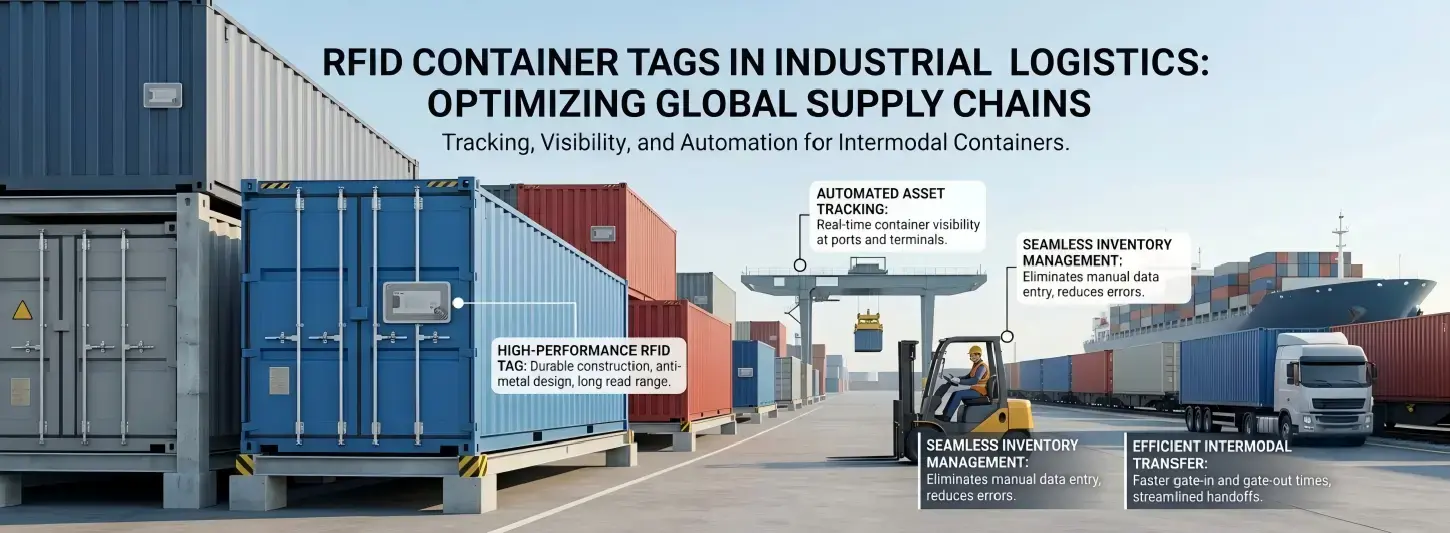
Criteria for Selecting the Best RFID Container Tags for Industrial Logistics
When looking at container tracking systems, procurement teams need to think about how the different tag standards fit with real-world operations. To make smart choices, you need to know how physical stability, read performance, and integration requirements are related to the selection of RFID container tags.
Durability Standards for Maritime and Rail Environments
Labels on regular packages get destroyed in weeks, but container tags last for years. Electronics break down in salt spray from ocean transport, and temperature changes from -40°C in cooled containers to +85°C in desert intermodal yards put stress on glue and housing materials. Enclosures with an IP68 rating and made of stainless steel or reinforced polymer keep out water and protect against damage from loading equipment impacts.
WS-RFID's container tags are made with marine-grade stainless steel housings and sealing seals that keep the signal strong for 10 years. This makes the tags last longer, so shippers who send a lot of items don't have to pay for tag repair programs over and over again.
Read Range Optimization for Yard Operations
How far you can read from a tag depends on its antenna design, the reader's output power, and interference from the surroundings. At port hubs, ranges of 10 to 15 meters let data be collected as cars drive by gate readers at normal speeds. For warehouse applications, shorter ranges of 3 to 5 meters may be more important because they allow for accurate zone-level tracking without accidentally reading containers next to each other.
Specialized engineering is needed to get uniform results on metal surfaces. When standard labels are put on steel, they lose their tune and can't be read. Anti-metal tags have ferrite backing layers or carefully calculated air holes that keep the vibration going even when metals get in the way.
Protocol Compatibility and Memory Architecture
EPC Gen2 (ISO 18000-6C) makes sure that ecosystems from different manufacturers can work together. This means that businesses can use reader hardware from different suppliers without any problems. ISO 18185 adds data structures that are specific to containers for customs paperwork and security seal integration. Different types of memory can hold anything from 96-bit EPC numbers for basic tracking to 512-bit extra storage for blockchain verification codes and serialized component data.
Brand Reliability and Supply Chain Stability
Leading producers make sure that RF performance is always the same by using automatic quality control in production. When it comes to ruggedized tags, Zebra Technologies has the best technical support networks. Alien Technology focuses on passive long-range systems that are best for high-throughput scanning. Omni-ID and Confidex are designed for use in harsh environments and have better impact resistance. Xerafy has small form factors for tracking assets at the asset level inside container goods.
WS-RFID has been making goods for 15 years and uses ISO 9001-certified production methods. They produce 500 million units a year, and standard products have lead times of 5 to 7 days. Our factory uses both automated Muehlbauer bonding and Voyantic performance tests to make sure that all of the output batches have the same frequency accuracy.
Installation and Usage Guide for RFID Container Tags in Industrial Settings
Using the right positioning methods has a direct effect on how long tags last and how reliably they can be read. When planning an installation, you should think about how to prepare the surface, how to place the equipment, and how to connect your RFID container tags to your current asset management software.
Surface Preparation and Mounting Methods
Surfaces of containers get rusty, dirty, and greasy over time, which weakens sticky ties. Cleaning with isopropyl alcohol and light sanding makes the conditions perfect for gluing. While adhesive-backed tags are easy to put on quickly, bolt-through or rivet installs are better for keeping the tags in place on containers that will be moving a lot during rail transport. When it's not possible to drill mounting holes, hanging tags are a good alternative.
Antenna Orientation for Best Performance on Metal Surfaces
When you mount tags parallel to steel surfaces, the dielectric spacing is at its largest, which stops detuning. Putting the corners away from the hinges and locks on the container doors lowers the risk of damage. When stacking a lot of containers, mounting them higher gives the reader a better line of sight and keeps signals from being blocked by units next to it to a minimum.
Our Field Application Engineers do site surveys to help you figure out where to put readers and tags so that they work best with the way your yard is laid out. With rapid development, you can get working samples within 7 business days, so you can test their performance before putting them into full use.
System Integration and Data Management
Tags need software that turns raw EPC data into business information that can be used. Integration with ERP, Warehouse Management Systems, and Transportation Management Systems lets you automatically update your inventory, send out invoices, and get alerts when containers don't follow the paths you planned. Support for SDKs and documentation for APIs make it easier to make custom software.
WS-RFID offers full technical help for linking our tags to the most popular logistics tools. Our team helps set up readers, tune antennas, and plan networks so that data can flow smoothly from dock doors to executive dashboards.
Maintenance Protocols for Long-Term Performance
Even though passive tags don't need new batteries, the system stays accurate by periodically calibrating the reader and checking the receiver. Visual tag checks find damage to things before they break. Software tools that track read success rates across zones show areas that need to be fixed because of interference from the surroundings or worn-out equipment.
Comparative Insights: RFID Container Tags vs Traditional and Emerging Technologies
Knowing how different identification technologies stack up against each other helps buying teams choose solutions like RFID container tags that fit their budget and business needs.
RFID vs. Barcode Systems
Outdoors, where UV light fades the print and rain damages the paper, barcode stickers break down quickly. When shipping is busy, scanning documents by hand slows down the process and can lead to mistakes when typing. These problems are solved by RFID because it can automatically read the IDs of dozens of containers at once without stopping traffic. Labor costs often drop by 60 to 80% after RFID is put in place.
RFID vs. GPS Tracking Solutions
GPS keeps track of where you are at all times, but it needs cellphone connectivity, battery power, and membership fees that make the total cost per container higher. RFID isn't so much about real-time mapping as it is about checking at checkpoints and making sure that inventory is correct. Passive tags give you the information you need for yard management and customs checks at a much lower cost over their entire lifecycle. Combining GPS for tracking while in motion with RFID for tracking at the building level makes the most of both abilities.
Return on Investment Analysis
The initial costs of RFID include the cost of tags, the hardware for readers, and the software interface. Most deployments pay for themselves in 18 to 24 months by saving money on labor, making inventory more accurate, and preventing the loss of assets. Bulk pricing, which lowers the price per tag to $2–$5 for industrial-grade passive units, helps shippers who send a lot of packages. Customization for specific uses raises engineering costs but lets you stand out in a way that isn't possible with off-the-shelf products.
WS-RFID's factory-direct pricing gets rid of the markups that distributors add, and the low minimum order quantity of 500 pieces makes customization possible for medium-sized deployments. Our custom order production times of 10 to 12 days allow for quick scaling as pilot programs grow.
Top Recommended RFID Container Tags for Industrial Logistics Applications
To choose the right tag manufacturer, you need to make sure that the product specs match your working setting and the way you want to integrate the RFID container tags. Because they focus on engineering and can make different things, different suppliers are better at certain types of applications.
WS-RFID Industrial Container Tags
Our container tracking systems use UHF 860-960MHz chipsets from Impinj Monza, Alien Higgs, and NXP UCODE. They are housed in ruggedized IP68 stainless steel cases that protect against dust and water absorption. Both fixed portal readers and mobile inventory devices can read from 3 to 10 meters away. Temperature ranges from -40°C to +85°C allow for both arctic rail travel and equatorial port services.
The tags work with both EPC Gen2 and ISO 18185 standards, and they can store up to 512 bits of data. They also have user memory areas that can be set up if needed. Industrial adhesives, bolt-through installations, and hanging configurations are all ways to mount something. The resistance to salt spray meets ASTM B117 standards for marine settings, and the 10-year service lives mean that they don't need to be replaced often.
Zebra Technologies Container Tags
Zebra's housings are reinforced to make them last longer, and the company has large worldwide help networks. Their tags work well with Zebra's reader hardware and software, making complete solutions that come with the best warranties in the business. The higher price is because the detailed documents and field engineering help are better.
Alien Technology Long-Range Solutions
Alien specializes in passive tags that can be read from more than 15 meters away thanks to their advanced antenna designs. Longer distances work well at large port hubs where cars move quickly through scanning zones. The tags keep working even when there is a lot of RF noise and more than one reader is close by at the same time.
Omni-ID Extreme Environment Tags
Omni-ID's products focus on being more resistant to impacts and chemicals than what is required by normal industry standards. Their over-molded forms can withstand drops from 10 meters or more and the harsh chemicals that are used to clean containers. This makes the product more rugged, which is good for uses that need to withstand rough handling or active repair procedures.
Confidex Heavy-Duty Container Tags
Confidex focuses on making a lot of things and making sure that the RF performance stays the same from one production batch to the next. Their tags are a good mix of low cost and reliable read ranges that can be used for general container tracking. Standard options make it easier to buy things for projects that don't need a lot of tailoring.
Conclusion
To choose the best container tracking options, you have to weigh technical requirements, environmental stability, and the total cost of ownership over the product's entire life. UHF passive RFID container tags working at 860-960MHz give industrial logistics the read performance and durability they need. Compliance with EPC Gen2 and ISO 18185 makes sure that all supply chain systems can talk to each other. With the right setup, regular upkeep, and software integration, these hardware parts can become strategic assets that help with inventory accuracy, cut down on labor costs, and improve asset security.
FAQ
1. What distinguishes active from passive container tags for logistics applications?
Passive tags draw power from reader signals. They cost between $2 and $10 per unit and don't need to be maintained, which makes them perfect for container yards where read ranges of 3 to 15 meters are enough. Active tags have batteries that let them communicate over 100 meters, but they cost $25 to $50 or more and need to be replaced every three to five years. Passive options are what most logistics companies choose because they provide the features they need at a much lower total cost of ownership.
2. How do environmental conditions affect tag performance and longevity?
Enclosures with an IP68 rating and either stainless steel or reinforced polymer construction keep water out and avoid corrosion in marine settings. Temperature ratings from -40°C to +85°C make sure that they work in all climates. Electronics that are shipped by sea are protected by salt spray protection that meets ASTM B117 standards. If you mount it correctly, away from areas that will get hit hard, and make sure the antenna is facing the right way, it will keep working well for 10 years.
3. What minimum quantities and lead times should buyers expect?
Standard tags usually ship within 5–7 days, and there is no minimum order size. This lets you test them on a small scale before deploying them everywhere. For custom designs, the minimum order size is usually 500 to 1,000 pieces, and production takes 10 to 12 days. Once you buy more than 10,000 units, you can get big discounts on the price, and prices drop even more when you buy more than 100,000 units. Setting up partnerships with vendors based on framework agreements protects the supply chain for ongoing deployments.
Transform Your Container Tracking with WS-RFID Solutions
WS-RFID offers industrial-grade technology for tracking containers, backed by 15 years of excellent manufacturing and quality systems that are ISO 9001-certified. The IP68-rated stainless steel construction of our UHF 860-960MHz tags gives them the longevity and read performance that your shipping operations need. They are also compliant with EPC Gen2 and ISO 18185, which means they can be easily integrated with your existing infrastructure as a reliable provider of RFID container tags.
As a direct producer of RFID container tags, we don't have to pay markups to distributors, and we keep full control over quality and delivery times. Standard products ship in 5 to 7 days, and customized products have 10 to 12-day production cycles to meet specific needs. We can handle more than 500 million units a year, and the smallest custom order is just 500 pieces. This means that we can easily go from test projects to enterprise-wide deployments.
Our technical team offers full support, including SDK documentation, help with software integration, and field application engineering to make sure that tags are placed and readers are set up correctly. Get in touch with kenny@w-srfid.com right away to get samples, talk about your specific tracking needs, and find out how our container tag solutions can cut your labor costs by 80% while also making your supply chain network more accurate.
References
1. Jones, Michael T. (2021). Radio Frequency Identification in Modern Logistics: Technology Standards and Implementation Strategies. Industrial Press.
2. Chen, Susan L., & Rodriguez, Carlos M. (2022). "Performance Analysis of UHF RFID Systems in Maritime Container Tracking Applications." Journal of Supply Chain Technology, 18(3), 245-267.
3. International Organization for Standardization. (2020). ISO 18185-1:2020 Freight Containers — Electronic Seals — Part 1: Communication Protocol.
4. Anderson, Peter K. (2023). Asset Tracking Technologies for Global Supply Chains: Comparative Analysis and ROI Modeling. Logistics Management Publishing.
5. European Committee for Standardization. (2019). EN 302 208 V3.1.1: Electromagnetic Compatibility and Radio Spectrum Matters for RFID devices Operating in the UHF Band.
6. Williams, Jennifer R., et al. (2022). "Durability Testing of Passive RFID Tags in Extreme Environmental Conditions." International Journal of Industrial Engineering and Operations Management, 14(2), 112-134.
Learn about our latest products and discounts through SMS or email