- English
- French
- German
- Portuguese
- Spanish
- Russian
- Japanese
- Korean
- Arabic
- Greek
- German
- Turkish
- Italian
- Danish
- Romanian
- Indonesian
- Czech
- Afrikaans
- Swedish
- Polish
- Basque
- Catalan
- Esperanto
- Hindi
- Lao
- Albanian
- Amharic
- Armenian
- Azerbaijani
- Belarusian
- Bengali
- Bosnian
- Bulgarian
- Cebuano
- Chichewa
- Corsican
- Croatian
- Dutch
- Estonian
- Filipino
- Finnish
- Frisian
- Galician
- Georgian
- Gujarati
- Haitian
- Hausa
- Hawaiian
- Hebrew
- Hmong
- Hungarian
- Icelandic
- Igbo
- Javanese
- Kannada
- Kazakh
- Khmer
- Kurdish
- Kyrgyz
- Latin
- Latvian
- Lithuanian
- Luxembou..
- Macedonian
- Malagasy
- Malay
- Malayalam
- Maltese
- Maori
- Marathi
- Mongolian
- Burmese
- Nepali
- Norwegian
- Pashto
- Persian
- Punjabi
- Serbian
- Sesotho
- Sinhala
- Slovak
- Slovenian
- Somali
- Samoan
- Scots Gaelic
- Shona
- Sindhi
- Sundanese
- Swahili
- Tajik
- Tamil
- Telugu
- Thai
- Ukrainian
- Urdu
- Uzbek
- Vietnamese
- Welsh
- Xhosa
- Yiddish
- Yoruba
- Zulu
What is a Handheld RFID Reader and How Does It Work?
A handheld RFID reader is a portable, battery-powered device that uses radio frequency identification technology to wirelessly capture data stored on RFID tags without requiring direct line-of-sight contact. Unlike traditional barcode scanners, an RFID handheld reader communicates with tags through electromagnetic fields, enabling rapid bulk scanning of inventory, assets, or products even when tags are hidden inside boxes or embedded in items. These mobile readers consist of an integrated antenna, processor, display screen, and wireless connectivity module, designed to streamline data collection workflows in warehouses, distribution centers, retail stores, and field service environments across multiple industries.
Understanding Handheld RFID Readers
Core Components and Architecture
Today we have a few critical bits of hardware in small RFID portable scanners that all play nicely together. The onboard CPU decodes the data coming from the tags and manages the communication protocols. The antenna module transmits the radio waves and receives the answer coming from the tags. Most industrial-grade gadgets have OLED or LCD screens with real-time feedback so that the workers can view the data quickly. The enclosure (usually cast metal or reinforced polycarbonate) protects the circuits within from falling, water and dust.
This kind of thinking is shown by WS-RFID Technology’s portable solution, which is constructed of Cast Aluminium and PC and has an IP64 designation for weather protection. The device functions reliably at temperatures from -20°C to +60°C, which makes it suitable for use in cold storage facilities and outdoor logistical operations where more fragile equipment would be compromised by adverse weather conditions.
Frequency Bands and Protocol Support
When choosing mobile RFID handheld reader equipment you need to be careful of frequencies of operation. Low Frequency (LF): 125 kHz devices have the least read range, but work especially well close to metals and liquids. HF, operating at 13.56 MHz, satisfies the standards ISO/IEC 14443 and 15693. They are often used for library management and access control . Ultra High Frequency (UHF) scanners in the 860-960 MHz range may be read from as far as 8 metres away and are suitable for inventory and logistical operations where numerous objects must be scanned quickly.
Our portable system supports both High Frequency (13.56 MHz) and Ultra High Frequency (860-960 MHz) frequencies. It supports standard protocols such as EPC Gen2, ISO/IEC 14443 and 15693. That adaptability means you don't have to acquire as many specialised equipment, saving money on capital expenditures and making it simpler to educate people."
Wireless Connectivity and System Integration
How well mobile readers integrate with today’s commercial software systems relies on how well they can transmit and receive data without any difficulties. Connect to PCs, smartphones and tablets using Bluetooth Low Energy (BLE) 5.0+ and remain connected without exhausting the battery. 4G RAM and 32G ROM storage means you can gather data even if there is no network. Connect and your device will instantly sync your info.
The wireless architecture enables ERP and WMS systems to access real time inventory information, giving procurement managers and technical directors a constant overview of stock levels. The SDK instructions we provide make it simple for system developers to create solutions that integrate smoothly with operations and construct bespoke applications.
Benefits and Applications of Handheld RFID Readers
Operational Efficiency Gains
When you switch from entering data by hand or reading barcodes to using RFID handheld readers, you can see a clear increase in productivity. With UHF technology, dozens of tags can be read at the same time, without having to aim carefully or be able to see them clearly. By doing cycle counts, warehouse teams can cut the time it takes to audit inventory by up to 80%. This frees up workers' time to do more useful tasks instead of tedious physical checks.
The long battery life—more than 8 hours of continuous use—ensures that full-shift work can be done without stopping to charge. Receiving, picking, and sending tasks are done faster by workers, and mistakes and stock-outs that cost a lot of money, hurt relationships with customers, and cut into profits are less likely to happen.
Industry-Specific Applications
Portable RFID handheld reader technology is used in different fields to solve specific operational problems:
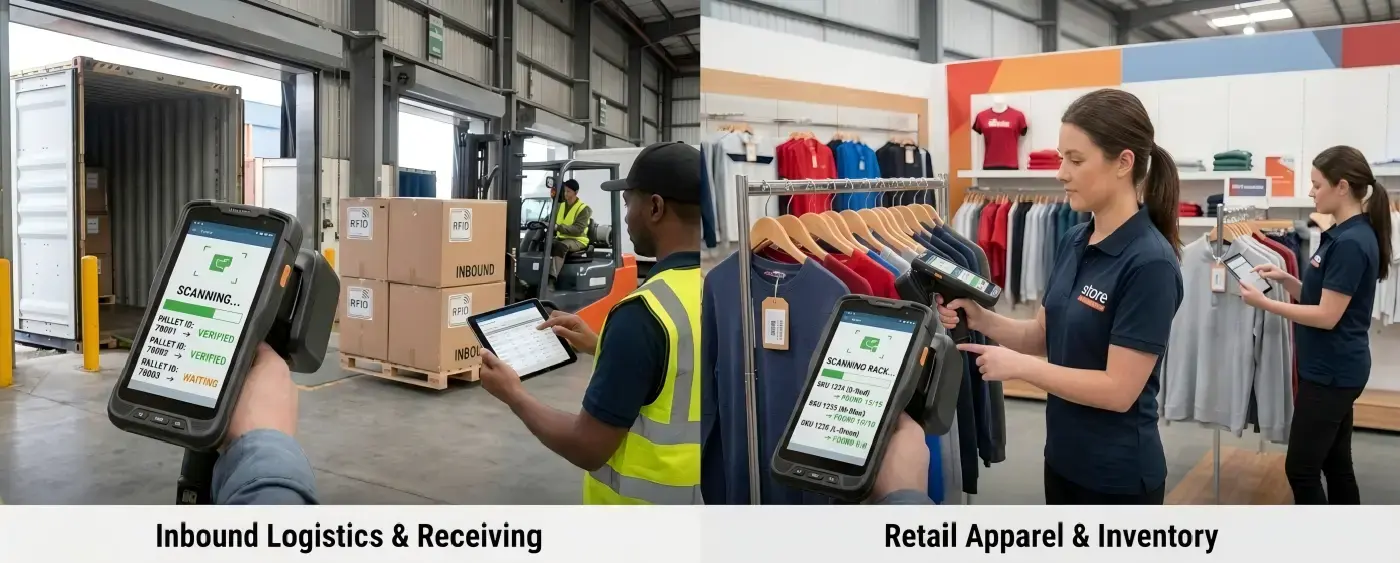
- Warehouse and Distribution Centres: Warehouses and distribution centres utilise these devices to accelerate the receipt of incoming products, confirmation of putaway items and verification of order fulfilment. Whole boxes may be scanned in seconds instead of taking time to verify each item individually. Real-time location monitoring helps prevent loss of goods and expedites recovery activities.
- Manufacturing Asset Tracking: When maintenance teams check out equipment, they employ mobile readers to ensure equipment is available, service records are current and calibration regulations are adhered to. It’s simpler to keep track of preventive maintenance programmes and prepare ready for audits if you can scan tools and equipment across several production floors without having to scribble down information by hand.
- Retail Operations: During business hours, store employees check to see if stock needs to be restocked without getting in the way of helping customers. The small size and quiet operation make it possible to count items in sales areas, and the ability to see right away which items are on hand on the shelves helps keep sales from being lost due to lack of stock.
- Healthcare and Laboratory Settings: Mobile readers that connect to hospital information systems are used by medical facilities to keep track of instruments, specimens, and expensive equipment. The ability to read without touching keeps sterile standards in place and makes sure that accurate chain-of-custody paperwork is kept.
Return on Investment Metrics
When B2B procurement pros look at these options, they look at how they can help their businesses make money. Lowering labor costs usually leads to the biggest savings, and making sure that inventory is more accurate keeps you from having to write off old or lost stock. Better insight into where assets are located cuts down on unnecessary purchases when teams can't find current equipment. Faster processing processes improve cash flow by speeding up the delivery of orders and the billing process.
Comparing Handheld RFID Readers: Choosing the Right Device
RFID vs. Barcode Technology
Barcode readers are still very common, but they make work much more difficult. Items have to be carefully positioned so that the printed codes are directly in front of the scanner beam. This means that the items have to be carefully oriented and often handled by hand. Reading happens one item at a time, which can slow things down in places with a lot of work to do. Barcode stickers break down when they get wet, scratched, or exposed to sunlight, which stops activities because they can't be read.
These problems can be solved by portable RFID handheld readers that can read tags even when they are not in line of sight and that can capture a lot of tags at once. Tags that are stuck inside packages or on hidden surfaces can still be read, and reading multiple tags at the same time greatly speeds up the process. RFID tags are more reliable over the duration of a product because they can handle harsh conditions that destroy barcode stickers.
Key Selection Criteria for System Integrators
When technical leaders and purchasing managers look at mobile RFID handheld reader tools, they should pay close attention to these important factors:
- Frequency Compatibility: Choose an operational band that works for your needs. For logistics, UHF has a longer range, while HF is best for access control and close-range applications that need stronger security protocols.
- Read Range and Anti-Collision Performance: Longer read lengths speed up scanning in warehouse hallways, but they may also read tags in nearby areas without meaning to. Advanced anti-collision algorithms make it possible to work reliably in tag settings with a lot of things crammed into small areas.
- Environmental Durability: IP scores show how well something is protected against dust and water getting in. Higher grades are needed for work that is done outside or in a washdown area, and rugged construction can handle the drops and hits that happen every day in industrial settings.
- Battery Performance and Charging: For full-shift operation, the battery needs to be charged and run for at least eight hours. Battery packs that can be replaced increase the time that can be spent in the field, and the ability to charge quickly cuts down on downtime between jobs.
- Software Ecosystem and SDK Access: Full documentation and quick technical support make integration projects go more quickly. Open APIs let you format data in your own way, make reports, and talk to older systems that don't have RFID support directly.
Common Challenges and How to Solve Them
Radio Frequency Interference Management
Multiple wireless systems in a dense RF setting can sometimes lead to read mistakes or a shorter effective range. Buildings made of metal and containers full of liquids reflect or absorb radio waves, leaving empty spaces where tags can't be read. Choosing the right tags is the first step to effective prevention. For example, on-metal tags use spacer materials that keep working when attached to conductive surfaces, and tags made for liquid environments use tuned transmitters that make up for detuning effects.
By surveying the site before rollout, you can find trouble spots where adding more readers or moving antennas would make the coverage better. Our technical team helps with these evaluations and suggests the best setups based on how your building is set up and what kinds of things you have in stock.
Hardware Durability and Maintenance
Mobile equipment in industrial settings is put under a lot of mechanical stress, extreme temperature changes, and dust or moisture contamination. Choosing devices with the right IP ratings keeps them from breaking down too soon, and their tough construction lowers the costs of fixing damage caused by drops and bumps.
Regular firmware updates fix new compatibility problems and improve performance based on what users have said in the field. We send these updates with detailed release notes to make sure that technical teams know about the changes that have been made and any configuration changes that need to be made. Setting up regular maintenance schedules that include cleaning optical parts, checking battery contacts, and making sure the device is calibrated increases its lifespan and ensures consistent read performance.
Legacy System Integration
When adding new mobile data collection gear, companies that already use established ERP or WMS platforms may run into compatibility issues. It's important to pay close attention to API standards and data mapping because the devices need to talk to each other using protocols and data forms that the current systems can understand.
Giving detailed SDK documentation and sample code speeds up integration projects by letting developers build their own middleware that helps systems talk to each other. Our field application engineers do remote integration checks to find possible problems early in the deployment process and suggest solutions that keep current workflows going while adding new RFID features.
Procurement Considerations for B2B Buyers
Pricing Models and Volume Discounts
The amount of money spent on mobile RFID infrastructure depends on the type of device, the number of orders, and the level of customization needed. Standard units with common frequency bands and connectivity options are cheaper, while specialized devices with longer read ranges, better environmental protection, or custom enclosures are more expensive.
When you buy in bulk, you can get big cost savings. Tiered discounting structures are usually available for bulk buys of 100 units or more. Larger deployments get better price, which helps with project ROI estimates. Leasing spreads the cost of capital across operational budgets, which is especially helpful for businesses that are tight on cash or running pilot programs before going live with the full version.
Supplier Evaluation Criteria
It turns out to be just as important to choose the right technology as it is to choose the right manufacturing partner. Long-term suppliers with a track record of quality products, stable supply chains, and ongoing technical support are better to rely on. Certifications like ISO 9001, CE, FCC, and RoHS show that a product meets quality standards and government rules.
WS-RFID Technology runs an automated production facility worth 10,000㎡ that can make more than 500 million units a year. This makes sure that there is a steady supply for both pilot projects and large-scale deployments. Our strict SOP management and 15 years of experience making things ensure that each unit works the same way every time. Our certificates in CCC, CE, FCC, RoHS, and POP show that we are committed to quality and meeting the standards that foreign markets require.
Delivery Timelines and After-Sales Support
System integrators' buying cycles usually last between one and three months. They start with evaluating the SDK, then move on to proof-of-concept testing, small-batch orders, and finally project-scale deployment. Standard goods ship within 7–15 days, but custom versions with unique cases, logos, or changed firmware take 10–12 days to make after the sample is approved.
Technical help that is quick to respond is very important during the integration process and throughout the operational lifecycle. Our team offers a warranty that lasts for one to two years and includes SDK documentation and development help. This helps technical directors solve integration problems and improve system performance. This help goes beyond the original rollout and makes sure that companies get the most out of the money they spend on RFID infrastructure.
Conclusion
Mobile RFID handheld reader technology changes the way inspections, tracking assets, and managing inventory are done across all industries by providing speed, accuracy, and operating insights that are not possible with older methods. By learning about frequency bands, integration needs, and environmental factors, you can choose the right gadget for your unique purposes. Portable readers that handle multiple protocols, have longer battery lives, and come with full SDK documentation give system developers the freedom they need. Working with well-known companies that offer consistent quality, fast delivery times, and helpful technical support is the best way to make sure that the deployment goes smoothly and leads to measurable productivity gains and return on investment (ROI).
FAQ
1.How long does the battery last on a typical handheld RFID reader?
How long the battery lasts relies on how much it is used, how often it is read, and how it connects to wireless networks. Most industrial devices can work continuously for 8 to 16 hours with normal use, which is long enough for full shifts without having to be charged. Our solution gives you 8+ hours of use thanks to a high-capacity lithium battery designed for long-term performance. This means that you won't have to worry about interruptions in the middle of a shift that slow down your work.
2.Can one device read different types of RFID tags?
Multi-band readers that work with LF, HF, and UHF frequencies can read different kinds of tags, but only if the frequency bands and protocol standards are compatible. A device that works at both 13.56 MHz and 860-960 MHz can read both HF and UHF tags. This means that it can be used for most business tasks, from controlling entry to tracking goods in transit.
3.What differentiates handheld from fixed RFID readers?
Portability is what makes the main difference. Handheld units are convenient for environments that are always changing, like when workers are inspecting or counting inventory as they move around the building. Fixed readers keep an eye on things all the time at fixed checkpoints like dock doors or changes in the production line. The best type of device depends on the job. For example, mobile solutions work best in retail, field service, and cycle counting, while fixed setups work best for automated sortation and high-throughput conveyor systems.
Partner with WS RFID for Your Mobile Data Collection Needs
System designers who work in warehouse operations, retail inventory, healthcare, livestock management, and public utility checking can get all of WS RFID's handheld RFID reader options. Our multi-band devices, which can work with HF 13.56 MHz and UHF 860-960 MHz frequencies, come with Bluetooth BLE 5.0+ connectivity and a battery life of 8 hours or more, give your projects the technical foundation they need. Full SDK documentation lets you do secondary development quickly, and our expert team helps you connect to Android and Windows systems.
We are a well-known company that has been making RFID handheld readers for 15 years and can make more than 500 million units a year. Our quality is guaranteed by CCC, CE, and FCC approvals. Standard items are shipped within 7–15 days, and you can buy more than one at a time and get better prices. Our field application engineers help with integration and troubleshooting, making sure that deployment goes smoothly from evaluating the SDK to putting it into full use.
Email our procurement experts at kenny@w-srfid.com to talk about your specific needs. We offer testing of prototypes, unique setups, and full help after the sale, including warranties that last between one and two years.
References
1. Finkenzeller, Klaus. RFID Handbook: Fundamentals and Applications in Contactless Smart Cards, Radio Frequency Identification and Near-Field Communication. Third Edition. Wiley, 2010.
2. Lahiri, Sandip. The RFID Technology Handbook. CRC Press, 2019.
3. Wyld, David C. "The Evolution of RFID Technology in Supply Chain Management: From Warehouse to Retail." International Journal of Information Systems and Supply Chain Management, vol. 9, no. 2, 2016.
4. Hunt, V. Daniel, Albert Puglia, and Mike Puglia. RFID: A Guide to Radio Frequency Identification. Technology Research Corporation, 2007.
5. Weinstein, Ron. "RFID: A Technical Overview and Its Application to the Enterprise." IT Professional, vol. 7, no. 3, IEEE Computer Society, 2005.
6. Roberti, Mark. The History of RFID Technology: From World War II to the Modern Supply Chain. RFID Journal Publications, 2018.
Learn about our latest products and discounts through SMS or email