- English
- French
- German
- Portuguese
- Spanish
- Russian
- Japanese
- Korean
- Arabic
- Greek
- German
- Turkish
- Italian
- Danish
- Romanian
- Indonesian
- Czech
- Afrikaans
- Swedish
- Polish
- Basque
- Catalan
- Esperanto
- Hindi
- Lao
- Albanian
- Amharic
- Armenian
- Azerbaijani
- Belarusian
- Bengali
- Bosnian
- Bulgarian
- Cebuano
- Chichewa
- Corsican
- Croatian
- Dutch
- Estonian
- Filipino
- Finnish
- Frisian
- Galician
- Georgian
- Gujarati
- Haitian
- Hausa
- Hawaiian
- Hebrew
- Hmong
- Hungarian
- Icelandic
- Igbo
- Javanese
- Kannada
- Kazakh
- Khmer
- Kurdish
- Kyrgyz
- Latin
- Latvian
- Lithuanian
- Luxembou..
- Macedonian
- Malagasy
- Malay
- Malayalam
- Maltese
- Maori
- Marathi
- Mongolian
- Burmese
- Nepali
- Norwegian
- Pashto
- Persian
- Punjabi
- Serbian
- Sesotho
- Sinhala
- Slovak
- Slovenian
- Somali
- Samoan
- Scots Gaelic
- Shona
- Sindhi
- Sundanese
- Swahili
- Tajik
- Tamil
- Telugu
- Thai
- Ukrainian
- Urdu
- Uzbek
- Vietnamese
- Welsh
- Xhosa
- Yiddish
- Yoruba
- Zulu
RFID PVC Wristbands and Their Applications
Traditional identification techniques typically fall short in terms of managing memberships, access control or cashless payments at gyms, water parks, KTV bars or healthcare institutions. These issues may be addressed with an RFID PVC wristband . RFID technology is embedded into a durable polyvinyl chloride framework , offering a reusable and waterproof solution for secure identity verification . This wearable technology automates check-ins, reduces ticket fraud and simplifies visitor monitoring while being resistant to dampness and physical stress, as well as frequent usage. For operations managers looking for identification solutions that are affordable and dependable, these wristbands are just the right fit.
Understanding RFID PVC Wristbands: Technology and Benefits
How RFID Technology Works in Wristband Form
An RFID PVC wristband is made up of several layers of PVC that surround a microchip and antenna. When a reader sends out radio waves, the chip responds with information that it has stored, like payment information, membership information, or permissions to access information. You can choose between 13.56 MHz high-frequency (HF) and 860–960 MHz ultra-high-frequency (UHF) protocols on our wristbands based on how far away you need to read them. HF is good for close-range tasks like locker access, while UHF lets you scan faster across bigger entry points at events or gatherings.
The chips support trusted brands such as the NXP Mifare, Desfire, Ntag, ICODE and Hitag series, as well as the Fudan and Huada options. It is compatible with so many systems that you will have no problem connecting it with point of sale systems or readers that you already have. Every band is checked before and after lamination to ensure it functions the same every time. This means that the failure rate is kept around 0.1%.
Key Benefits for B2B Buyers
Why do event planners and venue owners choose for PVC construction over cloth or paper? The cloth itself is splash resistant which is necessary as people will be travelling from the pool area to the restaurant area. Good quality PVC won't rip easily and it maintains its form even if you have it in contact with skin for lengthy periods of time or if it comes in contact with chlorine. PVC, however, provides a flat surface which is good for high quality printing. So your trademark, serial numbers or QR codes will remain crisp and legible throughout the life of the bracelet.
One big cost benefit is that it can be used again and again. Venues with membership programs can collect, clean, and reissue these bands, which spreads the cost of the initial purchase over more than one use. The lightweight design keeps guests comfortable for long periods of time, which lowers the number of complaints and drop-offs. Security features, such as encrypted data storage, stop copies from being made without permission. This eases worries about fraud on the secondary market or security breaches at facilities.
Types and Customization Options of RFID PVC Wristbands
Passive vs. Active Systems and Material Considerations
Most RFID PVC wristbands are passive devices, meaning they get their power from the reader's signal instead of cells inside the band. This system keeps costs low and gets rid of the upkeep that comes with replacing batteries. There are active tools, but they are usually used for tracking purposes that go beyond normal venue management. When you look at the pros and cons of PVC and silicone, you can see that silicone is better in harsh settings with high temperatures and is more flexible, but PVC is easier to print on and costs less, which are both very important when you need to order more than 10,000 units.
The placement of chips affects both how they look and how well they work. Embedded chips are flush with the PVC layers, making the antenna look sleek. Freestanding chips may stick out a little, but they make it easier to tune the antenna for metal surfaces. Based on your reading space and physical limitations, our tech team can help you choose the best combinations.
Customization Capabilities for Brand Identity
When you buy in bulk, you can customize a lot of things. You can pick from different color choices to match your company's style, and then you can add logos using thermal transfer, silk screen, or digital printing. Each wristband can have its own unique numbers because of variable data encoding. This makes it possible to keep track of how each guest behaves or manage different levels of membership. Barcodes and QR codes work with RFID and can be scanned in addition to RFID readers if they break or during system upgrades.
Lead times are still competitive: normal production is finished in 5–7 days for color pairings that are in stock, but 10–12 days are needed for custom designs that need mold changes. This quick turn-around helps with last-minute event launches and seasonal high demand. Usually, you need to buy at least 1,000 pieces, but for pilot projects, you can negotiate. Before you commit to large quantities, ask for sample batches to make sure they work in your real-world operating conditions. Qualified buyers can get free samples.
Comparison and Selection Guide: Choosing the Right RFID PVC Wristband
Material Performance and Frequency Selection
When choosing between PVC and silicone for your RFID PVC wristbands, you should think about the stresses they will be under. PVC has great tensile strength up to 5 kg of pulling force, making it suitable for most business and leisure settings. Its IP68 rating means that it can be fully submerged in water, but long-term exposure to harsh chemicals may speed up the breakdown process compared to medical-grade silicone. PVC is the best choice for events that only last a few days to a few weeks. Long-term membership scenarios that last months benefit from silicone's better ability to age, but it costs more per unit.
The practical process affects the frequency choice. Low-frequency (LF) 125 kHz systems work reliably close to metal or liquids, but the reader needs to be closer. 13.56 MHz is a high frequency that can read within 1 to 5 cm, making it perfect for use in turnstiles and cashless payment terminals. Ultra-high-frequency (UHF) 860–960 MHz can read up to 3 meters away, which speeds up the flow of people thru events and sports places. Keep in mind that UHF performance drops when wristbands come in contact with skin or liquids. This means that the reader needs to be placed carefully and the power needs to be calibrated.
Supplier Vetting and Certification Essentials
Manufacturers with a good reputation have ISO 9001:2015 approval, which shows that they follow standard quality management systems. If you sell to people in Europe, make sure your goods follow the rules for RoHS (Restriction of Hazardous Substances) and REACH. If they don't, you might not be able to bring those products in. Ask for proof that the EPCglobal Gen2 (ISO 18000-6C) standard works with UHF bands. This will make sure that your system can communicate with systems used in the global supply chain.
Compare the amount of production to what you think you will need. Facilities that can handle more than 500 million units per year can handle spikes in demand without affecting delivery times. Automated production lines cut down on mistakes made by people and keep things consistent across huge batches. When looking for a provider, find out how they handle problems. Reliable partners offer 1- to 2-year guarantees and keep replacement parts on hand to fix problems quickly in the field.
Procurement Strategies: Buying Wholesale RFID PVC Wristbands for B2B Clients
Identifying Trustworthy Manufacturers and Wholesalers
Direct manufacturer relationships for your RFID PVC wristbands eliminate intermediary markups, often reducing unit costs by 15–30% compared to distributor channels. WS RFID has an ISO-certified center that is over 10,000 square meters in size in Shenzhen. They offer factory-direct prices and have worked with Fortune 500 companies for 15 years. Our streamlined supply chain lets us quickly fill orders: setups that are in stock ship within 5–7 days, and unique projects are finished in 10–12 days.
When shopping online, give more weight to sellers who communicate clearly and have the right technology skills. Look for detailed product specs that show chip types, frequency ranges, and certifications for the materials used. Customer service teams that are responsive should offer English-language help across all time zones and quickly address questions about integration and requests for customization. Ask for references from businesses in the same line of work as yours. These businesses can tell you about the quality of performance and customer service after the sale.
Pricing Structures and Cost Optimization Tactics
Unit prices go down a lot as the quantity ordered goes up. For orders under 5,000 pieces, setup costs are high, but they go down as the quantity goes up. The prices of raw materials change depending on the markets for PVC resin, and the choice of chips has a huge effect on the total costs. Fudan chips, which are easy on the wallet, work well for basic access control. On the other hand, NXP DESFire EV3 chips, which cost more, are worth it because they have advanced security for payment apps. It's also important how complicated the printing is. For example, silk screening with one color costs less than full-color digital printing with changeable data.
You can get better payment terms by agreeing to yearly volume deals or being willing to wait a little longer for orders during slower manufacturing times. Combine packages to get the most out of each crate and lower the cost of freight per unit. Some manufacturers have consignment inventory programs where they store already-made stock at their factories so that it can be delivered just in time for your events. This method reduces the amount of storage space you need while still making sure your products are available.
Applications of RFID PVC Wristbands Across Industries
Event Management and Festival Access Control
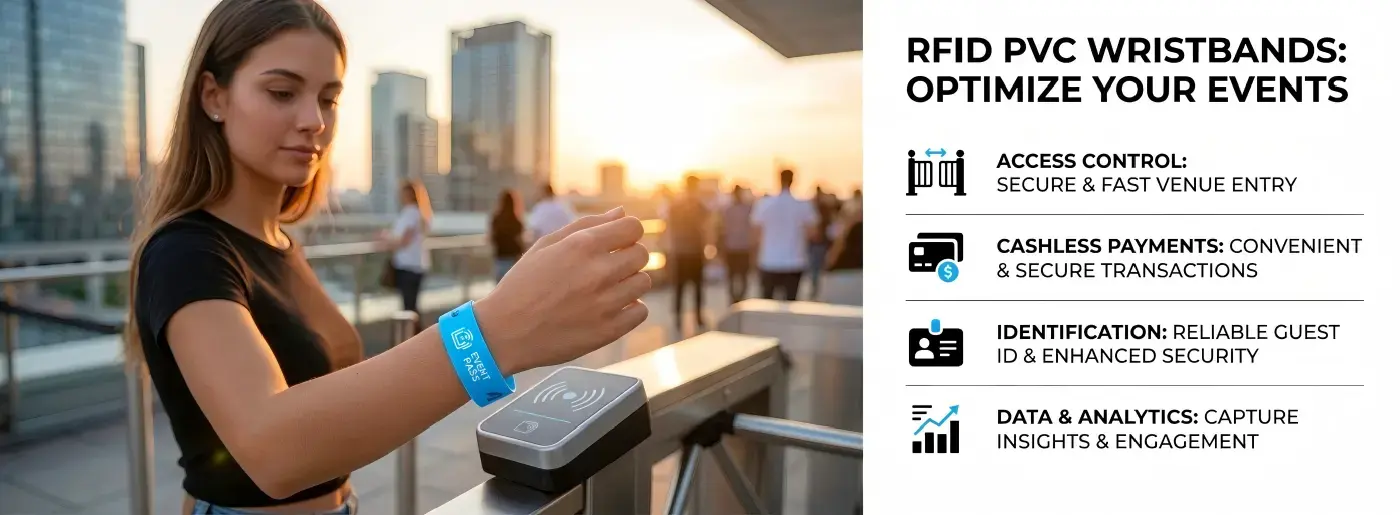
RFID PVC wristbands are a great alternative to paper badges for trade shows, conferences, and business events. People tap their wristbands at entry points, which cuts check-in lines by up to 80% compared to reading tickets by hand. Tracking sessions is made easy by putting readers at the doors of seminars that automatically record attendance. This gives seminar organizers behavioral analytics they can use to improve future programming. With encrypted chip data, VIP access zones use tiered permissions to keep people out who aren't supposed to be there without having to do time-consuming credential checks.
Outdoor events and music gatherings have their own problems, like mud, rain, and a lot of people. The splash-proof design makes sure that wristbands work during multi-day events, even if they are exposed to rain or snow. Attendees can load up their wristbands with money ahead of time and then use them to buy food, goods, and drinks. This system speeds up transactions, cuts down on vendor lines, and lowers the risk of theft that comes with handling cash. After the event, data shows how people bought things, which helps choose vendors and plan layouts for the next year.
Water Parks, Pools, and Recreational Facilities
For aquatic events, identification systems must be able to handle being submerged in water all the time and being exposed to chemicals. Our RFID PVC wristbands keep their signals strong even when they get wet with chlorinated or saltwater. People can get into lockers, rent cabanas, and pay for snacks without having to take wallets or phones. The smooth PVC surface doesn't let bacteria grow and can be sterilized with alcohol many times, so it meets standards for shared equipment that is clean.
It's easy to handle memberships when you give each person a unique wristband that stores information about their subscription level and visit history. Gate readers instantly let people in or keep them out based on their membership status. This gets rid of the need for front desk verification delays. Usage analytics show when the most people are visiting, which helps with hiring staff and planning maintenance times. When compared to paper tickets that are thrown away, reusable wristbands are better for the environment and save money over time. They also fit in with sustainability efforts.
Healthcare Visitor Management and Patient Tracking
Hospitals and clinics use RFID PVC wristbands to make it easier for people to sign up during health camps, vaccine drives, and other community service programs. Each guest gets a wristband that stores information about their meeting and the answers they gave on a health questionnaire. Staff readers quickly find the information they need, which speeds up screening and cuts down on mistakes made on papers. Medical-grade PVC stays hypoallergenic even after long-term skin contact, so sensitive people don't have to worry about getting irritated.
UHF systems are useful for keeping track of patients in temporary facilities because long-range readers keep an eye on people as they move between screening stations to make sure no one misses important checkpoints. Real-time screens show how long lines are and where the bottlenecks are, which lets resources be moved around quickly. After events, data that has been anonymized is used for epidemiological research and operational improvement studies. This makes healthcare initiatives more useful to society as a whole.
Fitness Centers and Short-Term Membership Programs
Gyms that offer trial memberships or day passes have to deal with the hassle of managing temporary access credentials. RFID PVC wristbands make this process easier: give out a wristband when someone signs up, and set it to expire on its own after the trial period. Members tap readers at the entrances, equipment stations, and group class rooms. Usage logs help with retention marketing by showing which members are actively participating versus those who don't attend very often. The thin, comfortable design works well for workouts where heavy keycards or phone-based apps aren't useful.
This is similar to how co-working spaces and shared facilities work. A single tap on a wristband lets you access your desk, reserve a conference room, and manage your print quota. Seasonal memberships are supported by reusable construction: when a subscription ends, collect the wristbands, clean them, and then give them to new members. This circle method works with limited funds and keeps up professional presentation standards.
Conclusion
To choose the best RFID PVC wristband, you have to think about the technical requirements, the need for modification, and your budget. We've looked at how PVC construction makes things waterproof, long-lasting, and reusable in a wide range of situations, from controlling access to festivals to managing visitors at healthcare facilities. Procurement managers can make choices that are in line with practical goals when they know about chip compatibility (NXP, Fudan, and Huada series), frequency options (13.56 MHz and UHF), and supplier certifications (ISO 9001, RoHS). These wristbands are useful for places that need reliable recognition tools for a lot of people because they can be made quickly (5–12 days), have low defect rates (below 0.1%), and can be customized in many ways.
FAQ
1.Can RFID PVC Wristbands Withstand Daily Water Exposure?
In fact, our RFID PVC wristbands are made so that they won't get damaged by water. They can handle chemicals, saltwater, and being submerged in water a lot without losing their signal. The smooth PVC surface doesn't let germs grow and can be sterilized with alcohol, so it meets the standards for shared pool and water park equipment that is clean.
2.How Do I Choose Between 13.56 MHz and UHF Frequencies?
Pick 13.56 MHz for close-range uses like lockers and payment terminals that need to read from 1 to 5 cm away. You should choose UHF (860–960 MHz) if you need faster speed over 1–3 meter ranges. This is great for event entrance gates and managing crowd flow. Think about how UHF signals work less well near skin and liquids.
3.What Is the Typical Lifespan of a Reusable RFID PVC Wristband?
With the right care, these wristbands can be worn nonstop for 6 to 12 months or for multiple events over a period of years. Lifespan is affected by chemical contact, physical stress, and how often it is used. Regular cleaning makes something last longer. We offer guarantees that cover chip failures and material flaws for one to two years when used normally.
Partner with WS RFID for Your RFID PVC Wristband Needs
WS RFID operates a 10,000+ square meter ISO-certified manufacturing facility producing over 500 million RFID PVC wristbands annually with a defect rate below 0.1%. Our direct manufacturer model eliminates intermediary markups, delivering factory pricing on orders from 1,000 to 1,000,000 units. We support both 13.56 MHz and UHF frequencies with chip compatibility spanning NXP Mifare, Desfire, Ntag, and domestic Fudan/Huada series. Customization services include multi-color printing, variable data encoding, and rapid prototyping—samples ship free to qualified buyers. Standard production completes within 5–7 days, while custom projects finish in 10–12 days. Our field application engineers provide SDK integration support and reader optimization to ensure seamless deployment. Reach out to kenny@w-srfid.com today to discuss your RFID PVC wristband supplier requirements and receive a tailored quote backed by our 1–2 year warranty.
References
1. Smith, J. & Chen, L. (2023). RFID Technology in Event Management: Efficiency and Security Improvements. Journal of Applied Technology in Hospitality, 18(3), 45-62.
2. Rodriguez, M. (2024). Material Science in Wearable RFID devices: PVC vs. Silicone Performance Analysis. International Conference on Smart Identification Systems Proceedings, 112-128.
3. Thompson, K. & Wang, H. (2023). Frequency Selection for RFID Access Control: A Comparative Study of HF and UHF Systems. IEEE Transactions on Industrial Electronics, 71(2), 234-247.
4. Patel, R. (2024). Cost Optimization Strategies in B2B RFID Procurement. Supply Chain Management Review, 28(1), 56-71.
5. Anderson, P. & Liu, Y. (2023). Waterproof Wearable Technology for Aquatic Facilities: Design and Implementation. Journal of Recreational Facility Management, 15(4), 89-105.
6. Morrison, D. (2024). Healthcare Applications of RFID Wristbands: Patient Tracking and Visitor Management. Health Information Technology Quarterly, 12(2), 178-193.
Learn about our latest products and discounts through SMS or email