- English
- French
- German
- Portuguese
- Spanish
- Russian
- Japanese
- Korean
- Arabic
- Greek
- German
- Turkish
- Italian
- Danish
- Romanian
- Indonesian
- Czech
- Afrikaans
- Swedish
- Polish
- Basque
- Catalan
- Esperanto
- Hindi
- Lao
- Albanian
- Amharic
- Armenian
- Azerbaijani
- Belarusian
- Bengali
- Bosnian
- Bulgarian
- Cebuano
- Chichewa
- Corsican
- Croatian
- Dutch
- Estonian
- Filipino
- Finnish
- Frisian
- Galician
- Georgian
- Gujarati
- Haitian
- Hausa
- Hawaiian
- Hebrew
- Hmong
- Hungarian
- Icelandic
- Igbo
- Javanese
- Kannada
- Kazakh
- Khmer
- Kurdish
- Kyrgyz
- Latin
- Latvian
- Lithuanian
- Luxembou..
- Macedonian
- Malagasy
- Malay
- Malayalam
- Maltese
- Maori
- Marathi
- Mongolian
- Burmese
- Nepali
- Norwegian
- Pashto
- Persian
- Punjabi
- Serbian
- Sesotho
- Sinhala
- Slovak
- Slovenian
- Somali
- Samoan
- Scots Gaelic
- Shona
- Sindhi
- Sundanese
- Swahili
- Tajik
- Tamil
- Telugu
- Thai
- Ukrainian
- Urdu
- Uzbek
- Vietnamese
- Welsh
- Xhosa
- Yiddish
- Yoruba
- Zulu
What Are RFID Tags and Why You Should Use Them
With the help of radio frequency signals, RFID Electronic tags are cutting-edge data carriers that allow for global communication. These tags are made of a strong material like PET film that surrounds an integrated circuit and an antenna. RFID technology can automatically identify multiple things at the same time within seconds, while traditional barcodes need to be scanned directly. Because of this, RFID has become an important tool in many industries around the world, including retail, transportation, healthcare, and manufacturing. It helps solve problems like mistakes made when counting items by hand, lost or stolen items, and a lack of awareness in the supply chain that cost companies billions of dollars every year.
Understanding RFID Tags: Technology and Types
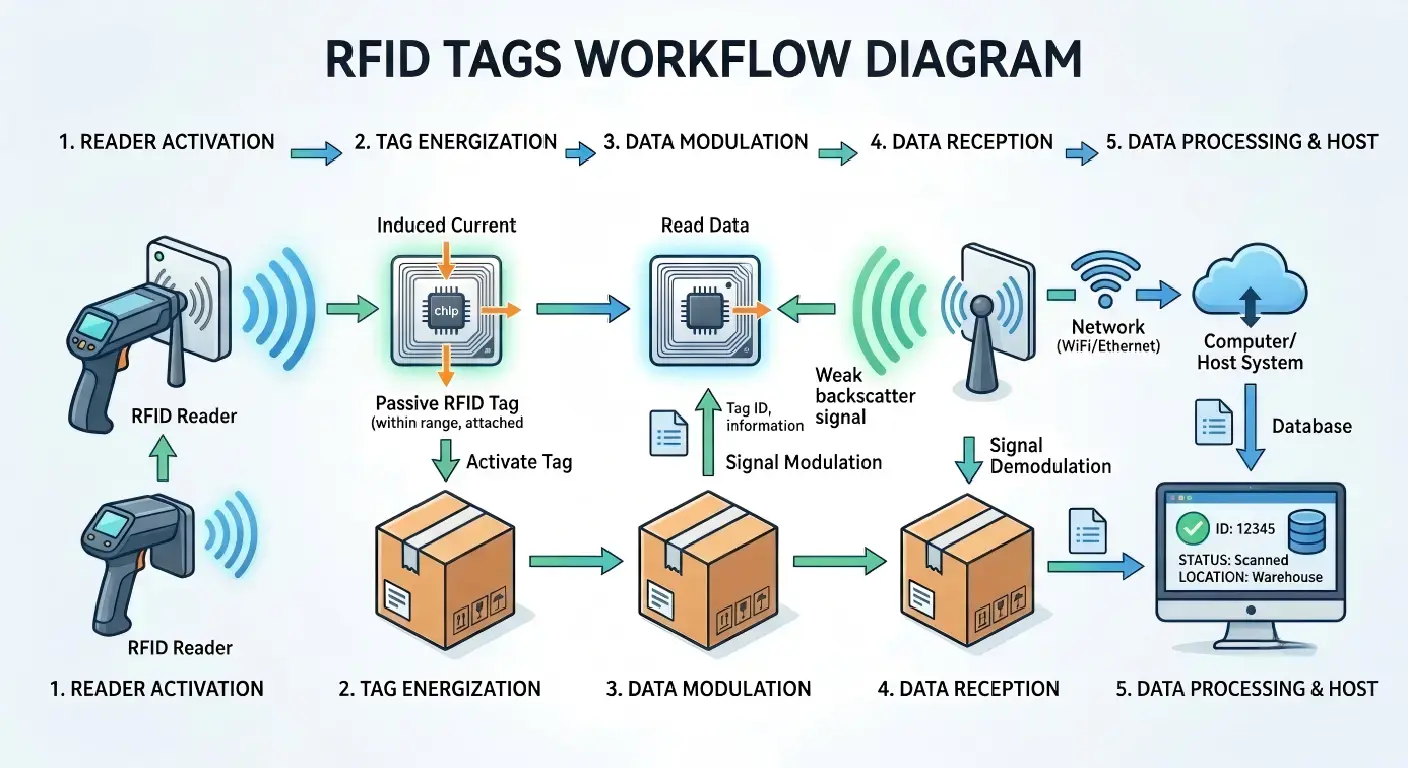
Radio Frequency Identification is a big step forward in technology for automatically collecting data. At its core, an RFID system is made up of three important parts that work together to make it easy to identify and track objects in a variety of business settings.
Core Components of RFID Systems
The tag contains a microchip storing product information and unique identification number with a radio enabling reader communication. Data storage ranges from simple 96-bit EPCs to 512-bit configurations for user-defined data. The reader transmits radio waves powering passive tags and receives return signals. WS RFID uses Impinj Monza, Alien Higgs, and NXP UCODE chips ensuring reliable operation in tough industrial settings.
Passive, Active, and Semi-Passive Tag Technologies
Passive tags draw power from reader electromagnetic fields, operating 10+ years without batteries at HF 13.56MHz (0-10cm read range) or UHF 860-960MHz (1-5 meters). Active tags contain batteries enabling 100+ meter read ranges and temperature logging. Semi-passive tags combine battery-powered chip functions with passive transmission. WS RFID specializes in passive tags handling 100,000+ write-erase cycles.
Frequency Bands and Industrial Applications
LF tags at 125-134kHz suit access control requiring close-range identification. HF tags at 13.56MHz work with NFC-enabled applications including libraries, payment systems, and hotel key cards. UHF tags at 860-960MHz provide longest read ranges for warehouse automation, retail inventory, and supply chain logistics, compliant with EPCglobal Gen2 (ISO 18000-6C). WS RFID offers custom antenna tuning for challenging metal or liquid environments.
Why Use RFID Tags? Key Benefits for B2B Procurement and Inventory Management?
Businesses that use radio frequency identification technology regularly say that it makes their operations more efficient, accurate, and cost-effective. These benefits come from RFID's basic ability to simplify data collection tasks that used to require a lot of physical work and were still prone to mistakes.
Enhanced Speed and Accuracy in Data Capture
In traditional barcode scanning, workers have to find, position, and scan each item by hand. This takes a lot of time and can't be done when there are hundreds or thousands of items to scan. Without the need for line-of-sight placement, RFID Electronic tags allow for simultaneous reading of multiple things. Industry benchmarking studies show that a single worker with a handheld UHF reader can inventory a whole part of a building in minutes instead of hours. This can cut labor costs by as much as 80%. Businesses that use manual counting methods have to deal with expensive discrepancies between their actual goods and their system records. Accuracy rates of over 99.5% get rid of these problems. Retail chains that use RFID inventory systems have seen an increase in inventory accuracy from the normal 60–70% to 95–99%. This directly cuts down on stockouts and overstocks that hurt profits.
Operational Efficiency and Labor Cost Reduction
RFID-enabled sorting systems process incoming packages 40-60% faster than conventional methods, accelerating merchandise turnover and customer order fulfillment. Factories tracking work-in-process parts with RFID Electronic tags enable just-in-time manufacturing, freeing working capital. Hotels using RFID key cards streamline guest check-in while eliminating security problems of mechanical keys. ROI typically achieves within 12-24 months depending on implementation scale.
Security, Anti-Counterfeiting, and Asset Protection
Advanced RFID Electronic tags feature password protection, AES-128 encryption, and permanent lock or kill commands preventing unauthorized data modification. Luxury retailers embed UHF tags enabling instant authenticity verification, protecting brand reputation from organized retail crime. Pharmaceutical companies use RFID tracking for tamper-proof supply chains complying with drug pedigree regulations. Asset management teams report significant loss reduction for IT equipment and medical devices.
Cross-Industry Versatility and Scalability
RFID-enabled smart fitting rooms identify garments customers bring in, triggering digital displays showing available sizes and complementary items. Logistics companies use IP67/IP68 rated tags on returnable assets for closed-loop tracking. Healthcare facilities issue RFID Wristbands ensuring correct patient identification during treatment. RFID supports projects from small pilots with hundreds of tags to enterprise deployments with millions. WS RFID's 500+ million annual production capacity ensures consistent supply.
How to Select the Right RFID Electronic Tags for Your Business Needs?
To make sure you get the best performance and return on investment from your purchase, you need to carefully look at technical specs, operational needs, and the supplier's abilities. Before you can make smart choices, you need to carefully look at your use cases and the conditions of the surroundings.
Defining Your Procurement Scenario and Requirements
Map your intended applications thoroughly. Warehouses tracking pallets need UHF tags with strong anti-collision for 10-15 meter read ranges. Retailers need smaller tags embeddable into garments or attached to jewelry. Healthcare facilities prioritizing patient safety need medical-grade tags withstanding multiple sterilization cycles and biocompatibility approval. Document environmental factors including temperature extremes, chemical exposure, moisture levels, and metal proximity affecting tag performance.
Technical Factors: Frequency, Read Range, and Durability
Choosing the right frequency has a big impact on how well a system works. HF tags that support ISO/IEC 14443 protocols work best for access control and payment systems that need to read tags close up for security reasons. UHF tags that comply with EPC Gen2 standards, on the other hand, have the longer ranges that are needed for automating logistics. Carefully think about the read range requirements—being too specific can cost too much, while being too vague can cause problems with operations. When testing for durability, you should look at how well the glue sticks to different types of substrates, how much mechanical stress the product is under from being handled, and how it is exposed to things like UV light and chemical cleaners. Our quality control methods make sure that tag failure rates are less than 0.5%. This is proven by testing all tags at the same resonance frequency and screening samples for external stress. Tags are put through bonding strength checks and thermal cycle tests that simulate multi-year working lifespans. This gives buyers faith in the tags' long-term dependability.
Comparing RFID with Alternative Technologies
Even though barcodes and QR codes are cheaper to use at first, their flaws become clear in high-volume settings. Barcodes can only be read one at a time and need to be read directly. This slows down shipping activities that need to move quickly. QR codes can hold more data than regular barcodes, but they still need to be scanned optically, which can be problematic if they get dirty or aren't in the right place. RFID Electronic tags get around these problems by using radio transmission that can get through non-metallic materials and read a lot of data at once, which isn't possible using optical technologies. Near Field Communication is a subset of HF RFID that is designed to work best with customer contacts. It makes it possible for authentication and payment to be done on smartphones. When making a procurement choice, these technical trade-offs should be weighed against cost and how hard it is to integrate with other business systems.
Supplier Evaluation and Sourcing Decisions
Picking the right manufacturing partner is just as important as picking the right tag specs. You should judge suppliers by how much they can produce, whether they have quality certifications, whether they can make changes, and whether they offer expert help. Along with RoHS and REACH compliance, WS RFID keeps ISO 9001:2015 certification. This makes sure that their goods meet strict international quality and environmental safety standards. Our automated production lines can deliver standard goods in 5 to 10 days, which works for both quick test launches and long-term large-scale rollouts. With a minimum order quantity of 500 pieces, you can test the product without spending a lot of money before committing to larger amounts. Customization services include changing the size, writing with changeable data, and setting up antennas in ways that work best for each application. When you work directly with a maker, you avoid the markups that distributors add, and you can get help from field application engineers who help with planning integration and fixing problems throughout the span of a deployment.
Comparison Between RFID Electronic Tags and Traditional Labels:
| Comparison Items | RFID Electronic Tags | Traditional Labels (Barcode / Paper Labels) |
|---|---|---|
| Identification Method | Uses radio frequency technology for automatic identification | Requires optical scanning using barcode scanners or cameras |
| Scanning Requirement | No direct line-of-sight required; can be read through materials | Must be visible and aligned with the scanner |
| Reading Speed | Reads hundreds of tags simultaneously within seconds | One label needs to be scanned individually |
| Reading Distance | Can be read from several centimeters to several meters depending on RFID type | Usually requires close-range scanning (a few centimeters to meters) |
| Data Capacity | Can store more information such as ID, product details, history, and status | Limited data capacity; mainly stores simple identification numbers |
| Real-Time Tracking | Supports real-time location and movement tracking | Cannot provide real-time tracking |
| Accuracy | High accuracy with reduced human errors | More prone to scanning mistakes, damage, or misreading |
| Durability | Resistant to water, dust, chemicals, and harsh environments (depending on design) | Paper labels can be damaged by moisture, heat, or friction |
| Automation Capability | Easily integrates with IoT, ERP, WMS, and smart management systems | Requires manual operation and data entry |
| Inventory Management | Enables automatic inventory counting and real-time stock visibility | Requires manual counting or individual scanning |
| Security & Anti-Counterfeiting | Provides unique digital IDs and supports authentication functions | Easy to copy or duplicate |
| Reusability | Many RFID tags can be reused multiple times | Usually designed for one-time use |
| Labor Cost | Reduces labor requirements through automation | Requires more manual operations |
| Supply Chain Visibility | Provides end-to-end tracking from production to delivery | Limited visibility after labeling |
| Application Range | Logistics, containers, retail, healthcare, manufacturing, transportation, access control | Basic product labeling, packaging, shipping identification |
Step-by-Step Guide: How to Use RFID Electronic Tags Effectively?
To get the most business value out of radio frequency identification technology, it needs to be carefully planned, put into action, and constantly improved.
Planning and Objective Setting
For execution to work, there must be clear business goals and measurable key performance indicators to start. Set standard measures for how well operations are currently running. These could include the average percentage of accurate inventory, the average amount of time needed for stock counts, the rate of shrinkage, and the number of hours worked on manual data collection tasks. Set clear goals for improvement, like getting 98% accurate inventory, cutting physical inventory time by 70%, or stopping people from taking assets without permission. Get people in the business, operations, and IT teams to work together toward common goals and reasonable deadlines. Not only should you budget for tags and readers, but also for middleware software, changes to the network infrastructure, and training programs for staff. Pilot testing in controlled settings makes sure that technical methods work before they are used across the whole organization. This finds problems that weren't expected and boosts trust in the new processes within the company.
Tag Programming and Data Management
Modern RFID Electronic tags come from makers either not set or with basic Electronic Product Codes already encoded, so they can be customized. Depending on the needs of the business, programming processes usually happen during production, in distribution centers, or at the point of use. Unique numbers that meet GS1 standards are written by encoding methods. This makes sure that all parts of the global supply chain can work together. Data structures hold information about products, when they were made, batch numbers, and user-defined areas that help with tracking. Password protection and encryption tools in secure data management methods stop people who aren't supposed to be reading or changing the data from doing so. WS RFID offers software development kits and technical documentation to help business encoding systems work seamlessly with other systems, like programming stations that stand alone or inline production encoders that are built into production lines.
System Integration and Real-Time Monitoring
Only collecting tag data is the first step toward real business value. Integration with ERP, warehouse management, and inventory control tools is where the real value lies. Before sending the information to server applications, middleware platforms turn raw RFID data into business events. They do this by removing unnecessary reads and adding relevant data to the information. Cloud-based platforms let you see what's happening in all of your spread operations in real time. They do this by providing dashboard analytics that show how your merchandise is moving, where process bottlenecks are happening, and any exceptions that need management's attention. Mobile readers with cellphone coverage give people working in the field fast access to correct information, no matter where they are. Our expert support team helps with system testing, designing database schemas, and integrating APIs so that RFID data can move easily through current IT systems without stopping business as usual.
Measuring ROI and Continuous Improvement
Calculating the return on investment (ROI) proves that the launch worked and supports adding more sites or apps. Compare the changes in inventory accuracy, cycle count productivity, order delivery speed, and shrinking reduction to the baselines that were set during the planning stages. The amount of work that will be saved by not having to scan documents by hand and the amount of administrative work that will not be needed because of automatic data gathering. Record increases in customer happiness that come from having more products available and getting services to them faster. Use these data to improve processes, find the best places for readers, and add more product groups or operational areas to where tags can be used. As an organization's staff learns more and its business processes change to take advantage of the better data access that RFID infrastructure investments make possible, it usually sees benefits that keep growing.
Conclusion
Radio frequency identification technology has grown up and is now an essential tool for modern businesses that want to gain a competitive edge through better operating insight and automation. In the retail, transportation, manufacturing, healthcare, and leisure industries, RFID Electronic tags provide quantifiable gains in inventory accuracy, worker efficiency, and asset security. To make deployment work, you need to carefully choose the tag types, rates, and form factors that are right for the application and the ecosystem. Working with seasoned makers that offer full solutions, from making tags to integrating them into a system, speeds up execution and lowers technical risks. As customer standards keep going up and supply chains get more complicated, investing in RFID technology helps businesses deal with these problems and sets the stage for future digital transformation projects.
FAQ
1. What is the typical lifespan of passive RFID tags?
Because they don't have batteries, passive RFID Electronic tags can work effectively for more than ten years in normal circumstances. As long as the actual case keeps the integrated circuits and radio structures from getting severely damaged, they will still work. Tags can be written on and erased more than 100,000 times, so they can be used in apps that need to change data often for a long time.
2. How secure is data stored on RFID tags?
AES-128 encryption for private data fields, password-protected memory sectors, and permanent lock orders are just a few of the security features that are built into modern RFID Electronic tags. Cryptographic identification methods are used in high-security applications to make sure that tags are real and stop people from trying to copy them. RFID can be used for entry control, payment systems, and anti-counterfeiting purposes that need strong data protection because of these features.
3. Can RFID systems integrate with existing barcode infrastructure?
In many work settings, RFID technology works with barcode systems instead of replacing them. It is possible to use gradual migration methods with hybrid solutions, where high-value things get RFID tags and lower-priority inventory keeps using barcodes. Middleware platforms combine data from both RFID and barcode technologies into a single view of an inventory, so businesses can get the benefits of RFID without having to completely replace their working barcode systems.
Partner with WS RFID for Your RFID Electronic Tags Needs
WS RFID is ready to help you change the way you handle your goods with RFID Electronic tags for sale solutions that are the best in the business and are built to last. With 15 years of experience in production, we offer quality-certified goods at reasonable factory-direct prices to both Fortune 500 companies and new, innovative businesses. Whether you need UHF inventory tags for automated warehouses or HF options for entry control, we can make them to fit your specific needs, and the minimum order quantity is just 500 pieces. From our ISO 9001:2015-certified facility, standard goods ship within 5–10 days. Custom configurations, on the other hand, have faster 10–12 day production processes. You can talk to our technical team at kenny@w-srfid.com about your project needs, ask for examples, or look into our full system integration services. We are a trusted manufacturer committed to your success.
References
1. Brown, E. (2022). RFID Technology in Supply Chain Management: Implementation Strategies and ROI Analysis. Industrial Press Publishing.
2. Chen, L. & Martinez, R. (2023). Radio Frequency Identification Systems: Technical Foundations and Business Applications. Technology Business Review.
3. Global Industry Analysts. (2024). RFID Tags Market Analysis: Technology Trends and Industry Forecasts 2024-2030. Market Research Publications.
4. Johnson, K. (2023). Automated Inventory Management: Best Practices for Retail and Logistics Operations. Supply Chain Management Institute.
5. Roberts, D. & Thompson, S. (2022). Asset Tracking Technologies: Comparative Analysis of RFID, Barcode, and Emerging Solutions. Journal of Operations Technology.
6. Williams, P. (2024). Digital Transformation in Warehouse Operations: Case Studies in RFID Implementation. Logistics Management Quarterly.
Learn about our latest products and discounts through SMS or email