- English
- French
- German
- Portuguese
- Spanish
- Russian
- Japanese
- Korean
- Arabic
- Greek
- German
- Turkish
- Italian
- Danish
- Romanian
- Indonesian
- Czech
- Afrikaans
- Swedish
- Polish
- Basque
- Catalan
- Esperanto
- Hindi
- Lao
- Albanian
- Amharic
- Armenian
- Azerbaijani
- Belarusian
- Bengali
- Bosnian
- Bulgarian
- Cebuano
- Chichewa
- Corsican
- Croatian
- Dutch
- Estonian
- Filipino
- Finnish
- Frisian
- Galician
- Georgian
- Gujarati
- Haitian
- Hausa
- Hawaiian
- Hebrew
- Hmong
- Hungarian
- Icelandic
- Igbo
- Javanese
- Kannada
- Kazakh
- Khmer
- Kurdish
- Kyrgyz
- Latin
- Latvian
- Lithuanian
- Luxembou..
- Macedonian
- Malagasy
- Malay
- Malayalam
- Maltese
- Maori
- Marathi
- Mongolian
- Burmese
- Nepali
- Norwegian
- Pashto
- Persian
- Punjabi
- Serbian
- Sesotho
- Sinhala
- Slovak
- Slovenian
- Somali
- Samoan
- Scots Gaelic
- Shona
- Sindhi
- Sundanese
- Swahili
- Tajik
- Tamil
- Telugu
- Thai
- Ukrainian
- Urdu
- Uzbek
- Vietnamese
- Welsh
- Xhosa
- Yiddish
- Yoruba
- Zulu
What Are RFID Flexible Tags and Why You Should Use Them
RFID flexible tags are specialized radio-frequency identification transponders built with pliable substrates like PET or polyimide film, enabling them to conform to curved, irregular, or non-flat surfaces. Unlike rigid tags that crack or delaminate under mechanical stress, these bendable tracking solutions maintain performance after enduring over 100,000 flexural cycles. They solve a critical industry pain point: reliable asset identification on surfaces where traditional labels fail—such as garments, cylindrical containers, medical wristbands, or textile-embedded logistics applications. Operating primarily in the UHF 860-960MHz frequency range and compliant with EPC Gen2 standards, they deliver read distances of 0.5 to 5 meters while maintaining an ultra-thin profile, often under 1.2mm.
What Are RFID Flexible Tags?
Understanding the Core Technology
At their core, RFID flexible tags use both radio-frequency identification and flexible material engineering. When the antenna is etched onto PET or PI film, it can talk to readers remotely and send recorded data without needing to be in line of sight. They are different from barcodes because they can be read without looking at them. The built-in chip keeps data like EPC codes (unique identifiers), product information, or authentication data. When an RFID reader sends out radio waves, the receiver on the tag picks them up and uses them to power the chip, which then sends back the information it has saved.
Material Composition and Construction Differences
Rigid tags usually have FR4 or hard plastic housings, which means they can't be used for clothing hang tags or material integration. Industrial-grade PET or polyimide substrates are used in flexible versions so they can bend many times without breaking. This type of material lets them be attached to fabric labels, hang tags, or woven into the clothes themselves, which is necessary for fashion brands that want to be more open about their supply chains. The layer of adhesive uses high-bond formulations (similar to 3M specifications) that don't shear on low-surface-energy plastics and textiles. This means that the adhesion stays strong even after washing or being outside.
Passive vs. Active Tags and Frequency Categories
Most flexible options don't have batteries inside, so they get their power from reading signals. This makes them a good value for use in high-volume situations like retail inventory. The UHF frequency range (860–960MHz) is most common in shipping and clothing because it has longer read ranges (up to 5 meters) and can scan multiple tags at the same time. There are HF/NFC versions (13.56MHz) for short-range authentication and brand protection, especially for checking the authenticity of expensive goods. Understanding the pros and cons of frequency helps procurement teams match technology to operational needs. For example, UHF is great for scanning large amounts of inventory, while HF helps stop counterfeiting at the item level.
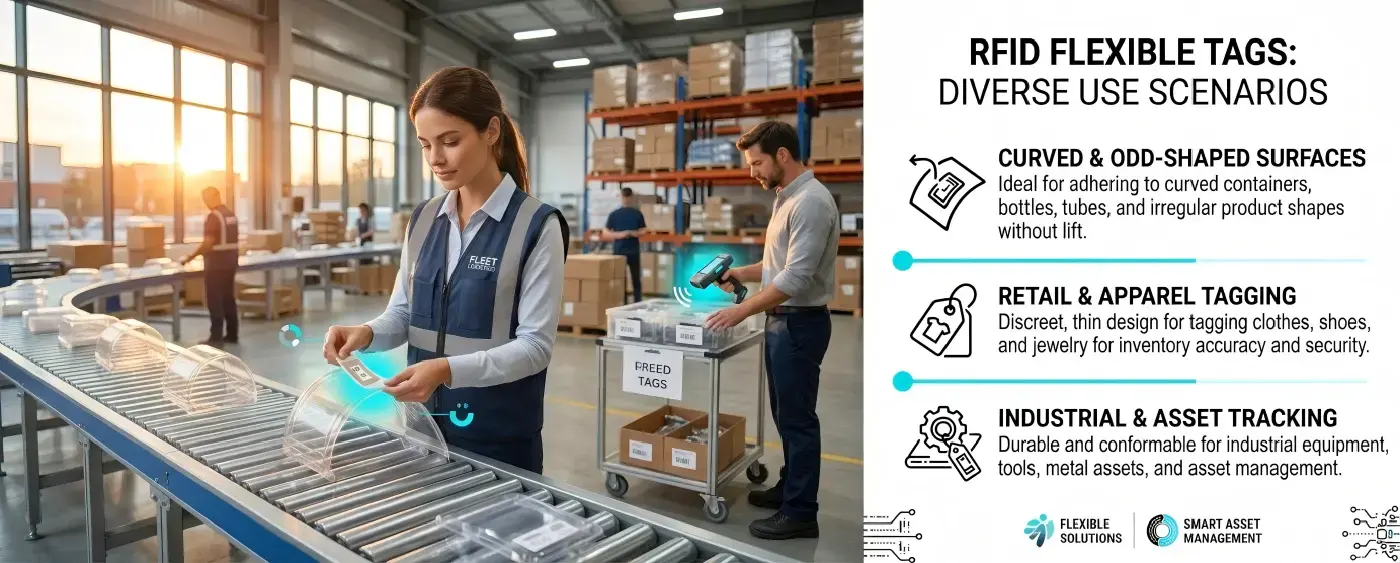
How Do RFID Flexible Tags Work?
Wireless Communication and Signal Transmission
When an RFID reader makes an electromagnetic field, the operational cycle starts. The antenna on the RFID flexible tags, which was made with a shape that makes it flexible, picks up this energy thru inductive coupling (HF) or backscatter modulation (UHF). When the chip receives energy, it changes the resistance of the antenna to change how it responds. This creates a pattern that the reader can decode. This direct exchange happens in milliseconds, which makes it possible to quickly scan hundreds of things at once, which is very different from barcode systems that need a clear line of sight for each item to be scanned.
Antenna Design for Flexibility and Durability
The performance on curved surfaces and metal environments depends on the antenna architecture. In more advanced designs, dipole patterns that meander keep their resonance even when they are bent. When used on metal barrels or chemical drums, some luxury versions come with ferrite or dielectric spacers to stop "detuning" effects. This tech makes sure that the read ranges are the same whether the tag is flat or wrapped around a cylinder with a 20 mm radius. With 15 years of experience in RF modeling, we've been able to make these designs work better, even in places like warehouses that are full of metal or laundry rooms that are full of water.
Integration with Existing Systems and Software
Middleware options make it easy for modern flexible tags to work with ERP, WMS, and MES systems. The EPC Gen2 protocol makes sure that readers from companies like Zebra, Impinj, and Alien Technology can work with each other. Tags send data directly to inventory management systems, which then send out automatic reorder or shipment confirmations. Our Field Application Engineers help with SDK integration, which makes sure that your existing software infrastructure can talk to your new hardware without any problems. Whether connecting to legacy systems or IoT platforms in the cloud, setting up the middleware correctly turns raw tag reads into business intelligence that can be used.
Benefits of Using RFID Flexible Tags in B2B Procurement
Enhanced Tracking Accuracy and Inventory Management
People make mistakes when they count goods by hand, so accuracy rates are only 60–70% of the time. This number goes up to 95–99% with RFID flexible tags technology, which scans automatically and in real time. A single reader link can record whole pallet loads as they pass thru storage doors, updating databases of inventory right away. This accuracy cuts down on stock-outs, stops overstocking, and makes it easier to predict demand. When retailers use these systems, they say the labor costs they used to spend on manual cycle counts go down by 80%. This frees up staff to do more valuable work.
Clothing brands have special problems, like having to deal with thousands of SKUs, seasonal turnover, and pressures to stop counterfeiting. Tracking items from the factory to the customer is possible with flexible tags attached to hang tags or woven labels. This makes it easier to spot gray-market goods and helps omnichannel delivery, in which shops act as distribution hubs. When a customer places an order online, staff use handheld readers to instantly find items in different locations. This means that orders are filled within hours instead of days.
Cost Advantages in Bulk Procurement
Even tho RFID flexible tags cost more per unit at first, they are cheaper to own in the long run. Barcodes need to be scanned with a clear line of sight, which slows down the process. RFID's ability to read multiple tags at once speeds up the receiving, picking, and sending processes, which saves time. Because our prices come straight from the plant, there are no markups for distributors. Customers who buy more than 500,000 units a year get per-tag prices that are about the same as premium barcode labels, but they also get business efficiencies worth many times the cost of the hardware.
Environmental durability makes tags last longer, especially on reusable transport items (RTIs). A flexible tag inside a plastic crate can withstand years of being shipped and received, but barcode labels become less useful after just a few months of being handled. RFID is better for closed-loop transportation because it can be used over and over again, spreading out costs over hundreds of uses.
Versatility Across Industries and Harsh Environments
Medical facilities put flexible tags on patients' wristbands that can withstand being sterilized and being exposed to body heat. Libraries put them in the spines of books so they can keep track of loans without marks being seen. Pharmaceutical companies put them on vials of medicines because they can withstand being frozen at -40°C. Our high-temperature versions can withstand industrial autoclaves that hit +250°C, making them good for paint shops that work on cars or tools used in aircraft.
This weather resistance comes from industrial-grade insulation that meets IP67/IP68 standards. This keeps water, dust, and chemical splashes from getting into the internal circuits. Clothing brands wash tagged clothes more than 50 times without the tags coming off. This keeps the clothes trackable thru hire uniform lifecycles or hotel linen services.
How to Choose the Right RFID Flexible Tags for Your Business
Assessing Operational Needs and Environmental Factors
Make a map of your operational environment to start. Will RFID flexible tags be exposed to high temperatures, chemicals, or being bent over and over again? Laundry-safe tags with textile-compatible glue are needed for clothing uses. In logistics settings, tags need to be able to be read on plastic crates, corrugated cartons, and maybe even metal racks. Knowing these things can help you avoid mistakes that cost a lot of money. For example, if you put a standard tag on a metal cylinder without using the right spacers, the tag might lose 70% of its read range.
The choice of frequency depends on the use case. UHF tags work best in open areas and have long read ranges, making them perfect for warehouse portals or scanning the whole inventory of a store. HF/NFC tags work well for item-level authentication at the point of sale, so customers can use their phones to check the accuracy of expensive goods. Our technology team does site studies to figure out the best way to set up the antennas and frequencies.
Balancing Performance and Budget Constraints
Premium tags that are tuned to metal or resistant to high temperatures cost more, but they keep operations from failing. A mid-range clothing brand might choose standard PET tags for hang tags (less expensive, works well) but industrial-grade PI tags for reuse shipping cases (more expensive, lasts longer). There are volume discounts—orders over 100,000 units unlock tiered price, which cuts the cost per unit by 15–25%.
You can change the size (from 10mm labels to full A4 sheets), the way it's mounted (adhesive, rivet, or embedded), and the branding that is printed. Our rapid prototyping service gives you working samples in 7 days, so you can test them in the real world before you commit to making them in large quantities. This lowers the risk of deployment and makes sure that tags work as expected in real-world settings.
Evaluating Suppliers and Avoiding Common Mistakes
With tried-and-true inlay patterns, big global providers like Avery Dennison and Smartrac control the clothing and store markets. The chips that power these tags come from companies like Impinj (Monza series), Alien Technology (Higgs), and NXP (UCODE). WS RFID puts these industry-standard chips into unique form factors, mixing antenna designs that are made to fit the chip's proven reliability.
Some common mistakes in procurement are not taking environmental challenges seriously enough (which can lead to tag failures), naming too many features (which can cause costs to rise needlessly), or not taking integration complexity into account (which can delay ROI). Get suppliers involved early on in the planning stages of the project. Our FAE team looks at different deployment scenarios, suggests the right tag specifications, and helps with pilot testing to make sure the system works well before it goes live on a large scale.
Applications of RFID Flexible Tags Across Industries
Retail and Supply Chain Management
Fashion stores put RFID flexible tags on hang tags for clothes, and they contain unique markers that are tied to data about style, size, and color. Portal readers keep inventory systems up to date instantly as things move from distribution centers to shops. Cycle counts are done by store employes walking down the aisles with handheld readers that quickly scan whole racks. This visibility lets you restock in real time, which cuts down on situations where you're out of stock, which costs you sales.
RFID-enabled exit gates set off alarms when unpaid things leave shops, which is used by anti-theft software. RFID systems mark things as purchased in the database, which updates inventory and stops theft at the same time, unlike standard EAS tags that need to be deactivated separately. Gray-market tracking keeps an eye on serialized items and lets brands know when products show up in channels that aren't approved. This is a very important feature for luxury goods that want to protect their brand identity.
Healthcare and Pharmaceutical Tracking
Hospitals give patients flexible rings with tags built in that connect to their computer health records. Before giving drugs, nurses read patients' wristbands to make sure they are who they say they are and that the dose is correct. Medication errors are a major cause of harm that can be avoided. Tags that are laundry-safe can be sterilized many times, so they can still be read during patient stays.
Using serialized tags on medicine packages, pharmaceutical supply chains stop fakes. A unique identifier is written on each vial or blister pack when it is made. Distributors and shops scan goods and check them against central records to make sure they are real. This makes sure that patients get real medicines because it meets packaging requirements set by regulations like the U.S. Drug Supply Chain Security Act.
Logistics and Warehouse Operations
Tags are put on pallets and containers at distribution centers to automate the receiving and putting away of goods. Readers on forklifts scan loads as they move, which keeps warehouse management systems up to date without having to enter data by hand. This gets rid of tracking on paper, which cuts down on mistakes and speeds up work. Cross-docking operations, in which things go straight from trucks coming in to trucks going out, gain a lot because automated scanning keeps track of the chain of custody.
Returnable transport items (RTIs), like metal racks and plastic totes, are marked with permanent labels that show where they are in the supply chain. Companies that use RTI tracking are able to get back 15 to 30 percent of "lost" goods, which saves them money on new costs. Partners are automatically billed when agreed-upon holding periods are exceeded. This improves the use of assets and accuracy in accounting.
Manufacturing and Quality Control
Plants that make cars put tags on parts that are going to be put together. This lets them keep track of work-in-progress as it moves thru the production stages. At quality checks, tags are scanned, and test results and inspector names are recorded in systems that run the production process. If problems show up after the product has been made, manufacturers track down the batches that were affected, figure out what went wrong, and separate the affected units. This ability to track helps with memory management and efforts to keep getting better.
High-temperature tags that can handle paint curing ovens and polymer autoclaves are used in aerospace equipment. Tool cribs give workers calibrated tools and use scanning tags to keep track of how they are used and set reminders for when to do the calibration. This automatic tracking makes sure that strict military quality standards are met, which stops the use of equipment that isn't within its limits.
Conclusion
Flexible RFID flexible tags technology improves the efficiency of businesses in the transportation, healthcare, industrial, and clothing industries by providing accurate, automated tracking that older systems can't match. These tags are important for modern supply lines because they can stick to different surfaces, work well in harsh conditions, and work with business tools without any problems. When purchasing teams look at these options, they should know about the regular trade-offs, the qualities of the materials, and the supplier's abilities. Successful launches start with pilot testing, which makes sure that the tags work in real-world situations before investing in them on a large scale. As chip prices level off and global standards become more stable, the hurdles to acceptance keep going down. This means that mid-market businesses that used to do things by hand can now use this technology. The operational gains—80% less work, 95% or more accurate inventory, and better brand protection—produce a measurable return on investment (ROI) within months, making initial investments worthwhile and setting up businesses for scalable growth.
FAQ
1.What is the typical lifespan of flexible RFID tags in industrial applications?
Under normal conditions, these tags function reliably for 5 to 10 years if everything goes as planned. Tags that are kept in climate-controlled warehouses last longer than tags that are kept in outdoor logistics or industrial laundries. High-temperature versions can handle thousands of sterilizer cycles, and tags that are sewn into textiles can handle 50 or more wash cycles. Our ISO 9001 production methods keep defect rates below 0.3%, which extends the life of our products.
2.Can these tags be reused or recycled?
Tags permanently attached to reused containers (RTIs, pallets, totes) last for hundreds of transit rounds, which spreads out the cost over many years. When their time is up, PET and PI substrates can be recycled thru special programs for electronics. We support sustainable procurement by providing eco-friendly tag designs that use the least amount of materials while still performing well.
3.How do costs compare to barcode labels in large deployments?
Barcodes cost between $0.01 and $0.05 per unit, while flexible tags cost between $0.10 and $0.50 per unit, based on the specs. However, RFID has a lower total cost of ownership because it saves time and money on labor. Automatic scanning gets rid of the need for manual barcode reading, which cuts cycle count labor by 80%. Clients who handle 10,000 or more deals every day usually get their money back within 6 to 12 months by making their operations run more smoothly.
Partner with WS RFID for Flexible RFID Tag Solutions
WS RFID is your one-stop shop for flexible RFID tags. We offer industrial-grade tracking options that are perfect for clothing brands, transportation companies, and healthcare facilities. Our 10,000 SQM factory makes more than 500 million tags every year, and we have ISO 9001, RoHS, and REACH certifications to back this up. We can make changes to sizes, fastening methods, and environmental requirements. Prototypes are sent out in 7 days, and production runs are finished in 10–12 days. Our Field Application Engineers help with everything, from setting the antenna to helping with the software SDK, whether they are connecting with current ERP systems or testing out new apps. Email kenny@w-srfid.com to get samples, talk about bulk prices for RFID flexible tags for sale, or find out how our 15 years of experience in RF engineering can help you improve access in your supply chain and cut costs.
References
1. Jones, Michael R., and Thompson, Laura K. RFID Technology in Supply Chain Management: Principles and Applications. Industrial Press, 2021.
2. Chen, Wei, et al. "Performance Evaluation of Flexible RFID Tags on Curved Surfaces." Journal of Radio Frequency Identification, vol. 8, no. 3, 2022, pp. 145-162.
3. Global Standards Organization. EPCglobal Gen2 UHF RFID Protocol Specification. Version 2.1, GS1, 2020.
4. Anderson, Patricia J. Textile RFID Integration: From Design to Deployment. Apparel Technology Publications, 2023.
5. Nguyen, Tuan A., and Rodriguez, Carlos M. "Cost-Benefit Analysis of RFID vs. Barcode Systems in Retail." International Journal of Logistics Management, vol. 34, no. 2, 2021, pp. 221-240.
6. European Union Agency for Industrial Safety. Environmental Durability Standards for Industrial RFID Tags. EU Technical Report 2019-847, Brussels, 2019.
Learn about our latest products and discounts through SMS or email