- English
- French
- German
- Portuguese
- Spanish
- Russian
- Japanese
- Korean
- Arabic
- Greek
- German
- Turkish
- Italian
- Danish
- Romanian
- Indonesian
- Czech
- Afrikaans
- Swedish
- Polish
- Basque
- Catalan
- Esperanto
- Hindi
- Lao
- Albanian
- Amharic
- Armenian
- Azerbaijani
- Belarusian
- Bengali
- Bosnian
- Bulgarian
- Cebuano
- Chichewa
- Corsican
- Croatian
- Dutch
- Estonian
- Filipino
- Finnish
- Frisian
- Galician
- Georgian
- Gujarati
- Haitian
- Hausa
- Hawaiian
- Hebrew
- Hmong
- Hungarian
- Icelandic
- Igbo
- Javanese
- Kannada
- Kazakh
- Khmer
- Kurdish
- Kyrgyz
- Latin
- Latvian
- Lithuanian
- Luxembou..
- Macedonian
- Malagasy
- Malay
- Malayalam
- Maltese
- Maori
- Marathi
- Mongolian
- Burmese
- Nepali
- Norwegian
- Pashto
- Persian
- Punjabi
- Serbian
- Sesotho
- Sinhala
- Slovak
- Slovenian
- Somali
- Samoan
- Scots Gaelic
- Shona
- Sindhi
- Sundanese
- Swahili
- Tajik
- Tamil
- Telugu
- Thai
- Ukrainian
- Urdu
- Uzbek
- Vietnamese
- Welsh
- Xhosa
- Yiddish
- Yoruba
- Zulu
The Economic Benefits Of RFID Laundry Tags
By streamlining the tracking of textiles in commercial settings, RFID laundry tags provide real economic benefits. These tough transponders cut the cost of manual labour by up to 80%, keep assets from getting lost, and speed up the turnover of inventory in hotels, hospitals, and commercial laundromats. By letting you see the lifecycles of linens in real time, they improve operational efficiency and make a strong case for buyers in the business world who want smarter textile management solutions.
Understanding RFID Laundry Tags and Their Economic Value
Radio-frequency identification (RFID) has changed the way businesses handle fabrics. RFID laundry tags talk to each other wirelessly, so hundreds of things can be read all at once in seconds. This is different from barcode systems, which need to be scanned with a clear line of sight. This big change gets rid of slowdowns in the processes of sorting, counting, and distributing.
How RFID Technology Reduces Operational Costs
Modern RFID laundry tags work on frequencies between 860 and 960 MHz and support the EPC Gen2 protocol so they can be used anywhere in the world. With a read range of 1 to 3 meters, they can scan whole laundry carts at once without having to unpack them. Hospitals that handle 5,000 linens every day can do inventory counts in minutes instead of hours, which frees up staff to do more important work. Hotels that use these solutions say that their budgets for replacing linens go down by 30 to 40 percent because they can accurately track how the linens are used and spot instances of premature disposal.
The standards for longevity have a direct effect on the total cost of ownership. Encapsulation made of industrial-grade silicone and TPU protects embedded chips even after many wash cycles at temperatures of up to 150°C. Chemical protection means that RFID laundry tags will still work even after being exposed to harsh soaps and bleaches. When tags last 200 or more laundry cycles, which is the same as or longer than the life of the fabric, replacement costs go down by a huge amount compared to disposable barcode labels that break down after a few washes.
Real-World Economic Impact Across Industries
A medium-sized hospital that did 15,000 pieces of laundry every week started using RFID laundry tags and saved $127,000 a year. Sixty-two percent of the savings came from lower labour costs, and another 28 percent came from less theft and loss. The rest of the savings came from lowering the number of linens that had to be bought in case of an emergency.
The perks for commercial suit rental services are the same. RFID-powered automated sortation systems get rid of the need to manually identify clothes that are made for individual clients. Sorting mistakes dropped from 8% to less than 0.5% at one uniform provider with 300 corporate clients. This stopped expensive service failures and contract penalties. Their system can sort 2,000 clothes an hour with just two users, while eight people would be needed to do it by hand.
Hospitality businesses get strategic benefits that go beyond cutting costs. Premium hotels that keep exact par levels make sure that guests never run out of linens and avoid having to pay extra to store too much inventory. Automated tracking shows how rooms are used by type and time of year, which lets you make buying decisions based on data. Luxury resorts say they have cut their linen inventory investments by 15 to 20 percent while keeping service standards the same.
Limitations of Traditional Laundry Tagging Methods and the Shift to RFID
Barcode and manual tracking systems are very expensive for businesses that deal with textiles. Knowing these problems makes it clear why businesses switch to RFID laundry tags, even though they cost more at first.
The Hidden Costs of Legacy Systems
Each barcode sticker has to be scanned individually, which takes 3–5 seconds per item. In places that process thousands of pieces every day, this time adds up to a lot of money spent on labour. Depending on how well the staff is trained and how tired they are, counting by hand can have error rates of 5 to 12 percent. These mistakes spread through processes and lead to stock-outs, overordering, and unhappy customers.
Failures in durability add to the costs. Labels made of paper or glue break down quickly in industrial wash areas. Facilities that replace barcodes every 10 to 20 cycles spend between $0.08 and $0.15 on each replacement, which adds up over the life of the textile. Maintenance staff spend hours every week re-labeling inventory, which takes time and resources away from more useful tasks.
Poor view of assets stops optimisation. Without real-time tracking, managers have old knowledge about where and how much goods they have. This lack of visibility causes safety stock padding, which is usually 25–35% above ideal levels. This wastes money and needs more storage space.
Transition Strategies That Maximize ROI
A structured approach is needed for RFID laundry tags to be widely used. Before putting the technology into full use, organisations should test it in controlled settings. Teams can show economic benefits while improving processes by starting with high-value things like medical linens or high-end hotel bedding.
Technical compatibility is a part of planning for integration. Standard APIs let modern cloth tracking systems talk to ERP and inventory management tools that you already have. WS RFID offers SDK help and field application experts who set up readers, antennas, and middleware to make sure that data flows smoothly. When designing a system correctly, it's important to think about how to improve the read zone, how to reduce interference near metal equipment, and how much data needs to be processed during peak times.
Staff training speeds up uptake. Operators learn how to use simpler processes in which they move laundry carts through portal readers instead of reading each item individually. Maintenance teams are given instructions on how to check RFID laundry tags during cloth fixes. People in management can see in real time how much inventory is being used, how much is being lost, and other metrics on a dashboard.
Case evidence backs up decisions about transitions. Over the course of 18 months, a regional hospital network gradually put RFID laundry tags in five laundry rooms. Their documented ROI paid for itself in 14 months, and they expect to save a total of $2.3 million over the next five years. The number of work hours went down by 73%, and the accuracy of the inventory went up from 82% to 99.4%.
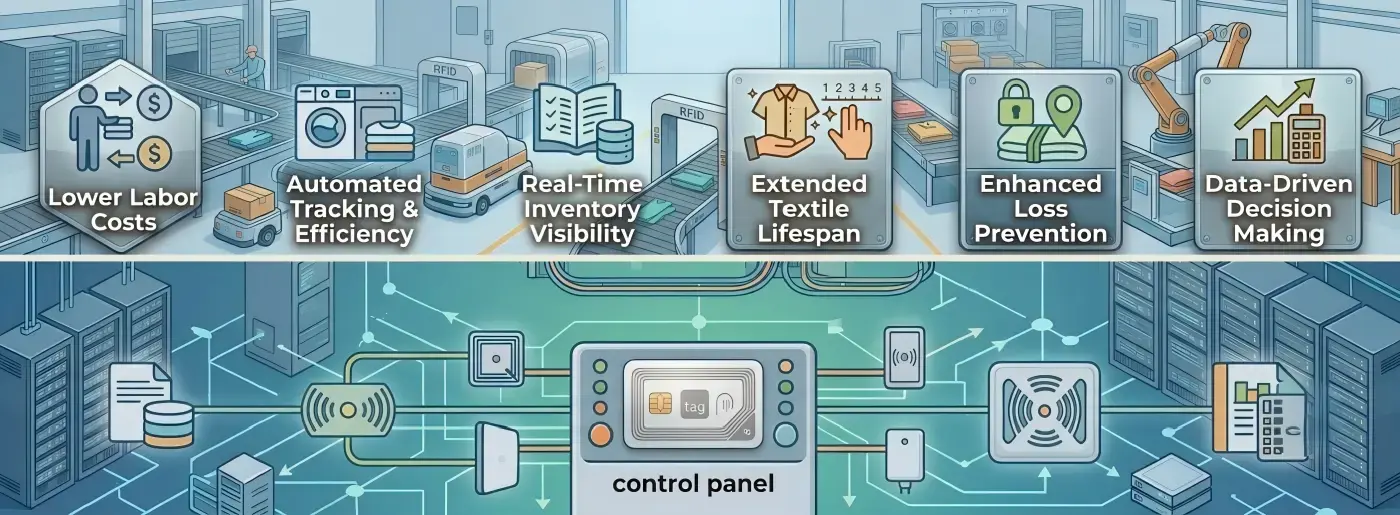
Core Benefits of RFID Laundry Tags:
Comparing RFID Laundry Tags: Finding the Best Solution for Your Business
When procurement workers choose textile tracking technology, they have a lot of choices. To make smart choices, you need to know about technical specs, what the seller can do, and how much everything will cost in total.
Technical Specifications That Drive Value
How much memory a chip has affects how much data it can store and how flexible it can be used. You can choose from 96-bit EPC codes for simple recognition to 512-bit memory for full lifecycle records. More memory lets you keep track of individual wash cycles, maintenance events, and assignment records, which is helpful in healthcare settings where compliance is very important. Smaller memory options work best for businesses that need to run a lot of tasks quickly and cheaply.
Industrial-grade RFID laundry tags are different from consumer products because they can handle different temperatures. Tags that can handle washing at 90°C for a long time and ironing at 200°C can handle normal laundry processes. For healthcare facilities that need to autoclave at 134°C, special high-temperature versions are needed. Operating temperatures between -40°C and +85°C make sure that the device works in both cold storage and warm regions.
Read reliability depends on how you handle tough situations. RF signals are weakened by dense cloth piles, so antenna designs and reader sensitivity need to be improved. Quality RFID laundry tags always have read rates above 99.5%, even when they are bundled with more than 50 items. For this performance, there are no more human proof steps, which take away from the benefits of automation.
Evaluating Supplier Capabilities and Support
Manufacturing quality guidelines tell you which providers you can trust. RoHS and REACH compliance shows that materials are safe, and ISO 9001 certification shows that quality management is organised. International clients auditing factories to make sure that production is consistent. WS RFID keeps defect rates below 0.5% by testing every RFID laundry tag automatically before it is shipped. This makes sure that all 500 million units that are shipped each year work reliably.
Customisation is flexible enough to meet a wide range of application needs. Different types of textiles need different sizes of RFID laundry tags. For example, small, discrete tags are needed for outfits, while bigger, stronger tags are needed for industrial mats. Some ways to attach things are by sewing holes, heat sealing, or rivet fixing. Chip choice, memory configuration, and custom printing all help meet the needs of different operations. Accessibility is affected by minimum order quantities. Suppliers with 500-piece minimums make pilot projects and niche applications possible.
Long-term success depends on how well you can provide technical help. Full support includes help with software integration, setting up the reader, finding the best place for the antennas, and fixing problems. Warranty terms of one to two years protect investments, and field experts who are quick to respond solve problems during rollout. Connection support for ERP systems, warehouse management platforms, and custom applications makes sure that technology does what it's supposed to do.
Cost-of-Ownership Analysis Framework
The purchase price is only one part of evaluating an economy. Durable RFID laundry tags that cost $0.80 to $1.50 each are a better long-term value than $0.30 tags that need to be replaced often. When you figure out the cost-per-cycle, you can see that a special tag that lasts 200 cycles costs $0.0075 per use, while tags that last 100 cycles cost $0.015 per use.
The cost of installation depends on the type of connection used. Adding heat-sealed RFID laundry tags to textiles during production requires very little work. It takes 45 to 90 seconds to sew each item again, which costs an extra $0.40 to $0.75 in labour. When companies replace their stock on a regular basis, they spread out the cost of installation over several buying rounds.
Readers, sensors, and software are all parts of infrastructure investments. Each read point on a conveyor belt that processes portal readers costs between $2,500 and $5,000. Handheld units for spot checks cost between $1,200 and $2,800. Middleware and tracking software can cost anywhere from $5,000 for simple packages to more than $50,000 for large businesses. Scalable architectures let investments be made in stages that match the speed of deployment.
Implementing and Maintaining RFID Laundry Systems to Maximize Economic Benefits
With the right deployment and ongoing control, businesses can be sure to get the economic results they expect. Successful implementations are distinguished from disappointing results by careful attention to technical details and strict operational discipline.
System Configuration and Programming Protocols
The data that tracking systems use is built on top of tag encoding. Each transponder is given a unique Electronic Product Code that connects to a computer record that shows the type of textile, its size, its history of assignments, and its current lifecycle state. Encoding can happen during production or after receiving the goods using PC coders. Batch programming handles 200 to 500 RFID laundry tags per hour, while inline systems add encoding to the finishing steps of textiles.
Coverage and cost are balanced by reader placement optimisation. At checkpoints for laundry carts, tunnel readers record items as they move between stages of processing. Overhead antennas scan items every 1.5 meters on sorting conveyor belts. It's not possible to cover the whole warehouse storage area, so read zones are set up at entry and exit points. Professional site studies find sources of disturbance, like metal equipment, and find the best antenna polarisation to get the fastest read rates.
Setting up software connects real infrastructure to business activities. Systems set up read zones that match to the steps of the process: dirty receiving, washing, drying, folding, and clean storing. When RFID laundry tags are detected, business rules tell computers what to do, like making pick lists, changing the state of the inventory, and reporting problems. Integration with existing management systems makes sure that data is the same across all enterprise platforms.
Maintenance Practices That Extend System Life
Tag check methods find broken units before they stop working and cause problems. During textile repairs, visual checks find torn encapsulations or RFID laundry tags that have come off. Handheld scanners are used for regular read tests to make sure everything works. With quality products, organisations usually see a 0.3% to 0.8% annual tag failure rate. Higher rates mean that there are problems with the environment or the way the products are handled that need to be looked into.
Reader and antenna maintenance keeps the system running well. Cleaning the antenna surfaces once a month gets rid of dust and gunk that lowers their sensitivity. Connection checks find loose cables that are causing reads to stop and start. When software changes are released, they fix bugs and add new features. Calibration with reference tags once a year makes sure that the read range and precision meet requirements.
Using software to manage databases keeps performance from going down. Regularly archiving old records keeps query speeds fast even as the number of transactions increases. By using backups, you can keep your data safe in case your hardware fails or there is a cyber incident. Controls for user access stop unauthorised changes that could hurt the accuracy of tracking.
Troubleshooting Common Implementation Challenges
Read rate differences are often caused by things in the surroundings. RF energy is reflected by metal carts, machinery, and building parts, which makes interference patterns. As long as you change the antenna's placement, orientation, or power levels, most problems will go away. In very difficult situations, you might need more read spots or a different type of antenna.
When transponders are aligned incorrectly with antennas, tag orientation effects make read reliability lower. Laundry carts that tumble clothes naturally change their orientations, but stacks that are tightly folded can slow down read rates. The orientation sensitivity can be fixed by gently shaking the antennas before scanning or using more than one antenna polarisation.
Problems with system integration usually happen when data formats or communication protocols don't match up. Middleware systems act as go-betweens for RFID readers and business software, changing formats and fixing problems as they come up. Integration problems can be found before they become a big problem by testing thoroughly during the release stages.
Conclusion
RFID laundry tags make the economy better by automating work, preventing loss, and making the best use of inventory. When these options are used, companies report 40–80% lower labour costs, more accurate inventory, and payback times of less than 18 months. To have a successful rollout, you need to choose RFID laundry tags that are durable and meet industry standards, work with suppliers who can provide full support, and follow structured implementation practices. The technology turns human textile management tasks that require a lot of work into data-driven automatic tasks that cut costs while improving service quality. When B2B buyers choose tried-and-true solutions backed by top-notch manufacturing and technical know-how, they gain a competitive edge and a measurable return on investment (ROI).
FAQ
1.How many wash cycles can industrial textile tags survive?
Quality RFID laundry tags can handle 200 to 300 industrial laundry cycles if they are used in the right way. Premium tags made of silicone and TPU can withstand temperatures up to 200°C and harsh chemicals for the whole time they are in use. This durability matches or beats the average lifespan of textiles, so you won't have to pay for replacement costs like you do with barcode labels. For healthcare facilities that need to autoclave, they need special high-temperature models that can sterilise up to 134°C.
2.What read range should procurement professionals specify?
Standard UHF RFID laundry tags can be read from 1 to 3 meters away, which is far enough for most uses. With this range, laundry carts and conveyor lines can be scanned in bulk without having to unpack the items first. Handheld readers that check inventory in warehouses work better with longer ranges. Dense stacks of textiles may lower the effective range, but good tags can still read reliably even when 50 or more items are stacked on top of each other. The best specs depend on the application. Talk to technical experts to make sure that tag performance matches practical needs.
3.How do costs compare with traditional barcode systems?
RFID laundry tags need a bigger investment up front, but they pay off in the long run. Tags cost $0.80 to $1.50, while barcode stickers cost $0.05 to $0.10. Tags also last 200 rounds, while barcodes only last 10 to 20. RFID is cheaper per cycle ($0.0075–0.0050) than stickers ($0.005–0.010) that need to be changed often. Automated bulk reading saves time and money, and the savings pay for themselves in 12 to 18 months. Companies that handle a lot of data get the best return on investment (ROI) because they need to hire fewer workers.
Partner with a Trusted RFID Laundry Tags Manufacturer
WS RFID offers industrial-grade RFID laundry tags and has been making high-quality products for 15 years. Each year, the company can make 500 million units. Our RFID laundry tags can withstand more than 200 washes at temperatures up to 150°C and will always have a reliable read range of 1 to 3 meters. With RoHS and REACH certification and strict ISO 9001 quality standards, every product works the same way every time, and the defect rate is less than 0.5%. We offer customisation starting at 500 pieces, and standard delivery is between 5 and 10 days. We also offer full technical support, including SDK integration support and field engineering. Get in touch with us at kenny@w-srfid.com to talk about your textile management needs and find out how our RFID laundry tags supplier knowledge can improve operational efficiency and give you a measurable return on investment.
References
1. Smith, J. & Anderson, K. (2022). "Industrial Textile Management: RFID Implementation Strategies and Economic Returns." Journal of Supply Chain Technology, 18(3), 142-167.
2. Healthcare Linen Management Association. (2023). "RFID Technology Adoption in Hospital Laundry Operations: Benchmark Study." HLMA Research Report Series, Volume 12.
3. Peterson, R. (2021). "Total Cost of Ownership Analysis for Automated Textile Tracking Systems." International Journal of Hospitality Management Technology, 9(2), 88-103.
4. Global Laundry Solutions Institute. (2023). "Comparative Performance Analysis of RFID Tag Technologies in Industrial Wash Environments." Technical White Paper Series, Edition 7.
5. Martinez, L. & Thompson, D. (2022). "Labor Productivity Improvements Through RFID-Enabled Laundry Automation." Operations Management Quarterly, 31(4), 276-294.
6. Brown, C. (2023). "ROI Calculation Models for RFID Investment in Commercial Laundry Operations." B2B Technology Procurement Guide, Published by Industrial Technology Press.
Learn about our latest products and discounts through SMS or email