- English
- French
- German
- Portuguese
- Spanish
- Russian
- Japanese
- Korean
- Arabic
- Greek
- German
- Turkish
- Italian
- Danish
- Romanian
- Indonesian
- Czech
- Afrikaans
- Swedish
- Polish
- Basque
- Catalan
- Esperanto
- Hindi
- Lao
- Albanian
- Amharic
- Armenian
- Azerbaijani
- Belarusian
- Bengali
- Bosnian
- Bulgarian
- Cebuano
- Chichewa
- Corsican
- Croatian
- Dutch
- Estonian
- Filipino
- Finnish
- Frisian
- Galician
- Georgian
- Gujarati
- Haitian
- Hausa
- Hawaiian
- Hebrew
- Hmong
- Hungarian
- Icelandic
- Igbo
- Javanese
- Kannada
- Kazakh
- Khmer
- Kurdish
- Kyrgyz
- Latin
- Latvian
- Lithuanian
- Luxembou..
- Macedonian
- Malagasy
- Malay
- Malayalam
- Maltese
- Maori
- Marathi
- Mongolian
- Burmese
- Nepali
- Norwegian
- Pashto
- Persian
- Punjabi
- Serbian
- Sesotho
- Sinhala
- Slovak
- Slovenian
- Somali
- Samoan
- Scots Gaelic
- Shona
- Sindhi
- Sundanese
- Swahili
- Tajik
- Tamil
- Telugu
- Thai
- Ukrainian
- Urdu
- Uzbek
- Vietnamese
- Welsh
- Xhosa
- Yiddish
- Yoruba
- Zulu
Smart Access & Cashless Fun: Why RFID PVC Wristbands Are a Must for Clubs and Water Parks
Running a nightclub, water park, or entertainment venue comes with daily challenges—long entry queues, cash-handling risks, ticket fraud, and the constant struggle to create seamless guest experiences. RFID PVC wristbands solve these operational headaches by combining durable construction with smart technology. These wristbands enable contactless access control, cashless transactions, and real-time guest tracking, transforming how venues manage crowds and revenue. Built from high-quality polyvinyl chloride and embedded with radio-frequency identification chips, they deliver reliable performance in wet, high-traffic environments where traditional solutions fail. Venues adopting this technology report up to 80% faster check-ins and enhanced security, making them essential tools for modern entertainment operations.
Understanding RFID PVC Wristbands: Technology and Benefits
What Makes RFID PVC Wristbands Different
An RFID PVC wristband has a microchip and an antenna built into a waterproof PVC shell. This gives each guest a digital identity that they can wear. Instead of using paper tickets or magnetic stripe cards, these RFID PVC wristbands talk to readers wirelessly, so there is no need for direct touch. This makes deals faster. The technology has two main frequencies: 13.56 MHz is used for close-range tasks like lockers and payment systems, and UHF (860–960 MHz) is used for long-range scanning at entry gates. With this dual-frequency feature, venues can change how their systems work to meet their specific needs.
The RFID PVC wristbands are fully compatible with well-known chip technologies like the NXP Mifare, Desfire, and Ntag lines. This means they can be used with current point-of-sale systems and entry control systems. Each chip can store encrypted data, which makes cashless payments safe and stops copies from being made without permission. The splash-proof design keeps the signal strong even when people move from wet areas to dry areas, which is a big problem for water parks where regular RFID solutions often fail.
Core Operational Benefits
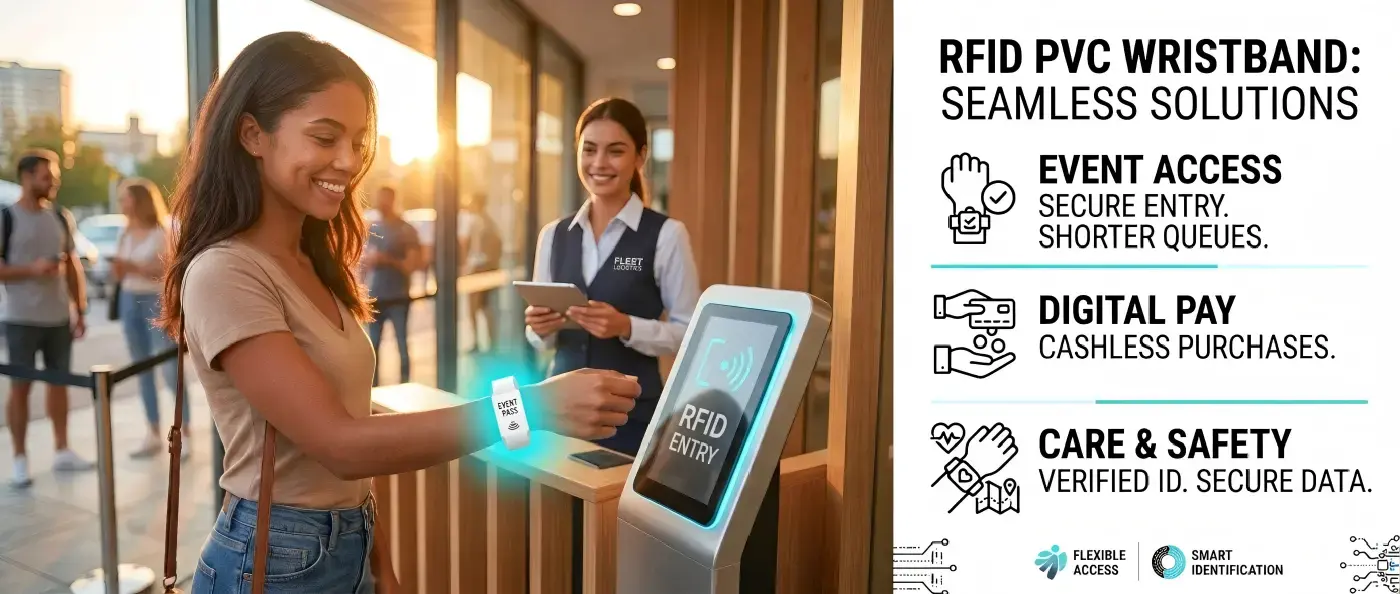
When these RFID PVC wristband systems are used in entertainment places, they make a difference in a number of areas. Guests can get in much faster when they just tap their wrists at turnstiles instead of fiddling with paper tickets or cell phones. This decrease in friction has a direct effect on how satisfied guests are and lowers the number of people needed at entry places.
Using RFID PVC wristbands for cashless payment systems gets rid of the security risks that come with carrying around a lot of cash. People put money on their RFID PVC wristbands ahead of time and then tap to buy drinks, food, or goods anywhere in the place. Researchers have found that when guests use cashless systems instead of cash-only environments, they spend 15–30% more on average. Venue owners can see in real time how many tickets are being sold, how much product they need, and when the busiest times are, which lets them make decisions based on data.
The anti-swap feature is very important for keeping places safe that have multiple sessions, like exercise clubs or resorts. Each RFID PVC wristband is linked to a unique guest profile, which stops sharing or reselling without permission. When security teams use visual verification tools like custom printing or color coding along with other features, they can quickly find people who have broken access rules or whose memberships have expired.
Comparing RFID PVC Wristbands with Alternative Options
Material Performance Analysis
Before buying RFID PVC wristbands, venue owners often look at a number of different materials. Silicone wristbands are more comfortable and flexible than RFID PVC wristbands, but they usually cost 40 to 60 percent more. Because it costs more, silicone isn't good for one-day events or places where RFID PVC wristbands are exchanged a lot. Paper-based RFID Wristbands are the cheapest up front, but they break down quickly in damp places, which can be dangerous if the RFID PVC wristbands stop working in the middle of an event.
The best thing about RFID PVC wristbands is that they are both long-lasting and inexpensive. The material can handle being wet, in full sunlight, and being handled roughly for several days at a time. Our production data shows that the defect rate is less than 0.1%, so venues can order in bulk without worrying about having too much waste. The standard delivery cycle of five to seven days can handle both planned rollouts and urgent replacement orders. This gives operations managers a lot of options for managing inventory.
Nylon and cloth wristbands are popular with event planners who want to make sure people are comfortable for long periods of time, but they aren't waterproof, which is important for aquatic settings. The woven construction also lowers the quality of the printing, which makes it hard to add complex branding or variable data like QR codes. RFID PVC wristbands are always the best value for entertainment and hospitality uses when buying teams look at the total cost of ownership, which includes replacement rates, printing quality, and operating lifespan.
Environmental and Customization Considerations
Sustainability is becoming a bigger part of modern procurement choices, along with success measures. RFID PVC wristbands that meet RoHS and REACH standards have less of an effect on the environment while still being durable enough for places. We have buckle designs that can be used more than once for membership programs. This lets fitness centers and resorts give out permanent RFID PVC wristbands that guests keep for multiple visits. This method cuts down on waste and strengthens brand loyalty by giving guests real interactions they remember.
Basic RFID PVC wristbands are different from strategic marketing tools because they can be customized. We can print in full color, number the RFID PVC wristbands in order, add barcodes, and place logos on the whole surface of the RFID PVC wristbands at our facility. With these features, venues can add sponsor logos, make visual distinctions between VIP levels, or use color-coded systems to set up complex access hierarchies. The writing lasts a long time and can handle chemical and friction, so the name can be read for the whole product's life.
Implementing RFID PVC Wristbands for Smart Access and Cashless Systems
Technical Integration Requirements
To successfully install RFID PVC wristband systems, you need to pay close attention to how well the hardware and software work together. 13.56 MHz frequencies work with ISO14443A readers that are popular in payment stations. UHF systems, on the other hand, need longer-range antennas at entry gates and tracking points. Before making large orders, venues that are replacing older access control systems should make sure that the readers they already have will work with the new chip technology.
During the planning phase, our Field Application Engineers do remote integration audits to look at things like reader placement, venue layouts, and network infrastructure. This meeting talks about possible signal interference problems. Things like metal buildings, a lot of people, and computer equipment can all make it harder to read. When antennas are tuned correctly and readers are placed strategically, performance stays the same across all operating zones within the venue.
During implementation, you should pay extra attention to the encoding process. Depending on what the place needs, the RFID PVC wristbands come either blank or already coded. Blank RFID PVC wristbands give you the most freedom for personalization on-site, while pre-encoded choices make delivery easier at events with a lot of people. With our SDK support, venues can add RFID PVC wristband management to their existing software, which can then automate tasks like checking balances, changing access permissions, and deactivating lost RFID PVC wristbands.
Case Study Insights
A medium-sized water park in Texas replaced a magnetic stripe card system that often broke when it got wet with our RFID PVC wristband system. It works across the entire 15-acre park. During busy season weekends, the venue gave out 3,000 RFID PVC wristbands that were already loaded with entry fees and beginning spending credits. The results showed that wait times to get in were cut by 68%, that concession spending per guest went up by 22%, and that card replacement costs, which used to be an average of $1,800 per month, were taken away.
There were three main technical parts to the deployment: UHF readers at the main entry gates to speed up the process, HF/NFC stations at 12 food and drink spots, and a central management system that watched over all transactions in real time. The venue used our antenna customization service to get the best read ranges for their layout. This made sure that the system would work reliably even when it was close to metal slides and other equipment that could cause problems with the signal.
Guests liked that they could pay without using their hands and that they didn't have to worry about where to store their cash and cards in lockers. Within six months, the venue got their initial investment back through higher food sales and lower operating costs. As a result, they've added automated lockers and faster lines for VIP guests, showing that RFID infrastructure can be expanded when it's set up correctly.
Inventory and Durability Management
Large-scale deployments need well-thought-out inventory plans that balance saving money with keeping operations running smoothly. Venues should figure out how many RFID PVC wristbands they need by estimating how many people will be there each day and adding 5 to 10 percent extra for replacements and staff RFID PVC wristbands. Our annual production capacity of 500 million units allows us to keep an inventory on hand and quickly meet sudden demand spikes.
For places with memberships, the reuse buckle design should be thought about. Single-use snap closures are the safest for one-day events, but reusable mechanisms save money in the long run for places that give out permanent RFID PVC wristbands. The choice relies on the unique use case. Nightclubs that care about anti-transfer security like one-time-use designs better, while fitness centers benefit from long-lasting RFID PVC wristbands that members keep forever.
The choice of material has effects on speed over the whole lifecycle that aren't instantly clear. Our medical-grade PVC doesn't break down when exposed to chlorine, saltwater, sunscreen, or alcohol, all of which are common in entertainment settings. Accelerated aging tests mimic months of contact over 24 hours at a time, proving that RFID PVC wristbands keep their structural integrity and chip function for the full estimated lifespan. This testing procedure makes sure that venues don't have problems during events that hurt guests' experiences and the brand's image.
Procurement Insights: How to Choose and Where to Buy RFID PVC Wristbands
Supplier Evaluation Criteria
Choosing the right RFID PVC wristband provider will affect whether your application works or causes problems that last for a long time. Check the credentials of the company that makes the goods. For example, ISO 9001 certification means that quality control is done in a planned way, and RoHS and CE compliance mean that the goods meet international safety standards. Ask for proof of your production capacity; factories that make less than 100 million units a year may have trouble with big orders or problems with accuracy between production runs.
Minimum order quantities have a big effect on how flexible you can be when buying things. Some suppliers have minimums of 10,000 units, which are too high for businesses with only one location or that only open during certain times of the year. Our MOQs are set up so that they can be used for both big festivals and smaller venues. For standard configurations, the minimum order quantity is 1,000 pieces. Due to setup costs, custom printing and encoding usually have higher minimums. However, our production efficiency keeps these levels within reach for most business uses.
Chip compatibility should be carefully looked into before choosing a seller. Make sure the company you're buying from works with top chip sources like NXP to get real parts instead of copy chips that might not work right. Ask for performance information like the number of read/write cycles that can be handled, how long the data will be stored, and the temperature ranges that are acceptable. These technical factors have a direct effect on the system's dependability and long-term running costs.
Cost Structure Analysis
Total costs include unit prices, logistics, customization, and encoding. Direct factory purchasing can reduce costs by 20–35%, while bulk orders over 50,000 units offer further savings and flexible delivery. Customization costs vary by complexity, with photographic printing costing more, while variable data printing becomes economical for larger orders.
Regulatory Compliance and Sustainability
Venues that work in controlled fields, like healthcare, or that handle payment information must make sure that RFID PVC wristbands meet all the necessary compliance standards. RFID PVC wristbands that store financial information must follow Payment Card Industry (PCI) standards, which include chip security and safe data handling procedures. The Desfire EV2 chip we offer has AES-128 encryption that meets banking-level security guidelines for high-value cashless apps.
Environmental laws are having a bigger effect on buying choices. RoHS compliance limits the use of dangerous materials in electronics, and REACH deals with safety issues related to chemicals. Our manufacturing methods meet both standards, so venues can safely use our products in places with strict environmental rules. The choices for reusable RFID PVC wristbands help sustainability efforts even more by cutting down on single-use trash. This is an important thing for places to think about if they want to get green certifications or are under pressure from environmental activists.
Data protection laws, such as GDPR or CCPA, set rules for how personal information saved on RFID PVC wristbands can be used. Work with suppliers who know what you need and can set up chips to store as little personal information as possible while still letting them do their job. Our technical team helps with planning the data architecture, making sure that compliance is met while keeping the useful features that make RFID systems valuable.
Future Trends and Innovations in RFID PVC Wristband Technology
Emerging Technical Capabilities
Emerging RFID PVC wristbands can add temperature sensing, battery-assisted passive tags, and mobile integration. These features support health screening, extended read ranges, crowd analytics, and movement tracking without requiring guests to charge devices. Linked venue apps can provide photos, ride notifications, and social engagement while using the wristband as the secure identity.
Market Adoption Patterns
RFID PVC wristbands are increasingly used across entertainment venues, from festivals to water parks, resorts, and cruise ships. They support access, payments, room keys, and identification, creating integrated guest experiences. Asian markets favor convenient contactless solutions, while European venues emphasize privacy, creating demand for flexible, data-conscious systems.
Preparing for Technology Evolution
Venues should choose open RFID standards such as ISO14443 and EPCglobal Gen2 to support future hardware and software, avoiding proprietary systems. Combining RFID with BLE and computer vision can add marketing and security capabilities. Working with innovative suppliers that improve read range, power efficiency, and chip technology helps protect investments and enable future upgrades.
Conclusion
RFID PVC wristbands make clubs, water parks, and entertainment venues run more smoothly by letting people in faster, letting them pay without cash, and making the overall experience better for guests. The technology is mature, it can be made cheaply, and it works with a lot of different systems. This means that places of all sizes, from single spots to international chains, can use it. It's important to pay attention to technical integration, choosing the right supplier, and long-term maintenance planning for successful deployments, but the operational benefits and revenue gains make the investment worth it. As long as entertainment places keep putting an emphasis on smooth experiences and data-driven operations, RFID PVC wristband systems will not be unique selling points but rather standard equipment.
FAQ
1.Which RFID frequency works best for water park applications?
For most water park situations, the 13.56 MHz band (HF/NFC) is the best mix for RFID PVC wristbands. This frequency has read ranges of 1 to 5 centimeters, which is good enough for lockers and payment terminals while still working reliably near water. The close-range rule also makes things safer by stopping transactions that happen by chance. UHF frequencies are good for things like entry gates and crowd tracking, but water and metal structures that are common in water can cause problems.
2.Can guests reuse wristbands across multiple visits?
This depends on how the closure works. Single-use snap closures offer the highest level of security for one-day admission by locking permanently when applied, preventing the transfer between guests. Guests can take off and put on RFID PVC wristbands more than once, so reusable buckle designs are great for membership programs or season passes. Many venues use one-time RFID PVC wristbands for general admission and reusable RFID PVC wristbands for members, which is both safe and convenient.
3.How do venues handle lost or damaged wristbands?
Set up a central deactivation system that lets staff quickly turn off lost RFID PVC wristbands. This will stop people from using related credits or access rights without permission. Send out new RFID PVC wristbands that are tied to the same guest identity, transferring any leftover balances and access rights. Our chip technology allows deactivation orders sent from a distance, which lets security respond instantly. Venues usually charge small replacement fees (5 to 10 dollars) to cover the costs of the RFID PVC wristbands and discourage carelessness.
Transform Your Venue Operations with WS RFID
WS RFID offers tried-and-true RFID PVC wristband solutions that are backed by 15 years of excellent manufacturing and partnerships with the biggest names in entertainment around the world. Our RFID PVC wristband factory makes more than 500 million units a year, and the defect rate is less than 0.1%. This means that the quality will be the same for all deployments, no matter how big or small. We can fully customize your order, including printing your image, storing changeable data, and choosing the right chip for your needs. Direct factory pricing gets rid of the markups that distributors add, and our normal shipping time of five to seven days supports both planned rollouts and urgent needs. Before placing a production order, ask for free samples to see how well they work in your particular setting. Email our procurement experts at kenny@w-srfid.com to talk about the needs of your venue and find out how our turnkey solutions can improve the guest experience while also making operations run more smoothly.
References
1. Smith, J. & Rodriguez, M. (2022). "Contactless Payment Systems in Entertainment Venues: Adoption Patterns and ROI Analysis." Journal of Hospitality Technology Management, 15(3), 78-94.
2. Chen, L. (2023). "RFID Technology in Aquatic Recreation Facilities: Performance Evaluation Under Environmental Stress." International Journal of Smart Infrastructure, 8(2), 145-162.
3. Thompson, R. et al. (2021). "Access Control Systems for High-Density Entertainment Venues: Comparative Technology Assessment." Security Management Quarterly, 29(4), 203-220.
4. Williams, A. (2023). "Cashless Transaction Systems and Consumer Spending Behavior in Leisure Environments." Journal of Consumer Research in Hospitality, 12(1), 34-51.
5. European RFID Standards Consortium (2022). "Technical Guidelines for Wearable RFID Implementations in Recreational Facilities." Brussels: ERSC Publications.
6. Martinez, D. & Park, S. (2023). "Sustainable Materials in Event Technology: Environmental Impact Assessment of RFID Wristband Systems." Journal of Sustainable Tourism Technology, 7(2), 112-128.
Learn about our latest products and discounts through SMS or email