- English
- French
- German
- Portuguese
- Spanish
- Russian
- Japanese
- Korean
- Arabic
- Greek
- German
- Turkish
- Italian
- Danish
- Romanian
- Indonesian
- Czech
- Afrikaans
- Swedish
- Polish
- Basque
- Catalan
- Esperanto
- Hindi
- Lao
- Albanian
- Amharic
- Armenian
- Azerbaijani
- Belarusian
- Bengali
- Bosnian
- Bulgarian
- Cebuano
- Chichewa
- Corsican
- Croatian
- Dutch
- Estonian
- Filipino
- Finnish
- Frisian
- Galician
- Georgian
- Gujarati
- Haitian
- Hausa
- Hawaiian
- Hebrew
- Hmong
- Hungarian
- Icelandic
- Igbo
- Javanese
- Kannada
- Kazakh
- Khmer
- Kurdish
- Kyrgyz
- Latin
- Latvian
- Lithuanian
- Luxembou..
- Macedonian
- Malagasy
- Malay
- Malayalam
- Maltese
- Maori
- Marathi
- Mongolian
- Burmese
- Nepali
- Norwegian
- Pashto
- Persian
- Punjabi
- Serbian
- Sesotho
- Sinhala
- Slovak
- Slovenian
- Somali
- Samoan
- Scots Gaelic
- Shona
- Sindhi
- Sundanese
- Swahili
- Tajik
- Tamil
- Telugu
- Thai
- Ukrainian
- Urdu
- Uzbek
- Vietnamese
- Welsh
- Xhosa
- Yiddish
- Yoruba
- Zulu
RFID Hard Tags: Durable RFID Solutions for Industrial Use
When you're managing high-value equipment in oil refineries, tracking returnable containers across mining operations, or monitoring tools in railway maintenance yards, standard barcode labels simply fail. RFID hard tags solve this problem by providing rugged, long-lasting identification solutions that withstand the mechanical shocks, extreme temperatures, and corrosive environments typical of heavy industrial settings. These specialized transponders—encased in engineering-grade polymers like ABS or polycarbonate—deliver reliable asset visibility for 10+ years, even when mounted on metal surfaces or submerged in harsh chemicals. Unlike flexible labels that peel or tear, industrial RFID hard tags maintain consistent read performance across demanding operational conditions, enabling automated tracking that cuts labor costs by up to 80% while ensuring seamless integration with MES, ERP, and WMS platforms.
Understanding RFID Hard Tags: Technology and Benefits
What Are Industrial RFID Hard Tags?
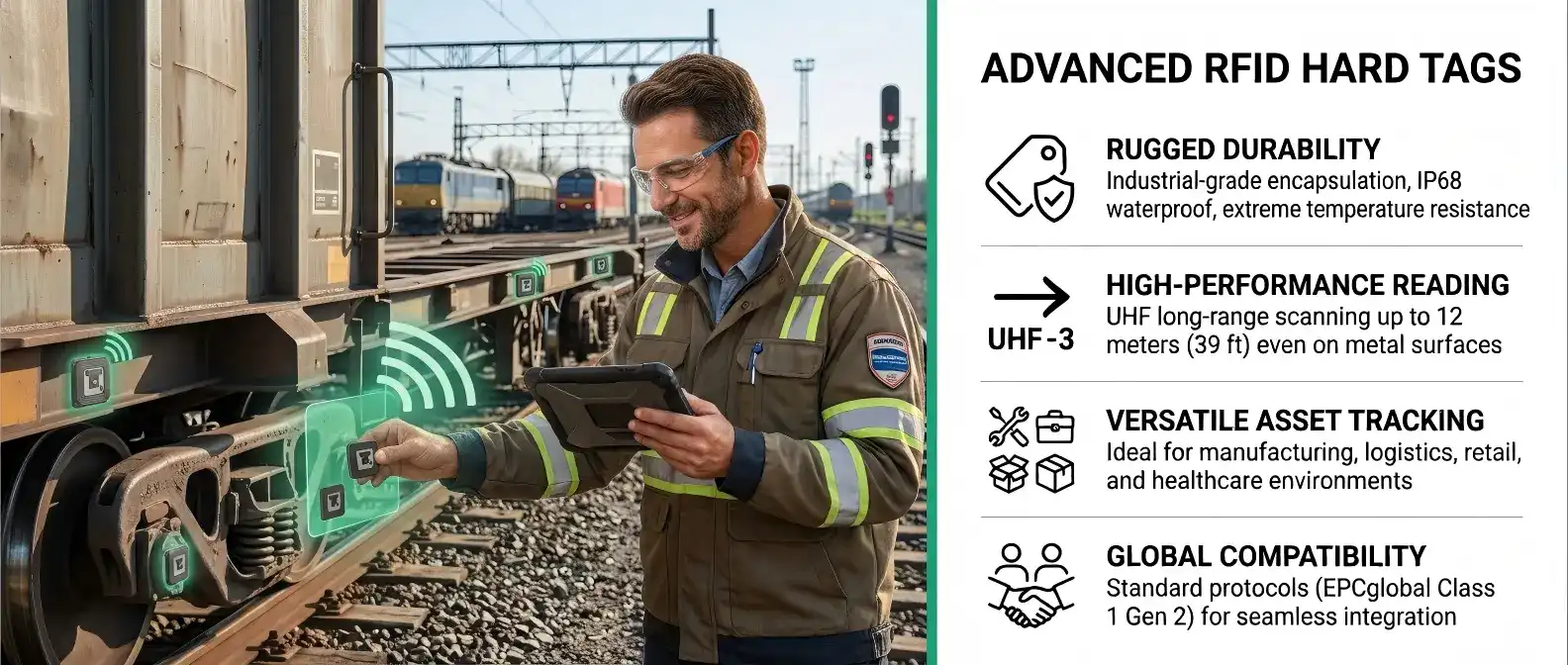
Industrial RFID hard tags are special transponders that are made to keep the chips and antennas inside safe from things in the environment that would damage regular labels. Most of the time, these devices' housings are made of impact-resistant materials like ABS, PC, or PPS, and they are rigid. They are designed for long-term asset lifecycle management. The main benefit is that they can keep data security and RF performance even when they are physically abused, exposed to chemicals, or heated to high temperatures. Instead of paper or flexible tags, these strong options fix important problems like tags not working in wet places, signal interference when used on metal equipment, and damage from vibration or abrasion. At WS RFID, our engineering team makes each tag to meet these needs by choosing the right material and setting the antennas in the most advanced ways. This makes sure that the tags work reliably in fields like mining, oil and gas, power generation, and heavy equipment hire.
How UHF Technology Powers Asset Tracking
Most commercial tracking uses UHF (Ultra-High Frequency) technology that works at 860-960 MHz and is compatible with the EPC Gen2 (ISO 18000-6C) standard. This frequency band can read from 1 to 8 meters away, or up to 15 meters with the right antenna designs. This makes it perfect for automated inventory gates, overhead crane readers, and mobile pocket scanners. UHF passive tags get their power from the radio waves of the reader, so they don't need to be charged and can be used for years. The technology works great for batch reading, which means scanning hundreds of tagged items at once as they go thru checkpoints. When placed on metal surfaces, which can be a problem in industrial settings, properly made on-metal tags have high-dielectric spacers that keep the signal from detuning. This means that the tags will always work the same way whether they are connected to steel lines, aluminum containers, or the chassis of heavy machinery.
Durability Features That Matter in Harsh Conditions
Survivability is based on protection scores. Tags with an IP67 or IP68 rating are completely dust-proof and can handle being submerged in water for a short time. This makes them suitable for outdoor storage yards and places that need to be cleaned. Higher ratings, like IP69K, mean that the item can withstand high-pressure steam cleaning, which is very important for equipment used in food processing or pharmaceutical manufacturing. Temperature stability is also very important. Standard models work effectively from -40°C to +85°C, while high-temperature models can handle up to +250°C and are used in places like metal foundries and paint shops. Drop tests and vibration standards like MIL-STD-810G make sure that tags are mechanically strong enough to withstand the constant hits of heavy machine usage. When tags are exposed to hydraulic fluids, salt spray in the ocean, or acids that break down metal in chemical plants, their chemical resistance is important. At WS RFID, we use materials that are compliant with RoHS and REACH in our manufacturing process. These materials also keep their structure integrity under harsh conditions.
Choosing the Right RFID Hard Tags for Industrial Use
Moving Beyond Barcodes and Traditional Tracking
Barcodes can only be read with a clear line of sight, and they become less useful when they get dirty, wet, or worn down. These problems cause delays in industrial settings. Manual scanning takes a lot of work, can lead to mistakes, and isn't useful for items that are stored high up or in racks that are packed very closely together. These problems can't happen with rugged RFID solutions because they read multiple tags without touching them and work even if the surface is dirty or the tags are in the wrong place. A single gateway reader can quickly record dozens of tools coming back from a maintenance site, updating inventory systems without any help from a person. This automation cuts cycle counting time by 75% and lets facilities in different parts of the world see where assets are at all times. When procurement teams look at tracking systems, they need to think about the total cost of ownership. For example, RFID hard tags cost more per unit than barcode labels, but they usually pay for themselves in 12 to 18 months because they eliminate the need for replacements, cut down on labor, and improve accuracy.
Material Selection and Mounting Options
The housing material has a direct effect on how long the tag lasts and how well it works. In general industrial settings, ABS is a cost-effective and impact-resistant material that can withstand drops from several meters and common solvents. Polycarbonate can handle more heat than other materials and stays clear to radio waves while providing optical clarity for integrated uses. Polyphenylene sulfide (PPS) is the best material for harsh settings because it can withstand autoclaves, steam sterilization, and long-term chemical contact without breaking down. Every building has different installation needs, so mounting flexibility is important. For stable attachment to machine frames, we offer screw fixing, riveting, cable-tie mounting, and epoxy bonding. Riveting is good for safe placement on metal containers, and cable-tie mounting is good for quick release on cylindrical objects. In some unique designs, the tags are made directly into plastic boxes or composite tool handles during production, which is called "embedded mounting." Our customization team works with clients to find the best ways to mount assets based on the type of asset, how it will be used, and the expected environmental stresses.
Key Selection Criteria for Procurement Teams
To pick the right industrial tag, you have to weigh a lot of technical factors against business needs. The read range needs to match the infrastructure. For example, 5-8 meter ranges are fine for fixed ports, but focused reads at 1-3 meter ranges are better for handheld inventory apps in crowded storage areas to keep tags from interfering with each other. For apps that need to store a lot of data, memory size is important. For example, basic EPC codes need 96 or 128 bits of memory, while quality tracking systems that need batch numbers, timestamps, and maintenance records need 512 bits of user memory. The frequency band used depends on where you are. For example, 902–928 MHz is used mostly in North America, while 865-868 MHz is used in Europe. For global deployments, tags must be certified across multiple regional standards. System compatibility is very important, so make sure that the tags you use will work with the readers and middleware platforms you already have. Before a full-scale rollout, our Field Application Engineers help with compatibility checks to make sure that the radio polarization matching and reader sensitivity settings are correct. Different industries have different certification needs. For example, installations in dangerous areas need materials that are ATEX or IECEx explosion-proof, and applications that come into contact with food need materials that are FDA-compliant.
Programming and Deploying RFID Hard Tags in Industrial Settings
Encoding and Data Management Best Practices
Using special encoding tools, you can program RFID hard tags by writing unique numbers and data that goes with them to the tag's memory. Before being sent out into the field, desktop encoders make sure that each tag has the proper asset number, maintenance plan, or ownership information by precisely verifying the write. On-site commissioning is possible with mobile handheld readers that can encode. This lets techs give tags to assets during installation and check right away to make sure they can be read. When integrating with supply chain systems, the EPC (Electronic Product Code) structure should match GS1 standards. Standardized formats make it easier for trading partners to share data. Extra data, such as calibration dates, operational hours, or inspection records, are stored in user memory areas and remain with the asset throughout its lifecycle. At high-traffic stops, too-complex data structures can slow down throughput, so our technical support team suggests encoding methods that strike a balance between the amount of data and how fast it can be read. Memory locking and password security stop unauthorized rewriting, which is very important for assets that are moving between sites or within a company.
Installation Techniques for Maximum Performance
How reliable a read is depends a lot on where the tags are placed. To keep the suggested standoff distance (3–10 mm) from metal objects, use the tag's built-in spacer or mounting tools to keep the signal from being absorbed. Do not put it near metal edges or corners, as field reflections will make the read zone null. For curved surfaces, you need flexible mounting options or special curved-base tag designs that keep the antenna-to-surface geometry. When you tag things that have moving parts, put the tags away from spinning parts and hydraulic pistons to keep mechanical stress to a minimum. It's important to test everything: once it's installed, check the read range from a number of different angles using the actual reader equipment in real-world situations, not just in a lab. Record where the mountings are with photos and standard position codes. This helps with future maintenance and makes sure that similar assets are all placed in the same way. For example, threaded pin-end mounts are used for drill pipe tagging in oil fields because they can withstand thousands of makeup-breakout cycles. Returnable transport container tags, on the other hand, should be mounted on the inside of containers to avoid damage from forklifts.
Maintenance and Troubleshooting Protocols
Even tho they are strong, industrial tags need to be checked every so often to make sure they keep working right. Every year, handheld readers should be used to check that all the tags on an asset are still working. This way, broken or delaminated tags can be found before they cause problems with operations. When tags are placed in places with a lot of dust, they need to be cleaned because the dust can weaken the signal, especially at UHF frequencies where surface dirt affects how well the antenna works. Keep an eye on the read success rates thru your middleware. If the percentages go down, it's likely because the reader's calibration is drifting, the environment is changing, or the tag population is getting older. When trying to figure out why a read failed, you should always check the tag's quality (look for cracks or delamination), the reader's function (test with known-good tags), and the surroundings (new metal structures or electrical interference sources). Keep extra tags on-site so that you can replace them quickly. For critical asset populations, we suggest keeping 5–10% of your inventory as spares. For one to two years, our guarantee covers problems caused by poor manufacturing, and our technical support team can help you with remote diagnostics to find problems with tag hardware, reader setup, and software integration.
Procurement Guide: Buying RFID Hard Tags for Industrial Applications
Evaluating Suppliers and Manufacturers
Finding industrial-grade tracking components takes more research than just comparing prices. Check the manufacturing certifications. ISO 9001:2015 shows consistent quality management, and IATF 16949 (automotive) or AS9100 (aerospace) shows experience in the specific field. Ask for performance test reports that show consistent read range across production runs, results from temperature testing, and drop test data that backs up the claimed durability specs. Check the manufacturer's ability to adapt to your needs: can they tweak antenna designs to work with your metal substrates? Do they offer fast prototyping services—WS RFID sends functional models within 7 business days—that let you test them in the field before committing to large orders? For big projects, production capacity is important. Check the yearly output capabilities (our 10,000-square-meter plant makes more than 500 million units a year) and lead time guaranties for both standard goods and custom orders. The level of technical support is what sets commodity sellers apart from solution partners. Look for makers that offer Field Application Engineers to help with site surveys, system integration, and post-deployment optimization, not just sending gear.
Understanding Customization Options
Custom RFID hard tags can be tailored in size, shape, color, marking, encoding, and branding for different industrial assets. WS RFID’s OEM/ODM services support customized tracking hardware, typically starting at 500–1,000 units. Engineering teams optimize antennas for challenging materials, ensuring reliable performance on assets such as aluminum parts and composite blades.
Pricing Strategies and Volume Considerations
RFID hard tags typically cost $1.50–$8+, while active tags cost $15–30. Orders of 10,000+ units can receive 15–25% discounts, with annual contracts offering greater savings. Evaluate encoding, installation, and infrastructure costs, and pilot 500–1,000 tags first. Consider payment terms and long-term durability when comparing total costs.
Core Architectural & Physics Differences
| Feature | Standard RFID Hard Tag | On-Metal RFID Hard Tag |
| RF Shielding Layer | None. The inlay sits directly near the casing backing. | Built-in Ferrite or Absorber Layer. Incorporates a thin sheet of flexible ferrite or magnetic material between the antenna and the mounting surface to block metal interference. |
| Antenna Design | Dipole / Standard loop. Tuned for dielectric materials like plastic, wood, glass, or cardboard. | Patch / Microstrip antenna. Engineered to use the underlying metal surface as a ground plane or reflector to direct and boost read range. |
| Physical Standoff | Thin enclosure profile. | Often includes integrated spacing (foam, plastic layer, or specialized housing) to create physical distance between the antenna and metal. |
| Substrate Placement | Attaches to non-metallic assets (plastic crates, wooden pallets, textiles). | Attaches directly to steel beams, machinery, shipping containers, tools, and metal pipes. |
Future Trends and Innovations in RFID Hard Tags for Industry
Integration with IoT and Industry 4.0 Frameworks
RFID integration with IIoT uses edge computing and cloud analytics to provide near-real-time asset visibility, predict maintenance, and optimize operations. Sensor-enabled tags add temperature, shock, and humidity monitoring, while digital twins use accurate RFID location and status data to synchronize physical assets with their virtual models.
Emerging Materials and Environmental Sustainability
Emerging tag materials emphasize sustainability, using ceramic, glass, thermoplastics, and bio-based polymers to reduce petroleum-based plastics. Graphene composites and self-healing polymers may improve durability and heat management, while smaller chips and optimized antennas enable 30–40% smaller tags. Improved chemical resistance also supports demanding industrial environments and maintenance procedures.
Preparing Your Operations for Advanced Tracking Technologies
Future-proof asset tracking by supporting multiple RFID protocols, open middleware APIs, and strong data governance for retention, access, sharing, and privacy. Train employees in system operation and RF fundamentals, and use controlled trials to evaluate sensor tags, UWB positioning, and blockchain. WS RFID’s roadmap supports greater customization and IoT integration.
Conclusion
Tracking industrial assets requires more than just adhesive labels. It needs identification solutions that were designed to work reliably even under the most extreme conditions. Rugged tracking devices with IP67+ ratings, the ability to be mounted on metal, and EPC Gen2 compliance provide operating insight that changes how maintenance is planned, how accurately inventory is kept, and how capital equipment is used. WS RFID Technology has been making RFID hard tags for 15 years and has advanced chip relationships and customization options that can help heavy businesses with their toughest tracking problems. Our solutions can work in temperatures ranging from -40°C to +250°C, withstanding chemicals that are known to be toxic, and with failure rates below 0.3% across production runs of more than 500 million units per year. Whether you're keeping track of drill pipe in offshore oil fields, returnable containers in mining operations, or power generation equipment thru maintenance cycles, properly specified industrial tags give you the data you need for digital transformation projects and give you a measurable return on investment (ROI) by cutting down on labor and making the best use of your assets.
FAQ
1.Can RFID Hard Tags Function Reliably on Moving Metal Equipment?
Of course. Specialized on-metal designs use dielectric spacers and tuned antenna geometries to make up for the fact that conductive surfaces weaken signals. When attached correctly with the suggested 3-10 mm spacer, these RFID hard tags can be read from 3 to 8 meters away, even on steel machinery. The important thing is to choose tags that are made to be mounted on metal rather than tags that can be used for any reason. Our technical team gives you advice based on the materials of your assets and the setting in which they will be used.
2.What Differentiates Hard Tags from Standard Flexible Labels?
The main differences are physical safety and working lifespan. Impacts, chemical exposure, and mechanical wear and tear that would destroy paper or film labels in months are kept out of the internal parts by rigid housings. Most hard tags last 10 years or more, while most bendable tags only last 1 to 2 years. Permanent asset identification systems have a higher starting cost that is three to five times higher, but they have a lower total cost of ownership because they don't need replacement workers and are more reliable.
3.How Quickly Can Custom Designs Be Deployed?
Our rapid prototyping process can make functional samples in 7 working days after the specifications are approved. This lets you test them in the field before committing to large-scale production. Standard customization, like choosing a color, encoding, and printing a logo, doesn't add much time to stock items; they usually ship in 10–14 days. For tools and validation testing, it could take 3–4 weeks if the antenna optimization is complicated or the form factor is unique. Once the plans are approved, mass production of 10,000 or more units usually takes two to three weeks.
Partner with WS RFID for Robust Industrial Tracking Solutions
WS RFID Technology makes RFID hard tags that are especially designed for asset managers who have to work in harsh environments. Our UHF 860-960MHz solutions are reliable for your oil and gas, mining, power production, and heavy equipment needs because they are approved to IP68 standards and tested from -40°C to +250°C. Our company is certified by ISO 9001:2015, follows RoHS and REACH rules, and can make more than 500 million units every year. You can trust us to make both standard goods (shipped in 5 to 7 days) and fully customized OEM solutions. Our Field Application Engineers help with all aspects of integration, including antenna tuning for metal surfaces and system compatibility checks that make sure deployment goes smoothly. Get in touch with kenny@w-srfid.com to talk about your tracking problems and get application-specific advice based on 15 years of manufacturing experience.
References
1. Brown, M. & Thompson, R. (2022). Industrial Asset Tracking: RFID Implementation Strategies for Heavy Industries. Industrial Press.
2. Chen, L., Rodriguez, P., & Singh, A. (2021). "Performance Evaluation of UHF RFID Tags in Metal-Rich Environments." Journal of Industrial Automation and Information Systems, 18(4), 342-359.
3. Global Standards Organization. (2023). EPCglobal Gen2 RFID Protocol: Technical Specification for UHF Asset Tracking Applications. GSO Technical Publications.
4. Hammond, J. & Patel, K. (2023). "Durability Testing Protocols for Industrial RFID Hardware in Extreme Environments." International Journal of RFID Technology and Applications, 7(2), 89-112.
5. Industrial Asset Management Consortium. (2024). Best Practices for RFID-Based Asset Lifecycle Management in Oil, Gas, and Mining Operations. IAMC White Paper Series.
6. Zhang, W., Mueller, D., & Kovacs, T. (2022). The Complete Guide to RFID System Integration: From Tag Selection to Enterprise Software Connectivity. Technology Press International.
Learn about our latest products and discounts through SMS or email