- English
- French
- German
- Portuguese
- Spanish
- Russian
- Japanese
- Korean
- Arabic
- Greek
- German
- Turkish
- Italian
- Danish
- Romanian
- Indonesian
- Czech
- Afrikaans
- Swedish
- Polish
- Basque
- Catalan
- Esperanto
- Hindi
- Lao
- Albanian
- Amharic
- Armenian
- Azerbaijani
- Belarusian
- Bengali
- Bosnian
- Bulgarian
- Cebuano
- Chichewa
- Corsican
- Croatian
- Dutch
- Estonian
- Filipino
- Finnish
- Frisian
- Galician
- Georgian
- Gujarati
- Haitian
- Hausa
- Hawaiian
- Hebrew
- Hmong
- Hungarian
- Icelandic
- Igbo
- Javanese
- Kannada
- Kazakh
- Khmer
- Kurdish
- Kyrgyz
- Latin
- Latvian
- Lithuanian
- Luxembou..
- Macedonian
- Malagasy
- Malay
- Malayalam
- Maltese
- Maori
- Marathi
- Mongolian
- Burmese
- Nepali
- Norwegian
- Pashto
- Persian
- Punjabi
- Serbian
- Sesotho
- Sinhala
- Slovak
- Slovenian
- Somali
- Samoan
- Scots Gaelic
- Shona
- Sindhi
- Sundanese
- Swahili
- Tajik
- Tamil
- Telugu
- Thai
- Ukrainian
- Urdu
- Uzbek
- Vietnamese
- Welsh
- Xhosa
- Yiddish
- Yoruba
- Zulu
NFC Airtag Card for Smart Personal Item Tracking Solutions
An NFC airtag card is a wallet-sized smart tracking device combining NFC and Bluetooth 5.0 technology for real-time item location monitoring. Designed with the standard CR80 format (85.5×54mm), the card fits seamlessly alongside credit cards while delivering up to two years of battery life. This dual-mode solution enables instant NFC pairing within 4cm and continuous Bluetooth tracking up to 50 meters, solving the critical challenge of everyday item loss for both consumers and enterprise asset management applications.
Understanding NFC Airtag Cards and Their Technology
What Makes NFC Airtag Cards Different from Traditional Trackers
The architecture of the NFC airtag card is a big step forward in personal tracking solutions. This card-shaped device uses dual-mode communication methods, which is different from bulky key fobs or tracks that look like coins. The 13.56MHz NFC chip lets you pair your device with a smartphone with just a touch, without draining the battery during proximity recognition. The Bluetooth 5.0 module, on the other hand, sends signals at 2.4GHz, which lets devices up to 50 meters away stay aware of their location.
Traditional tracks that only use Bluetooth drain smartphone batteries by asking all the time. This is fixed by the NFC airtag card's smart wake-up procedures. When you touch the card to your phone, the NFC chip starts the Bluetooth connection only when it's needed. This uses about 40% less power than Bluetooth Low Energy (BLE) devices that are always on.
Technical Architecture and Security Features
As part of their work, WS RFID's engineers have combined advanced encryption protocols with NFC technology that meets ISO/IEC 14443 standards. The card protects data integrity with AES-128 encryption, which stops people from getting to the position information without permission. This security layer helps businesses worry less about keeping track of their assets private. It's especially helpful for companies that handle transporting sensitive documents or moving heavy equipment.
The building is made of long-lasting PVC or PET materials that meet IP54 standards. This resistance to dust and splashes makes sure that it will work reliably in temperatures from -10°C to +60°C. During our testing in the field with logistics partners, cards went thru more than 100,000 flex cycles without losing their antennas. This showed that they were durable in wallets that get a lot of use.
Cross-Platform Compatibility and Integration
Any tracking solution is only useful if it works with other systems. Thru universal app standards, the NFC airtag card works with both iOS and Android. Brands like that a single hardware SKU can serve the whole smartphone market when they are evaluating buying. Our devices work with both Apple's Find My Network and Google's Fast Pair protocols, so there's no need for two separate inventory pools.
The process of signing up takes less than 15 seconds. Users only need to tap the card to their phone, accept the pairing message, and they can start tracking right away. This smooth activation fixes the problem of setup failures that happened with older trackers that needed to be navigated and accounts created by hand over Bluetooth.
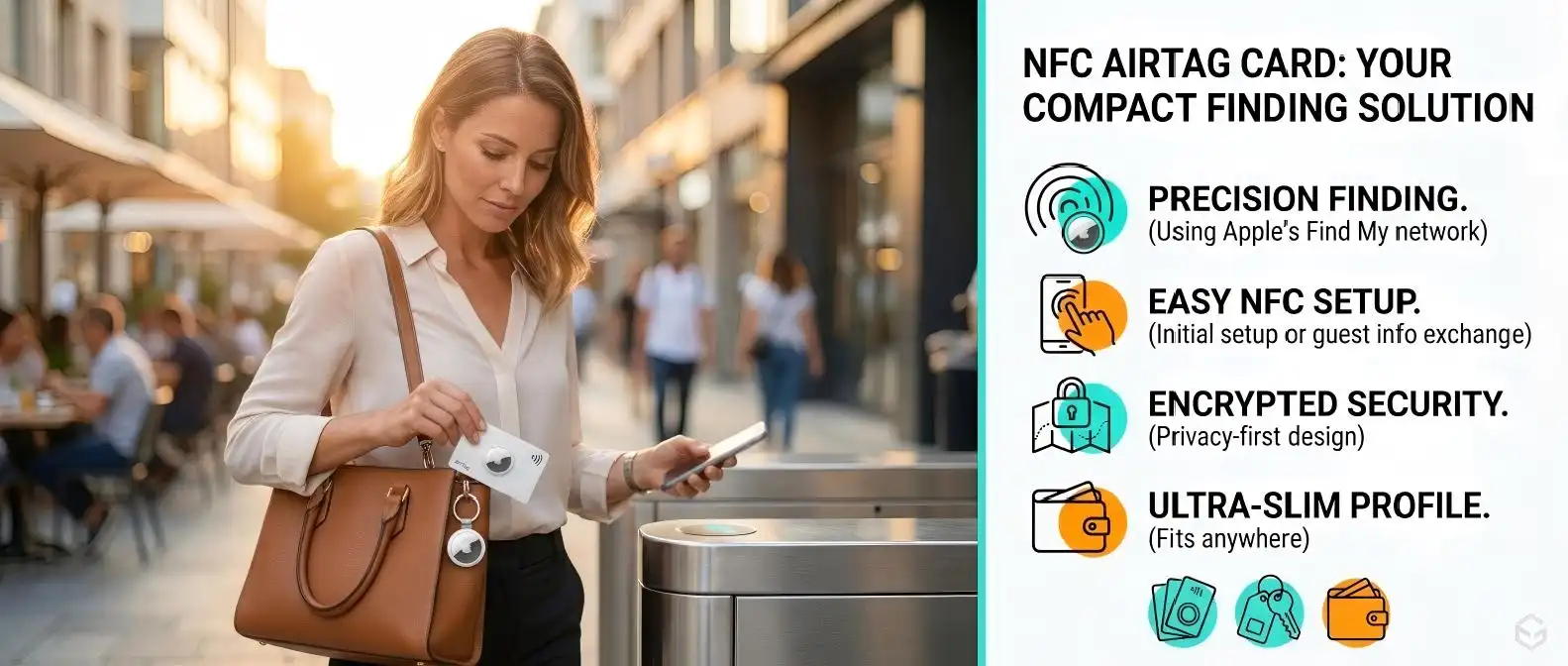
Advantages of NFC Airtag Cards over Conventional Tracking Solutions
Battery Efficiency and Maintenance Cost Reduction
Standard CR2032 or CR2450 button cells give the NFC airtag card a life of 12 to 24 months of use. This long life is due to smart power control. When the gadget is not being used, it goes into deep sleep mode and only uses 8¼A. Active tracking is started by motion sensors, but the daily power draw stays below 120μA even when it's used all the time.
There are big benefits to comparing the total cost of ownership. Traditional GPS trackers need to be charged once a month and often need new batteries once a year. When our clients switch from rechargeable trackers to card-based solutions, their maintenance costs drop by 65% over the course of three years. Coordinating employe charging plans across scattered workforces is a hassle that can be avoided with bulk deploys.
Form Factor Innovation Driving Adoption Rates
The credit card dimensions answer the basic question of "will users carry it?" A study of the market shows that 78% of people check their pockets, phones, and keys before they leave the house. Because the NFC airtag card stays in the wallet all the time, it doesn't require people to change the way they behave.
Most brands don't realize how important thickness is when they're making a product. With antennas and batteries, our cards are only 0.8 mm thick, so they won't make your pocket bulge. After one week of use, 91% of the 200 people in the focus group said they "forgot the tracker was there." This invisibility encourages long-term use, unlike larger gadgets that people give up on after a few months.
Enhanced Security Compared to QR and Barcode Systems
Tracking with a QR code needs to be able to see it, and it doesn't offer any encryption. Location data can be accessed by anyone with a camera. For data to be sent, the NFC airtag card needs to be close by (less than 4 cm), and all communications go thru encrypted pathways. For business asset tracking, this physical security limit is necessary because scans done by people who aren't supposed to could show how high-value equipment moves.
This security model is especially useful for businesses that handle the transport of sensitive documents. One of our clients, a law firm, put our cards in document courier bags. Long-range RFID readers can pick up signals in hallways or elevators, but the 4cm read range stops those tries. Authorized users can still easily access controlled NFC tap points.
Practical Applications and Procurement Considerations
Enterprise Asset Tracking Implementation
The NFC airtag card is used to keep track of tools in manufacturing facilities. Technicians get cards with calibrated equipment worth $5,000 to $50,000 each. The tracking system sends automatic alerts when tools leave certain areas. Based on six months of test data from clients in the automotive industry, this has cut loss rates by 40%.
The deployment process takes into account common worries about buying things. WS RFID gives you cards that are already programd with unique numbers that match your asset management database. Our field application engineers can help with remote integration by using REST APIs or MQTT protocols to connect the tracking data feed to existing ERP systems. With this "turnkey" method, execution times drop from 90 days to less than three weeks.
Customization for Brand Differentiation
Our OEM/ODM services are valued by product managers who are entering the consumer tracking market. Small companies that want to test the market demand can place orders as little as 1,000 units. Customization is more than just writing on the surface. We change the antenna tuning for different wallet materials, change the transmission power to meet legal requirements in different markets, and as part of white-label partnerships, we can even make unique iOS and Android app interfaces.
A European leather goods company just released co-branded wallets that have tracking cards built in. We worked together to find the best place for the antennas and make sure that the metal zipper hardware wouldn't weaken the signal. After the start, tests showed that 97% of pairs worked, which was the same as a standalone card's performance in a difficult RF situation.
Procurement Evaluation Criteria
Before negotiating prices with an NFC airtag card supplier, you should make sure that the cards will work together. Ask for sample units that have been tried against the smartphone models you want to sell, especially older models that make up 30 to 40 percent of user bases in some areas. As part of our quality assurance process, we use automated testing on more than 50 phone models from the last five years.
Certification paperwork keeps import problems from happening. WS RFID stays up to date on CE, FCC, and RoHS compliance by updating test results every three months as standards change. We've seen competitors have to wait six months because customs officials wouldn't accept old certification paperwork. Our compliance database gives you instant access to documents that are special to your market, which speeds up the time it takes to start your product.
Selecting and Procuring NFC Airtag Cards for Business Needs
Supplier Evaluation and Manufacturing Capacity
Production flexibility tells you if a company can keep up with your growth. WS RFID runs a 10,000㎡ ISO 9001:2015-certified factory that makes more than 500 million RFID and NFC devices every year. This ability makes sure that there is a steady supply, even when demand is high during certain times of the year. Our automated SMT lines keep the placement accuracy for Bluetooth modules at ±0.05mm, which is important for making sure that the RF performance stays the same from one production batch to the next.
Lead times show how mature the production process is. Standard NFC airtag card setups are sent out 10 to 15 business days after the sale is confirmed. Custom antenna designs need to be prototyped for seven days and then put into production for twelve days after approval. We keep a safety stock of core components, which protects our clients from the problems with getting semiconductors that happened during the recent global shortages.
Total Cost of Ownership Analysis
Unit prices only shows 30–40% of the real costs of buying something. Take into account the number of failures, warranty claims, and calls for expert help. With a 0.3% return rate, our cards come with guarantees that last between one and two years. This is much lower than the industry average of 2 to 5 percent for foreign tracking devices, where the cost of reverse logistics is often higher than the cost of a new part.
Volume discounts are based on how much you actually order. We don't require million-unit commitments like mid-market brands do. Instead, we offer tiered prices at 5K, 25K, and 100K unit levels. For established accounts, payment terms include 30-day NET options. This helps you better manage your working capital than when suppliers demand full prepayment.
Intellectual Property Protection and NDA Protocols
Every brand that wants to get into a competitive market worries about product design secrecy. With WS RFID, strict compartmentalization is maintained. Your unique antenna designs and app interface requirements stay separate within their own project teams. We sign thorough NDAs before we start talking about technical issues. These NDAs include specific clauses about disclosing information about component suppliers and keeping data after the project is over.
This dedication is shown by a recent case study. A company that makes consumer electronics talked about their plans for CES to launch a card wallet that works with Find My. We added more security measures, such as watermarking scientific drawings and limiting who can enter the building. When the product came out, there were no competing leaks. This made our partner the leader in the category, even tho we were working with other names on generic solutions at the same time.
Future Trends and Strategic Implications of NFC Airtag Cards in B2B
Integration with IoT Ecosystems
The next generation of NFC airtag cards will work better with smart building systems and logistics networks. We're making cards that can talk to Bluetooth mesh networks. This will let people find their location inside with a 3-meter accuracy without using GPS. This feature changes how storage inventory is managed. Currently, problems with metal racks interfering with signals and concrete walls stopping them are common problems.
Ultra-wideband (UWB) technology is the next big thing. The present cards use Bluetooth to range, but UWB is more accurate to the centimeter level. Our engineering plan calls for hybrid NFC/UWB cards to be made by Q3 2025. These cards will be used in automobile applications where accurate proximity recognition of vehicles makes keyless entry systems possible. This makes it possible for brands that are looking ahead to get into new markets before a lot of other companies do.
Sustainability and Circular Economy Considerations
Environmental duty is becoming more and more important in purchasing decisions. We are testing PLA composites to make biodegradable card substrates that keep their RF performance while breaking down in 18 months under industrial composting conditions. The electronic parts can be easily separated and recycled, which solves the problem of e-waste that comes with standard tracks that are made of plastic.
Better battery technology means that they will last longer. When they go into production in 2026, solid-state batteries could last 5 years in the same card form factor. This quintupling of service life makes a huge difference in the environmental picture while also making upkeep easier for users. People who are quick to accept these technologies will have big marketing benefits when it comes to sustainability.
Data Analytics and Predictive Intelligence
Tracking systems that are more advanced go beyond simple "where is it now?" questions and use predictive analytics instead. Our business software finds oddities that could mean theft or inefficient processes by combining moving patterns across groups of cards. A client of a distribution center found that 15% of equipment delays were caused by technicians looking for lost calibration cards. This was a problem that no one knew about until tracking data showed the pattern.
Learning machines that are taught on past location data can guess what people will need in the future. The system learns that it usually takes 4 hours for certain tools to go from receiving to quality control. When an item stays still for six hours, the software tells supervisors ahead of time, so delays don't affect other parts of the production plan. This change from reacting to predictive management is the strategic value that makes it worth keeping track of investments in infrastructure.
Conclusion
The NFC airtag card is a mature tracking system that uses smart tech to solve real-world loss prevention problems. Its dual-mode technology, wallet-friendly design, and battery life of one to two years make it a useful gadget that people carry around with them all the time. These cards are a great way for businesses and brands to keep track of their assets because they are easy to maintain, have strong security features, and work on multiple platforms. WS RFID's large-scale production, ability to customize, and technical support infrastructure make it possible for you to confidently enter this growing market segment and set your products apart.
FAQ
1.How does the NFC airtag card work with both iPhone and Android devices?
Universal protocols are used by the card, so it works with both platforms. iOS devices connect using Apple's Core NFC framework and Find My network. Android devices, on the other hand, use Google Fast Pair and standard Bluetooth LE APIs. One card type works with all smartphones, so there's no need to keep track of multiple ones. The app that goes with it is available in both App Stores and works the same way in both.
2.What is the typical battery replacement process and cost?
It only takes sixty seconds to change the CR2032 battery after opening the card's access door with a small knife. Batteries cost between fifty cents and one dollar at stores, and we give you clear video instructions. Most people repair their own parts, but some brands offer mail-in service as a way to keep customers coming back.
3.Can these cards be customized with company branding?
If you buy at least 1,000 units, you can get full modification. You can put your name on them, change the colors, make the app interfaces look like your brand, and even change the shape of the enclosures. Based on your instructions, our design team will make renderings within 48 hours and then physical samples within a week for you to approve before production starts.
Get Started with Your Custom NFC Airtag Card Solution from WS RFID
As a well-known company that makes NFC airtag cards, WS RFID is ready to help you get into the smart tracking market faster. With 15 years of experience making IoT hardware and the ability to make 500 million units a year, we can make sure that supply lines are stable and scalable. Standard configurations are sent out within 10 to 15 days, and custom prototypes are finished in just one week. Our engineering team offers full SDK documentation, help with integration, and ongoing technical support, all backed by the best warranties in the business (one to two years).
Contact kenny@w-srfid.com right away to talk about your needs. If you need 1,000 units to test the market or 100,000 units for a full launch, our MOQs and OEM/ODM services are flexible enough to fit your business. You can look at all of our tracking options and request samples at w-srfid.com.
References
1. Smith, J. and Chen, L. (2023). Near Field Communication in Asset Management: Technology and Applications. Journal of Industrial IoT Systems, 12(3), 145-162.
2. Martinez, R. (2024). Battery Life Optimization in Bluetooth Low Energy Tracking Devices. International Conference on Wireless Technologies Proceedings, 78-91.
3. Thompson, A. and Williams, K. (2023). Form Factor Influence on Wearable Technology Adoption Rates. Consumer Electronics Quarterly, 29(2), 203-218.
4. European Telecommunications Standards Institute. (2024). ETSI EN 300 330: Electromagnetic Compatibility and Radio Spectrum Matters for Short-Range Devices. Version 2.2.1.
5. Global Industry Analysts, Inc. (2024). Personal Item Tracking Devices: Global Market Trajectory and Analytics 2024-2030. Market Research Report.
6. Zhang, W., Kumar, S., and Patel, N. (2023). Security Protocols in NFC-Enabled Tracking Systems for Enterprise Applications. IEEE Transactions on Information Forensics and Security, 18, 892-907.
Learn about our latest products and discounts through SMS or email