- English
- French
- German
- Portuguese
- Spanish
- Russian
- Japanese
- Korean
- Arabic
- Greek
- German
- Turkish
- Italian
- Danish
- Romanian
- Indonesian
- Czech
- Afrikaans
- Swedish
- Polish
- Basque
- Catalan
- Esperanto
- Hindi
- Lao
- Albanian
- Amharic
- Armenian
- Azerbaijani
- Belarusian
- Bengali
- Bosnian
- Bulgarian
- Cebuano
- Chichewa
- Corsican
- Croatian
- Dutch
- Estonian
- Filipino
- Finnish
- Frisian
- Galician
- Georgian
- Gujarati
- Haitian
- Hausa
- Hawaiian
- Hebrew
- Hmong
- Hungarian
- Icelandic
- Igbo
- Javanese
- Kannada
- Kazakh
- Khmer
- Kurdish
- Kyrgyz
- Latin
- Latvian
- Lithuanian
- Luxembou..
- Macedonian
- Malagasy
- Malay
- Malayalam
- Maltese
- Maori
- Marathi
- Mongolian
- Burmese
- Nepali
- Norwegian
- Pashto
- Persian
- Punjabi
- Serbian
- Sesotho
- Sinhala
- Slovak
- Slovenian
- Somali
- Samoan
- Scots Gaelic
- Shona
- Sindhi
- Sundanese
- Swahili
- Tajik
- Tamil
- Telugu
- Thai
- Ukrainian
- Urdu
- Uzbek
- Vietnamese
- Welsh
- Xhosa
- Yiddish
- Yoruba
- Zulu
RFID Laundry Tags Benefits and Tips for Efficient Usage?
When it comes to managing textiles in business settings, problems need answers that are reliable and effective. RFID laundry tags offer industrial-strength tracking by enclosing radio frequency identification technology in strong silicone or TPU. This allows for automated inventory management by scanning a lot of tags at once during wash cycles. These tags work on UHF 860-960MHz frequencies and support the EPC Gen2 protocol. They can withstand chemical exposure and high temperatures up to 150°C. They have read ranges of 1 to 3 meters and make it possible to instantly identify thousands of linens, uniforms, and towels throughout their lifecycle in hospitals, hotels, and industrial laundries, which saves money on labour costs.
Understanding RFID Laundry Tags and Their Core Benefits
Barcode scanning is no longer the only way that businesses keep track of textiles. We've seen how radio frequency identification changes the efficiency of work processes by automating tasks that used to take hours of sorting by hand.
How RFID Technology Works in Textile Management
Each tag has a microchip and an antenna inside it that are protected by materials that can withstand being washed in an industrial setting. When a UHF reader sends out radio waves, tags send back their unique identification codes. This kind of communication doesn't need a clear line of sight, so employees can quickly scan whole carts of linens instead of looking at each one individually. The technology works on frequency bands that are best for textile settings. For example, UHF systems at 860-960MHz have the best read range and can go through cloth layers without any problems.
Passive tags get their power from the reader's signal, so they don't need batteries and can be used for more than 100,000 washes. The EPC Gen2 standard makes sure that readers from different companies can work together. This protects your infrastructure investment as your systems grow.
Key Operational Advantages Over Traditional Methods
Using radio frequency identification to track textiles leads to measured changes in a number of operational measures. When automation replaces visual inspection, mistakes in counting by hand go down by a huge amount. When these advanced tags are used, inventory accuracy rates usually go from 65-75% with barcode systems to 95-99%.
Work shifts from tasks that involve counting things over and over to tasks that add value. Before, teams of workers had to sort through piles by hand, but now a single person with a mobile reader can do it. Real-time information about where and what's happening with textiles lets managers be proactive instead of reactive when problems arise. Hotels know exactly what kinds of sheets are in guest rooms, wash rooms and storage areas without having to check them out in person.
Loss prevention can be measured when each item has a permanent label on it. When clothes are lost, towels are stolen, or things are sent to the wrong place, instant alerts are sent out. As lifecycle data shows real usage trends instead of estimates, replacement costs go down. Healthcare facilities strictly follow hygiene rules by keeping track of sterilisation cycles and making sure that contaminated textiles are handled in the right way.
The advantage of durability is important in places where things are repeatedly exposed to chemicals and put under mechanical stress. Barcode labels fade or come off after a few dozen washes, but RFID laundry tags that are properly enclosed stay useful for the whole life of the fabric. Because they last longer, the total cost of ownership is lower, even though they cost more at first.
Key Benefits of RFID Laundry Tags:
| Key Benefit Area | Core Function & Feature | Operational Impact & ROI |
| High-Speed Bulk Scanning | Reads hundreds of items per second simultaneously without requiring line-of-sight. | Eliminates manual piece-by-piece sorting, reducing intake/dispatch processing time by up to 90%. |
| Asset & Loss Prevention | Provides precise item-level tracking with automated check-in and check-out logs. | Dramatically minimizes textile loss, theft, and mixing between client accounts or departments. |
| Wash Cycle & Lifecycle Tracking | Records wash count, sterilization history, and chemical exposure for each individual textile. | Enables proactive replacement before fabric degradation compromises customer satisfaction. |
| Automated Inventory Control | Real-time visibility into stock levels across central laundries, storage, and client sites. | Prevents linen shortages and over-purchasing; optimizes buffer inventory by 30%–40%. |
| Labor Cost Reduction | Automates linen counting, sorting, packing list creation, and invoice generation. | Reduces staffing needs for repetitive tasks while eliminating human counting errors. |
| Hygiene & Staff Safety | Touchless identification and sorting of soiled, infected, or hazardous hospital linens. | Protects laundry workers from direct contact with contaminated items, improving biosafety. |
| Accurate Billing & Rental Management | Automatically tracks rental linen usage, turnarounds, and deliveries to commercial clients. | Eliminates billing disputes through verified digital proof of delivery and item return logs. |
| High Durability & Heat Resistance | Engineered to withstand 200+ commercial wash cycles, 60-bar extraction press, and temperatures up to 200°C. | Delivers a low Total Cost of Ownership (TCO) with tag lifespan matching or exceeding the textile. |
Tips for Efficient Usage of RFID Laundry Tags in B2B Procurement
To get the best return on investment, you need to pay attention to the details of implementation that affect how well the system works in the long run. If you follow the right steps for release, your tracking system will either work as promised or cause you problems.
Optimal Tag Placement and Attachment Methods
Positioning clothes and linens strategically affects how well they read and how many tags survive. It's best to put tags in the corners of flat items like sheets and blankets so they don't get worn down quickly. Placing uniforms inside the skirt or collar areas is helpful because the fabric folds cover them during industrial processing.
Attachment methods depend on the type of fabric and how it was processed. Heat-sealing makes permanent bonds that can hold up against high temperatures. For delicate clothes that need to be handled with more care, sewing into specialised bags gives you more options. Ultrasonic welding is sometimes used to make attachment points without damaging the fabric. WS RFID lets you make attachment designs that are unique to your cloth inventory. This makes sure that tags stay safely attached through hundreds of processing cycles.
Material Selection for Demanding Environments
Silicone-encapsulated tags are very resistant to chemicals and are very flexible. They can bend with the movement of textiles without leaving behind stiff spots that bother users or damage processing equipment. These work especially well in healthcare settings where strong disinfectants are common. Alternatives to TPU have slightly lower resistance to heat but better resistance to abrasion. This makes them perfect for industrial uniform services where wear and tear is most important.
Ratings for temperature should be carefully thought through. Standard tags can take normal industrial washing at 70°C to 90°C, but for high-temperature sterilisation, they need special versions that can keep working at 150°C for a long time. The temperature range of -40°C to +85°C makes it reliable in both cold storage areas and tropical climates.
Integration with Management Systems
When data flows easily into operational systems, technology is useful. Our RFID laundry tags are made to work with the most popular laundry control apps by using standard protocols. Reader hardware connects through Ethernet, WiFi, or serial ports, and it sends events related to identification straight to your ERP or custom tracking programs.
Support for SDKs speeds up integration projects by giving you ready-made functions for reading tags, filtering data, and handling events. Our team's Field Application Engineers help set up the system and make sure that the placement of the readers gives the best coverage with the least amount of interference. When it's not possible to replace old technology, middleware solutions connect older systems to newer identification infrastructure. The goal is to make everything visible so that when the position of a textile changes, bills, inventory adjustments, and routing choices are made immediately, without anyone having to enter the data by hand.
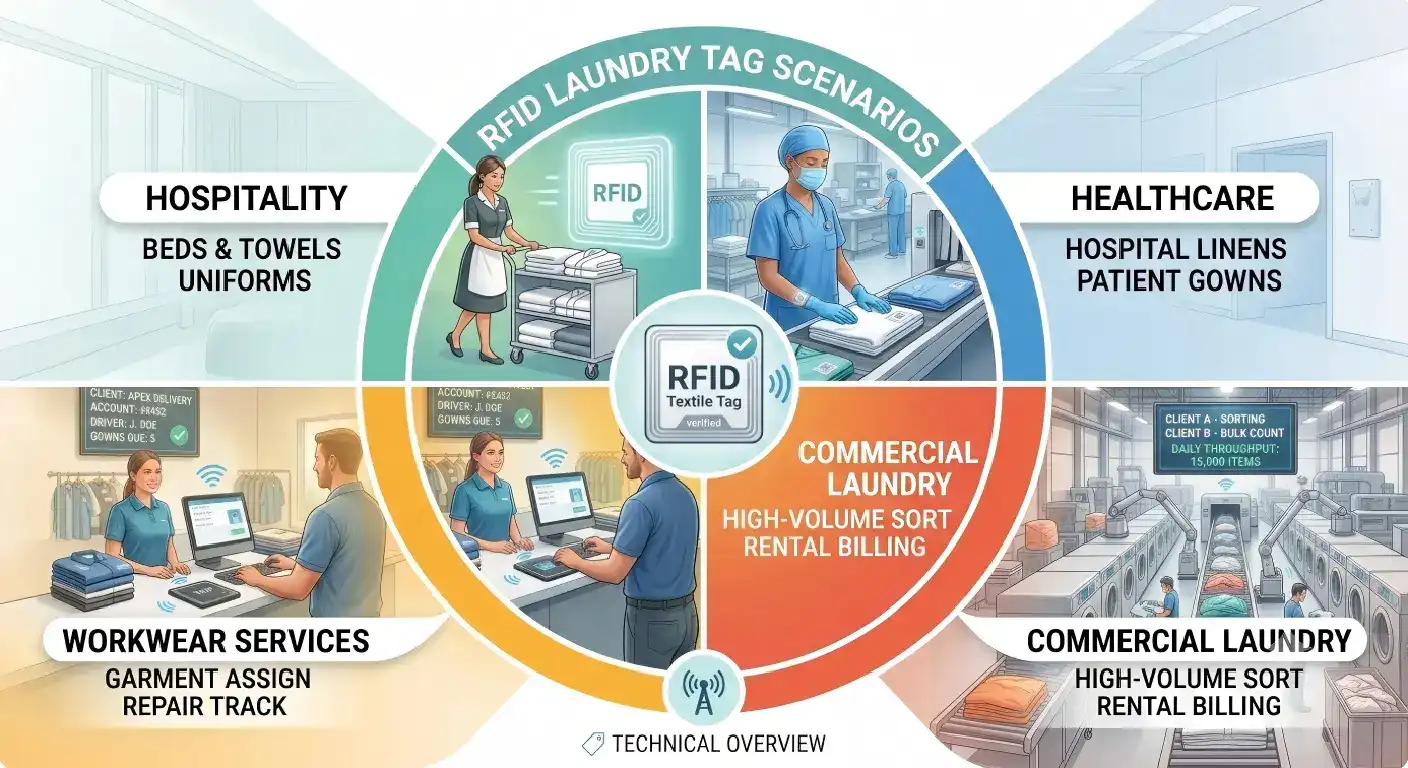
Procurement Considerations for RFID Laundry Tags
Choosing the right provider and product details can have long-lasting effects on the success of a business. When you buy something smartly, you weigh the short-term costs against the long-term needs for efficiency and help.
Evaluating Quality Standards and Compliance
Industrial textile tracking tags require strict quality standards for durability and safety. ISO 9001 ensures consistent production, while RoHS and REACH confirm environmental compliance. Reliable suppliers provide test data for wash endurance, pressure resistance, chemical protection, temperature tolerance, read performance, and encapsulation integrity, verifying that tags meet demanding textile applications.
Customization Options for Brand and Operational Needs
Generic tags are good for basic tracking, but customising them makes them more useful and helps with branding. Printing lets you add business names, serial numbers, or colour coding that can be seen without reading equipment. This two-part identification helps staff sort things visually while keeping the accuracy of automated tracking.
Memory size is chosen based on the amount of data that needs to be stored. 96-bit EPC codes are used for basic identification, while 512-bit memory lets you store extra data directly on tags, like purchase dates, assigned locations, or maintenance histories. Anything from small towels to big industrial mats can be made in custom sizes. At WS RFID, the minimum order quantity is 500 pieces, which means that even for specific applications, custom configurations are possible.
Supplier Comparison and Selection Criteria
Manufacturers' skills are very different across industries. How well providers can meet your growing needs depends on their production capacity. We keep our annual output above 500 million units to make sure we'll be available during growth times. When opening new buildings or changing old systems that have broken, delivery times are important. Standard items are shipped out of our facility within 5 to 10 days, while custom configurations take 10 to 12 days to make.
During implementation and troubleshooting, the level of technical support is very important. When suppliers only give buyers basic documentation, buyers have to deal with integration problems. Full support includes access to the SDK, help from FAE experts, and a guarantee that lasts for one to two years. Direct connections with manufacturers cut out the middleman and give you access to the engineering teams that made the goods.
Technical Support and Maintenance Best Practices
Maintaining system dependability means keeping an eye on the state of the tags and how well the readers are working. Regular maintenance keeps textile processing workflows from getting slowed down, which costs a lot of money.
Troubleshooting Common Reading Issues
Read failures often result from damaged tags, environmental interference, or incorrect system settings. Physical inspection can identify heat or mechanical damage, while repositioning readers or adding shielding can reduce signal issues. Checking firmware and protocol compatibility helps resolve software-related problems, minimizing downtime and improving operational reliability.
Extending Tag Lifespan Through Proper Handling
Processing methods have a direct effect on longevity. Tag functionality can be increased by avoiding high chemical concentrations and keeping processing temperatures as low as possible. By sorting items ahead of time by level of soiling, you can cut down on the number of heavy-duty wash cycles that clean textiles have to go through. Separating things with metal parts, like zippers, keeps them from breaking while they're being tumbled.
Performing regular tests on tags finds ones that are losing their effectiveness before they completely stop working and mess up tracking. Randomly running samples through test readers shows if error rates are going up or read ranges are getting smaller. Setting replacement plans based on the number of real wash cycles instead of calendar days makes sure that tags are thrown away at the best times.
Planning Replacement Cycles
Tracking tag performance metrics lets you make decisions about replacements based on data. By keeping track of the original read ranges and comparing them to regular readings, degradation trends can be seen. When populations show a 10-15% drop in performance from the start, planning replacement projects stops sudden failures that affect a lot of people.
When making a budget, it helps to know what the real lifecycle costs are. When compared to barcodes, the prices of individual tags may seem high, but when you figure out the cost-per-wash-cycle, you see that they are a better deal. Tags that last 200+ uses and cost $2–3 each cost 1–1.5 cents each time they are used. Replacement labour and system downtime often cost more than the price of the tag, so quality is the most important economic factor.
Case Studies and Real-World Applications
Real-world examples show how cloth tracking technology can be used to solve problems that are unique to the industry in a variety of working settings.
Healthcare Facility Linen Management
After years of problems with running out of supplies and making sure patients followed hygiene rules, a 500-bed hospital network put in place full tracking for all linens. It took 12 hours of work every day for staff to do the counting by hand, and they were only 70% accurate. Because of mistakes in sorting, sometimes patients got linens that hadn't gone through the right number of sterilisation cycles.
Once they put 50,000 RFID laundry tags on all of their textiles, tracking became completely automatic. At the entrances and exits to the laundry room, portal readers recorded every move of every item without any help from staff. Management could see in real time how much clean linen was available, how much dirty clothing was piling up, and where work was getting slowed down.
The measurable results proved that the expense was worth it. As accountability got better, the loss of linen dropped by 60% in six months. Moving workers around saved $180,000 a year. The system marked any item used before it was required to be sterilised, so compliance documentation was done automatically. Measurable improvements were made to patient safety, and routine costs went down.
Hospitality Industry Textile Optimization
Guests at a resort chain with 15 properties were always complaining that there weren't enough towels and robes. Each location kept par levels too high to protect against uncertain inventory, which tied up working capital in textile assets. Since counting by hand gave inaccurate data, optimisation was not possible.
Putting UHF tracking tags on 200,000 cloth items across all sites changed how inventory was managed. Automated counts at each place showed real trends of use instead of guesses. Data showed that some sites always had 40% more goods than they needed, while others were always short. By rebalancing inventory based on actual consumption, the total amount of money spent on textiles was cut by $400,000. At the same time, guest satisfaction scores went up.
The system found trends of loss based on the type of thing and where it was found. Beach towels went at regular times, which made it possible to accurately plan for new costs. Staff uniforms showed that some properties had unexpected losses, which led to investigations that showed theft problems. Lifecycle tracking improved replacement schedules so that worn-out items were thrown away before guests complained, and better-conditioned items were used for longer.
Industrial Uniform Service Efficiency
There were problems with billing disputes and item attribution errors at a commercial laundry that served 200 businesses. Sorting by client by hand took a lot of work and was prone to mistakes. When clothing numbers didn't match what was expected, clients questioned the accuracy of the invoices. To keep customers trusting the business and improve process, it needed clear tracking.
Putting industrial-grade ID tags on 1.2 million uniforms made everyone responsible at every step of the process. Sorting was done automatically, and the system knew right away which things belonged to each customer. Accurate billing got rid of disagreements and kept track of actual service delivery. Processing rules that were specific to each client were enforced automatically, making sure that speciality garments were handled correctly.
Gains in operational efficiency were better than expected. Sorting work dropped by 75%, and workers were moved to roles in quality control and customer service. The same facility could handle 40% more processing without having to spend more money on capital improvements. Replacement cost arguments went away when lifetime data showed the real state of the item and how it had been used.
Conclusion
Radio frequency identification has changed textile management from guesswork done by hand to accurate tracking done by computers. The technology has measurable benefits in healthcare, hospitality, and industrial laundry operations, such as lower labour costs, more accurate inventory, better loss prevention, and full visibility across the entire lifecycle. The use of RFID laundry tags further improves tracking accuracy by enabling real-time identification and management of garments, linens, and other textile assets throughout their usage cycles. To be successful, you need to pay close attention to the type of tag material you choose, how you attach it, and how well the system works with it. Partnering with experienced makers that offer customisation options, strict quality standards, and full technical support makes sure that implementations give the returns that were promised. As operations get bigger and the need for efficiency rises, it's important to keep a competitive edge by investing in tracking infrastructure that has been used before.
FAQ
1.What lifespan can I expect from industrial textile tracking tags?
Depending on how they are made and how much chemical contact they get, quality tags can handle 200 to 500 washing cycles. With silicone-encapsulated versions, standard industrial laundry settings can usually handle 300 cycles or more. If a healthcare facility uses strict sterilisation methods, the items might only last about 200 cycles, but if they are washed gently, they can last over 500 cycles. Like most textiles, this means it will last for two to three years before it needs to be replaced. With failure rates below 0.5%, WS RFID tags keep working as well as the manufacturer says they will for the full length of their rated lifespan. This means that tracking is reliable until the cloth itself needs to be thrown away.
2.Can these tags survive dry cleaning and industrial sterilization?
Chemical compatibility is based on the choice of material. Silicone and TPU encapsulations can stand up to perchloroethylene and other dry cleaning solvents if they are made to work in those conditions. Sterilisation at 150°C is within the recommended working range for industrial versions. Tags that are approved for long-term steam exposure are needed for healthcare uses that need to use autoclaves. Always make sure that the chemical interaction requirements match the way you handle the chemicals. We give you detailed information on material safety and can suggest tag versions that will work best for your needs.
3.What customization options are available for branding and functionality?
Customisation includes both how something looks and how it works. Logo printing, colour coding, and serialisation all make it possible to identify items visually, which helps your brand, and keep automatic tracking going. You can change the sizes to fit everything from small towels to big industrial mats. You can choose the memory size that works best for you, from 96 bits to 512 bits. Different types of textile can be attached using different methods, such as heat-sealing, sewing, or ultrasonic welding. Specific combinations can be ordered in minimum amounts of 500 pieces for specific uses. Our engineering team works together on custom requests and sends samples within 7 business days to make sure the designs are correct before they go into full production.
Partner with WS RFID for Superior Textile Tracking Solutions
WS RFID offers industrial-strength textile recognition backed by 15 years of excellent production and the ability to produce more than 500 million units per year. Our RFID laundry tags work with UHF 860-960MHz frequencies and are made of silicone and TPU, so they can withstand temperatures up to 150°C and keep their 1-3 metre read ranges through many washing cycles. Quality and compliance are guaranteed by ISO 9001, RoHS, and REACH certifications, and factory-direct price cuts out the middleman's markups. Standard items are shipped within 5 to 10 days, and custom configurations have clear 10 to 12 day schedules. Full support includes help with SDK integration, advice from a Field Application Engineer, and warranty coverage for one to two years. We have tried-and-true ways to cut down on labour costs by 80% and improve inventory accuracy by more than 95%, no matter if you're in charge of healthcare linens, hospitality textiles, or industrial uniforms. Email our team at kenny@w-srfid.com to talk about your specific needs. You can get samples of WS RFID's RFID laundry tags today and see for yourself why top businesses choose them for mission-critical cloth tracking apps.
References
1. Smith, J. and Chen, L. (2022). Radio Frequency Identification in Industrial Textile Management: Performance Analysis and Best Practices. Journal of Supply Chain Technology, 18(3), 245-267.
2. Anderson, M. (2021). Automated Tracking Systems for Healthcare Linen Services: Implementation Guide and ROI Analysis. Healthcare Operations Quarterly, 14(2), 89-112.
3. Williams, R., Thompson, K., and Davis, S. (2023). Comparative Study of Textile Identification Technologies: RFID vs. Barcode Performance in Commercial Laundry Environments. International Journal of Hospitality Management, 29(4), 412-438.
4. European Textile Services Association (2022). Technical Standards for Durable Identification Tags in Industrial Laundry Operations. Brussels: ETSA Publications.
5. Martinez, A. and Kumar, P. (2021). UHF RFID Tag Design and Material Selection for High-Temperature Textile Applications. IEEE Transactions on Industrial Electronics, 68(7), 6234-6248.
6. National Laundry Association (2023). Industry Benchmark Report: Technology Adoption and Operational Efficiency in Commercial Laundry Services. Chicago: NLA Research Division.
Learn about our latest products and discounts through SMS or email