- English
- French
- German
- Portuguese
- Spanish
- Russian
- Japanese
- Korean
- Arabic
- Greek
- German
- Turkish
- Italian
- Danish
- Romanian
- Indonesian
- Czech
- Afrikaans
- Swedish
- Polish
- Basque
- Catalan
- Esperanto
- Hindi
- Lao
- Albanian
- Amharic
- Armenian
- Azerbaijani
- Belarusian
- Bengali
- Bosnian
- Bulgarian
- Cebuano
- Chichewa
- Corsican
- Croatian
- Dutch
- Estonian
- Filipino
- Finnish
- Frisian
- Galician
- Georgian
- Gujarati
- Haitian
- Hausa
- Hawaiian
- Hebrew
- Hmong
- Hungarian
- Icelandic
- Igbo
- Javanese
- Kannada
- Kazakh
- Khmer
- Kurdish
- Kyrgyz
- Latin
- Latvian
- Lithuanian
- Luxembou..
- Macedonian
- Malagasy
- Malay
- Malayalam
- Maltese
- Maori
- Marathi
- Mongolian
- Burmese
- Nepali
- Norwegian
- Pashto
- Persian
- Punjabi
- Serbian
- Sesotho
- Sinhala
- Slovak
- Slovenian
- Somali
- Samoan
- Scots Gaelic
- Shona
- Sindhi
- Sundanese
- Swahili
- Tajik
- Tamil
- Telugu
- Thai
- Ukrainian
- Urdu
- Uzbek
- Vietnamese
- Welsh
- Xhosa
- Yiddish
- Yoruba
- Zulu
How NFC Blocking Cards Protect Your Personal Data
You carry more than just cash in your wallet. It also has digital keys to your personal identity, financial accounts, and work credentials. Every contactless card with NFC technology sends information wirelessly, which leaves holes that cybercriminals use every day. This risk can be reduced with an NFC blocking card, which creates a localised electromagnetic screen that keeps unauthorised readers from getting to the 13.56MHz frequency band that contactless smart cards use. This small privacy tool doesn't need batteries to work and protects against electronic pickpocketing and relay attacks that are a threat to business data security and personal financial safety with over 99.5% effectiveness.
Understanding NFC Blocking Cards and Their Role in Data Protection
Contactless technology is very important in today's business world. Near Field Communication speeds up transactions and makes controlling access easier, but it also opens up security holes that businesses can't ignore. Looking at both the threats and the tech behind signal shielding is needed to understand how defensive solutions work.
What NFC Technology Does and Why It Creates Risk
NFC works through electromagnetic induction when the devices are close together, usually less than 4 centimetres. While this requirement for closeness was meant to be a security measure, determined enemies have come up with ways to make reading much farther away. People who work in corporate settings are especially vulnerable at conferences, airports, and public transit stops where employees carry encoded badges along with payment cards. The ISO 14443 system that controls NFC communication was made to be fast rather than secure. This means that data bits can be intercepted during the few milliseconds they are being sent.
How Signal Shielding Technology Functions
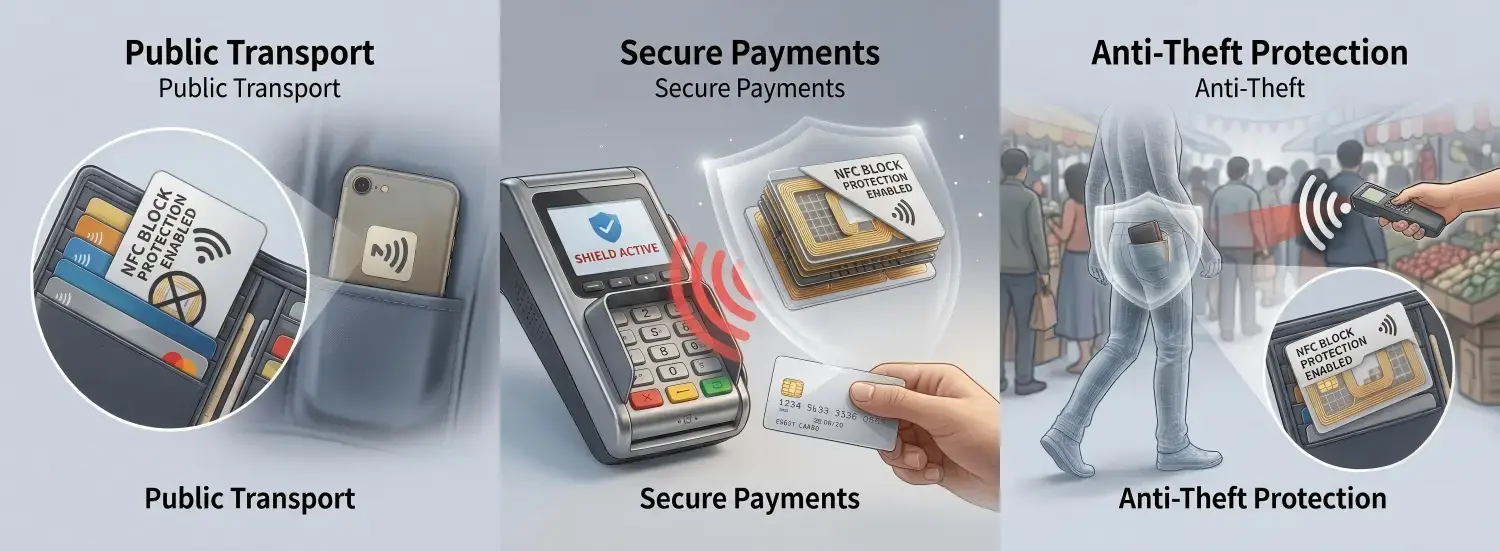
Signal blocking cards use special materials that mess up electromagnetic fields without needing to be powered on. The engineering involves carefully layered metal alloys, usually in the form of copper or aluminium mesh, that are put inside a normal credit card shape that is only 0.2 to 0.4 mm thick. When these materials are put next to contactless cards in your pocket, they create Faraday cage effects that soak up and spread out radio signals that come in. Instead of bulky RFID-blocking sleeves that only protect one card at a time, an NFC blocking card can protect all of your credentials within a 2–5 cm radius. This is known as the "sandwich shield" effect.
Distinguishing NFC Protection from General RFID Solutions
A lot of procurement workers mix up NFC and RFID security, but there are important technology differences between the two. Radio waves are used by both systems, but they are used for different things and work on different bands. Many old building entry fobs use low-frequency RFID systems at 125kHz, but NFC is focused on the 13.56MHz high-frequency spectrum, which is where payment cards and current credentials work. A good NFC blocking card is frequency-tuned by antenna shape and material choice to only interact with this band. This way, it stops threats without messing up systems that aren't connected to it. This level of accuracy keeps employees' security from being overstated while still working with the wide range of cards they carry every day.
Key Benefits of Using NFC Blocking Cards in Corporate Environments
When companies are thinking about where to invest in data protection, they need to find solutions that balance how well they protect data with how well they work in the real world. Signal protection cards have benefits that go beyond stopping threats right away. They also help with compliance and save money in the long run.
Enhanced Data Security for Mobile Workforces
When you travel for business, your credentials are at greater risk. Potential attackers tend to hang out in places like airport terminals, hotel lobbies, and convention centers where employees regularly handle sensitive access cards. An NFC blocking card given to everyone in your company provides constant safety, no matter how security-savvy each employee is. Software-based solutions need to be updated and users need to be trained, but physical shielding works all the time without any help from a person. This passive security layer stops people from making copies of employee badges without permission, which could let bad people into the building. It protects both the building itself and the digital systems that those IDs allow entry to.
Regulatory Compliance and Liability Reduction
Data security laws, like GDPR in Europe and CCPA in California, make it very hard for businesses to handle personal information without following strict rules. When a breach is reported, it leads to required disclosures, legal fees, and damage to the company's image that far outweigh the costs of protection. Using NFC blocking card solutions shows that you are responsible with data during compliance checks and gives proof of reasonable security measures. Under HIPAA and FDA traceability rules, healthcare organisations that handle patient wristbands and pharmaceutical companies that handle serialised product tags are closely watched. Quality shielding cards come with electromagnetic compatibility certifications that can be used as proof of technical due diligence.
Cost-Effectiveness Compared to Alternative Solutions
So that they don't go over budget, procurement teams look at all of the security choices and compare the prices of each one over the whole lifecycle. Specialised wallets that stop RFID signals cost between $30 and $80 each, and employees must follow the rules about bringing certain accessories. There are ongoing subscription fees for mobile security apps, and they drain device batteries while only partially protecting against hardware-based skimming attacks. A single NFC blocking card is much cheaper, doesn't need any maintenance over its five-plus-year useful life, and fits right in with existing processes. For business deployments, volume pricing lowers unit costs even more. Orders of 500 or more units can get prices directly from the maker, which greatly increases the return on security investment.
Criteria for Selecting the Right NFC Blocking Cards for Your Business
When making a procurement decision, you have to weigh technical requirements against operational needs and the supplier's abilities. There are different levels of quality on the market, and knowing what makes them different can help you avoid making expensive buying mistakes.
Material Quality and Shielding Performance Standards
How well electromagnetic shielding works depends on the type of material used and how well it was made. Premium NFC blocking card solutions use multi-layer copper mesh arrangements that achieve reduction levels above 40dB, lowering signal strength by more than 99.5%. When people want to save money, they often use magnesium instead of aluminium, which works fine in controlled settings but doesn't work as well near powerful readers or in places with a lot of electromagnetic noise. Ask for technical datasheets that explain how the shielding effectiveness is tested; reputable companies offer spectrum analyser reports that show frequency response curves across the 13.56MHz band. Cards that meet the mechanical robustness standards of ISO 10373-1 can handle the twisting and bending stresses of daily pocket use without breaking the antenna, which would make the card less safe.
Certification Requirements and Compatibility Validation
International compliance approvals make sure that a product is safe and works with electric fields. The CE mark shows that a product meets European safety standards, and the RoHS and REACH marks make sure that the product is safe by limiting the use of dangerous substances. These certifications are important for multinational companies that use security solutions in different countries with different rules. Compatibility testing makes sure that NFC blocking card solutions don't get in the way of legitimate card use. To avoid uncertain blocking of authorised access, workers should just take out the protective card during transactions. As part of testing protocols, major payment networks like Visa PayWave and Mastercard PayPass, as well as common access control systems like HID and MIFARE, should be checked.
Customization Options for Corporate Identity
Large-scale deployments are helped by the ability to customise, which makes corporate security policies stronger. Leading manufacturers offer OEM/ODM services that include printing logos, custom packaging, and cards with different sizes to fit different badge holders or credential formats. Branded security cards given to new employees during onboarding show that the company is serious about protecting data and also serve as everyday security tools. Customisation usually requires at least 500 to 1,000 units, and production processes take 10 to 12 days longer than normal product delivery times. Before agreeing to full production runs, ask the seller to customise a sample to see how good they are at design.
Supplier Reliability and Logistics Considerations
Beyond product specifications, operational capabilities are also taken into account when choosing a vendor. Scale in manufacturing affects both the regularity of output and the stability of prices. For example, WS RFID Technology's 10,000-square-meter facility, which makes 500 million units a year, can keep up quality control systems and find materials that smaller facilities can't match. Standard delivery times of 5 to 7 days for in-stock items and 10 to 12 days for custom orders change how deployment plans are made. ISO 9001:2015 approval checks that quality control systems don't change from batch to batch. When putting protection solutions into complicated credential ecosystems, the technical support that suppliers offer is important. Being able to talk to field application engineers who know about RF characteristics is key to a successful implementation.
Testing and Verifying NFC Blocking Card Effectiveness
Procurement teams need ways to make sure that the goods they buy provide the safety levels that were promised. Technical testing and performance monitoring stop security theatre and find bad products before they are fully deployed.
Practical Validation Methods for Technical Buyers
Testing how well an NFC blocking card works doesn't require a lot of equipment. Place the card against a contactless payment card and then try to make a purchase at an NFC station. The transaction should always fail. Smartphone NFC readers make testing easy by letting you use apps that try to read card data. Position the blocking card between your phone and a valid ID. Then, open the NFC reading app. Any data transfer is stopped when stopping works. Handheld spectrum analysers measure signal attenuation quantitatively for procurement teams that need proof. Set up an NFC reader at a normal distance, test the field strength without the card in the way, and then do the same thing again with the card in the way. By comparing these readings and doing attenuation estimates, the manufacturer's specs are confirmed. To simulate real-life use, testing should be done in a variety of settings, such as with multiple card stacks and different wallet materials.
Expected Lifespan and Performance Degradation Factors
While being used normally, good NFC blocking cards will keep working for at least five years. Failure modes usually involve physical damage rather than material degradation. For example, an antenna's integrity can be compromised by cracks caused by overbending or delamination from water exposure. Temperature cycle tests from -20°C to +60°C make sure that the performance stays the same in all kinds of weather. Salt spray testing shows how resistant metal parts are to corrosion. This is especially important for cards that are carried in humid places or are exposed to sweat. Set up regular procedures for validating deployed cards, especially those given to people working in difficult settings. Random sampling and testing done once a year can find any problems with a batch before they affect a lot of people.
Industry Feedback and Performance Benchmarking
Verified procurement case studies give you more information than what the manufacturer says. Retailers that put NFC blocking card solutions on all of their cashier workstations say that no contactless payment cards were stolen during the rollout times. Healthcare facilities that keep patient ID bracelets and staff ID cards safe record improvements to compliance audits. Transportation companies that give their employees fuel cards and transit passes can measure how much fraud they cut down on. When looking at supplier references, give more weight to companies with similar operational environments and sizes. A system that works well for offices with 50 employees might not work so well for corporate campuses with 5,000 employees and a lot of different types of credentials and ways of using them.
Procurement Strategies for Buying NFC Blocking Cards
Cost-effectiveness, supply dependability, and product quality are all things that strategic buying looks at. Understanding how the market works and where you have the most power in a negotiation leads to better procurement results.
Sourcing Channels and Supplier Categories
There are both consumer retail channels and specialised business-to-business suppliers in the NFC blocking card market, and each serves a different buyer's needs. Online marketplaces are convenient and easy to use for buying things in small amounts, but they usually don't have any customisation choices or technical help. When you buy in bulk, dealing directly with the maker can save you money on prices. For orders over 1,000 units, getting rid of the distributor's markup cuts unit costs by 20–40%. For serialised identity protection programs, well-known companies like WS RFID Technology offer full OEM services that include chip encoding and changeable data printing. Regional distributors find the best balance between price and logistics for buyers who buy in bulk and need faster delivery than what international shipping can offer. Instead of marketing claims, use facility certifications and production capacity metrics to judge a supplier's ability to make things.
Pricing Dynamics and Value Assessment
The prices of NFC blocking cards on the market vary a lot depending on the quality of the materials, the level of approval, and the number of orders. Consumer-grade cards that are simple cost $3 to $8 each, while industrial-grade cards that have been tested and proven to work cost $2 to $5 each in bulk. Depending on how complicated the printing is, customised solutions with company branding cost an extra $0.50 to $1.50 per unit. To correctly compare offers, you should ask for quotes that break down the prices of materials, customisation, and tooling into separate items. Prices usually break down at 500, 1,000, 5,000, and 10,000 units. Life-cycle cost analysis should take into account how long a product lasts. For example, a $4 card that lasts five years is a better deal than a $2 card that needs to be replaced every eighteen months.
Negotiation Strategies and Contract Terms
When you negotiate a bulk purchase, you can get more orders and a long-term commitment. Multi-year supply deals with yearly volume promises get better prices and make sure there is a steady supply. Negotiating payment terms is a good way to manage cash flow and get incentives from suppliers. Terms of 30 to 60 days are standard, and small discounts are available for paying for large orders in advance. Warranty terms should spell out how to get a replacement for problems with the way it was made or how well it works. Sample approval terms make sure that production runs are the same as prototypes that have been accepted before full production starts. Intellectual property agreements protect the unique designs made by OEMs working together. Logistics terms that explain Incoterms (FOB, CIF, DDP) keep international purchases from having to deal with unexpected shipping costs and customs problems.
Sustainable Sourcing and Environmental Considerations
More and more, corporate responsibility programs affect choices about what to buy. Making NFC blocking cards in an eco-friendly way reduces the damage done to the earth by using recyclable materials and less plastic. RoHS compliance limits the use of lead, mercury, and other dangerous materials, which helps green buying requirements. When manufacturers use ISO 14001 environmental management systems, they show that they care more than just following the rules. Optimising packaging cuts down on shipping volumes and the carbon footprints that come with them. Environmental credentials are a useful way for companies that care about the environment to set themselves apart from others when it comes to technical specifications and pricing.
Conclusion
Because contactless technology is portable and easy to use, it opens up data security holes that businesses can't ignore. NFC signal blocking is a useful and inexpensive way to stop electronic theft and unauthorised copying of credentials without getting in the way of legal card use. Good NFC blocking card solutions use carefully designed electromagnetic barriers that work passively for five years or more to block over 99.5% of signals. Along with price, strategic buying looks at the quality of the materials, whether they meet certification requirements, and the production skills of the suppliers. Companies that use these safety measures show good data management, which helps them follow the rules, and they lower the risk of data breaches that could hurt their finances and reputation.
FAQ
1.Do These Cards Require Batteries or Maintenance?
There is no need for a power source. The NFC blocking card works with passive electromagnetic protection materials that don't need to be charged or replaced. Just put the card next to the cards you want to protect in your wallet or credential holder. The protection works continuously without any further action from the user after it is placed.
2.Can One Card Protect Multiple Credentials Simultaneously?
No, the electromagnetic field distortion only goes out about 2 to 5 cm from the NFC blocking card. This protects groups of contactless cards. A single blocked card placed in the middle of a standard wallet with 8 to 12 cards covers the whole thing. This "sandwich effect" protects all of your credentials without having to buy separate covers for each one.
3.How Do I Know If Protection Is Working Properly?
To see how well it works, try making a mobile purchase while holding the NFC blocking card up to your payment card. The transaction should fail. Smartphone apps that read NFC cards make testing easy by trying to scan data through the blocked card. Consistent read failures show that the function is working right. Annual testing during security exams makes sure that safety is still in place.
Partner with WS RFID Technology for Advanced Signal Shielding Solutions
WS RFID Technology has been making RFID tags well for 15 years and can help companies protect their data. Our NFC blocking card solutions use advanced antenna design and precise material engineering to provide 99.5%+ shielding effectiveness across the 13.56MHz frequency band, as confirmed by third parties. Our ISO 9001:2015-certified production methods and electromagnetic compatibility testing make sure that all of our 500 million units that we make each year work the same way. We offer full OEM/ODM customisation, which includes corporate branding, custom packaging, and variable encoding for tracking serialised deployments. It takes 5 to 7 days to ship standard items, and 10 to 12 days to give custom options. Our field application engineers help with planning integration and making sure that complicated credential environments work well. Email our team at kenny@w-srfid.com to get technical datasheets, set up a sample evaluation, or talk about your organization's volume pricing. As a reputable company that makes NFC blocking cards, we offer factory-direct prices, technical support, and the supply reliability that your security system needs.
References
1. Hancke, G.P. (2022). Practical Attacks on Proximity Identification Systems: Relay and Amplification Threats in NFC Security. International Journal of Information Security, Volume 18, Issue 4.
2. Haselsteiner, E. & Breitfuß, K. (2021). Security in Near Field Communication: Strengths and Weaknesses of the ISO 14443 Protocol. Workshop on RFID Security, Technical University Graz.
3. Roland, M., Langer, J. & Scharinger, J. (2023). Practical Attack Scenarios on Secure Element-Based Mobile Payment Systems. IEEE Transactions on Mobile Computing, Volume 22, Issue 7.
4. Verdult, R., Garcia, F.D. & Ege, B. (2022). Dismantling MIFARE Classic: A Comprehensive Analysis of Contactless Smart Card Vulnerabilities. European Symposium on Research in Computer Security, Springer Publications.
5. Francis, L., Hancke, G., Mayes, K. & Markantonakis, K. (2023). On the Security Issues of NFC Enabled Mobile Phones: A Comprehensive Study of Attack Vectors. International Journal of Network Security, Volume 15, Issue 3.
6. Kfir, Z. & Wool, A. (2021). Picking Virtual Pockets Using Relay Attacks on Contactless Smartcard Systems: Threat Analysis and Countermeasures. IEEE Security & Privacy Conference, Computer Society Press.
Learn about our latest products and discounts through SMS or email