- English
- French
- German
- Portuguese
- Spanish
- Russian
- Japanese
- Korean
- Arabic
- Greek
- German
- Turkish
- Italian
- Danish
- Romanian
- Indonesian
- Czech
- Afrikaans
- Swedish
- Polish
- Basque
- Catalan
- Esperanto
- Hindi
- Lao
- Albanian
- Amharic
- Armenian
- Azerbaijani
- Belarusian
- Bengali
- Bosnian
- Bulgarian
- Cebuano
- Chichewa
- Corsican
- Croatian
- Dutch
- Estonian
- Filipino
- Finnish
- Frisian
- Galician
- Georgian
- Gujarati
- Haitian
- Hausa
- Hawaiian
- Hebrew
- Hmong
- Hungarian
- Icelandic
- Igbo
- Javanese
- Kannada
- Kazakh
- Khmer
- Kurdish
- Kyrgyz
- Latin
- Latvian
- Lithuanian
- Luxembou..
- Macedonian
- Malagasy
- Malay
- Malayalam
- Maltese
- Maori
- Marathi
- Mongolian
- Burmese
- Nepali
- Norwegian
- Pashto
- Persian
- Punjabi
- Serbian
- Sesotho
- Sinhala
- Slovak
- Slovenian
- Somali
- Samoan
- Scots Gaelic
- Shona
- Sindhi
- Sundanese
- Swahili
- Tajik
- Tamil
- Telugu
- Thai
- Ukrainian
- Urdu
- Uzbek
- Vietnamese
- Welsh
- Xhosa
- Yiddish
- Yoruba
- Zulu
Handheld RFID Reader: Buyer’s Guide for Rugged Industrial Use
When evaluating mobile data collection technologies, procurement managers quickly realize that choosing the right RFID handheld reader can significantly impact operational efficiency across warehouses, logistics centers, and manufacturing facilities. These rugged devices serve as the digital backbone for automated inventory management, asset tracking, and compliance verification. Unlike traditional barcode scanners, modern handheld RFID readers enable contactless, multi-tag scanning from distances up to 8 meters, transforming hours of manual stocktaking into rapid, accurate data capture. This guide addresses the technical criteria, procurement considerations, and integration strategies that system integrators and technical decision-makers need when deploying mobile RFID solutions in demanding industrial environments.
Understanding Handheld RFID Readers: Technology and Applications
Radio Frequency Identification (RFID) technology revolutionises the methods of tracking physical assets in enterprises by employing electromagnetic fields to identify and locate tags instantaneously and read the information stored in them. RFID handheld readers are the most critical connection between tagged objects and your corporate software systems. “They let you see in real time what’s happening in your complex supply chains.
How RFID Technology Powers Industrial Operations
Industrial RFID systems use tags, readers and software to wirelessly capture data without the need for line-of-sight, and may scan many things at the same time. LF is suitable for wet situations, HF at 13.56MHz is suitable for near field access and document control, and UHF at 860-960MHz is suitable for warehouse and logistics applications up to a distance of 8 metres.
Frequency Selection and Protocol Compatibility
The success of your equipment depends on which frequency band you have chosen. The EPC Gen2 (ISO 18000-6C) protocol is what UHF readers work with. This protocol has become the global standard for supply chain applications. Most HF systems can handle the ISO/IEC 14443 and 15693 protocols, which are used for item-level identification in library management, access cards, and drug tracking.
System integrators who have to deal with different client needs can be more flexible when they use multi-band readers. A single gadget that can switch between HF and UHF modes cuts down on the cost of inventory and makes training technicians easier. This adaptability is especially useful when putting solutions to use in different fields, like checking store inventory in the morning and healthcare assets in the afternoon.
Integration with Enterprise Systems
Modern RFID handheld readers should be able to work with your current software infrastructure without any problems. The quality of the API instructions and the availability of SDKs have a direct effect on release times and the ability to make changes. Smartphones and tablets can be turned into powerful data collection devices with Bluetooth readers. In many situations, this means that special handheld computers are not needed.
The best implementations let ERP, WMS, and asset management platforms sync data in real time. Technicians should be able to quickly update work orders and compliance files when they scan equipment during maintenance runs. For this level of integration, readers need to have strong onboard processing (4G RAM, 32G ROM), secure data buffering for working offline, and the ability to work with your enterprise apps that run on Windows or Android.
Industrial Applications Driving ROI
When UHF RFID handheld readers are used in warehouses, output goes up right away. Teams can finish cycle counts 80% faster if they scan multiple items with tags per second as they walk down the aisles. Barcode systems often make mistakes when entering data by hand, but this technology gets rid of those mistakes. This raises the accuracy of inventory from the usual 65-75% to 95-99%.
Asset tracking departments use RFID handheld readers to check where equipment is and if it needs to be serviced in different buildings. During yearly checks, workers with rugged RFID handheld readers can process thousands of assets every day, creating compliance reports instantly that used to take weeks of manual compilation. The devices can store data even when there isn't good cell service, so data collection can still happen. When connection returns, the data is instantly synced.
Logistics companies use longer read ranges to speed up the sending and receiving processes. Because you can scan whole boxes from 8 meters away, you don't have to open shipments to check each item individually. This speed advantage directly leads to lower labor costs and faster throughput at distribution sites that handle thousands of deals every day.
Handheld Readers vs. Fixed Portals and Barcode Scanners
Fixed RFID portals are great for watching chokepoints, like automatically logging things as they go thru doors or conveyor systems, but they aren't flexible enough for spot checks, handling exceptions, or mobile inventory verification. With RFID handheld readers, operators can look into problems right away, do random audits, and get to storage areas that are hard to get to.
RFID technology doesn't need to be placed in a certain way like traditional barcode scanning does. Before screening, operators don't have to turn things over or clean off dirty labels. The ability to read thru packaging materials and record multiple things at once increases efficiency enough to warrant the higher original investment. In high-volume settings, ROI is usually reached within 12 to 18 months.
| Benefit | Description |
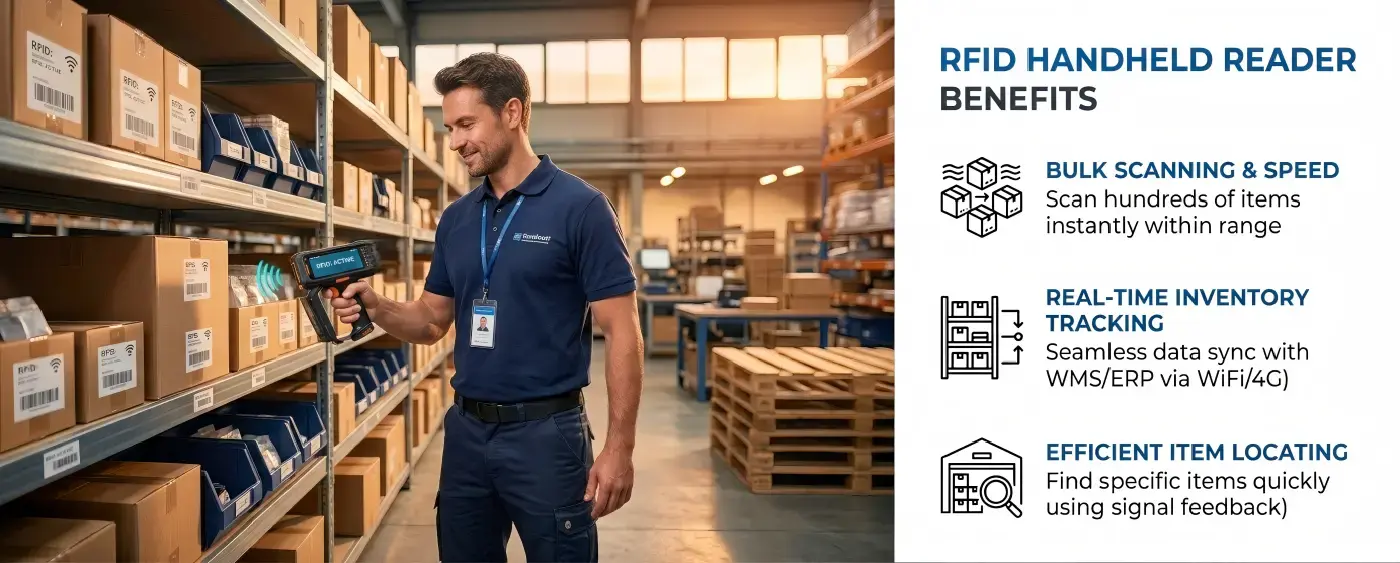
| Bulk & Long-Range Reading | Captures hundreds of tags simultaneously within a range of several meters without line-of-sight visual targeting. |
| Non-Contact Penetration | Reads data through outer packaging like cardboard boxes or wooden crates without needing to unpack items. |
| Real-Time Data Sync | Transmits scans instantly to WMS/ERP systems via Wi-Fi or cellular networks, reducing manual entry errors. |
| High Durability | RFID tags withstand dust, moisture, and rough handling, while industrial handhelds feature rugged, drop-resistant designs. |
| Portability & Item Location | Allows operators to inspect hard-to-reach areas and use signal strength indicators to quickly locate misplaced inventory. |
Choosing the Best Rugged Handheld RFID Reader: Criteria and Market Options
When system designers buy RFID handheld readers for clients, they need to look at both the technical specs and the total cost of ownership. To make the choice, you have to weigh the need for speed against the available budget while also making sure that the tools you choose will work well for the 5 to 7 years that it is supposed to last.
Environmental Durability and Protection Standards
Rugged RFID readers are housed in reinforced aluminium and industrial polymer housings to survive repeated drops from over 1.5 metres, and IP64 protection keeps dust and water splashes out. They operate from -20°C to +60°C and provide constant read range and battery performance in cold storage, outdoor and hot weather applications to reduce temperature related downtime.
Battery Performance and Operational Endurance
High-capacity lithium batteries sustain 8+ hours of continuous scanning, enabling full-shift work without frequent recharge. USB charging makes infrastructure and spares management easier. Battery life is also dependent on use, since continuous high power UHF scanning consumes more power. Accurate duty cycle testing and intelligent power management balance endurance and read reliability.
Read Range, Speed, and Anti-Collision Performance
RFID read range in real world is generally lower than advertized because tag type, orientation, metal surfaces, stacking and warehousing conditions impact performance. Advanced anti-collision systems can handle more than 200 tags per second, facilitating the handling of pallets and bulk items. Testing using genuine tags and typical densities is more reliable than manufacturer specs.
Software Flexibility and Development Support
With strong SDKs that give code examples, API documentation and integration help, professional RFID readers also come with pre-sales technical support. Flexible data formatting, programmable alerts, connection choices and field software upgrades speed application development, keep pace with growing security requirements and safeguard long-term technological investments
Comparing Leading Manufacturers and Market Offerings
There are a number of well-known brands of RFID handheld readers, and each one has its own engineering approach and intended uses. Zebra Technologies uses its many years of experience with barcodes to make ruggedized Android-based systems with RFID built in. These are popular with businesses that want to control all of their devices from one place. Honeywell focuses on making products that are durable enough for businesses and have a lot of accessories that can be used for logistics and field service.
Impinj works on developing new UHF technologies and making readers with improved sensitivity and selectivity that are perfect for supply chain viewing. System integrators who need flexible tools for industry-specific solutions like Chainway and Nordic ID like these options because they are priced similarly. Each company specializes in a certain type of use case. For example, Zebra is good for retail and healthcare, Honeywell is good for warehouse logistics, and niche industrial applications are handled by specialized providers.
By looking at customer feedback, you can find patterns of reliability that go beyond what the marketing says. When choosing a long-term seller, procurement teams should ask for references from customers in related industries and look at how quickly help responds, how readily available spare parts are, and how often firmware updates happen.
Procurement Tips: How to Buy Rugged Handheld RFID Readers for Your Business
Clear documentation of needs and reasonable budget planning are the first steps to a successful deployment of RFID handheld readers. As system designers, our job is to make sure that the hardware we choose works well with the software we already have and meets the performance requirements of both the client and the project's budget.
Pricing Models and Volume Considerations
Industrial RFID handheld readers typically cost $1,200–$4,500, with significant discounts at 50–100 units. Framework agreements can stabilize costs and secure supply. For short-term projects or proof-of-concept deployments, renting reduces upfront approval requirements, while leasing or lease-to-own options spread costs, preserve upgrade flexibility, and reduce supplier adoption risks.
Evaluating Total Cost of Ownership
Total cost of ownership includes more than the purchase price, covering charging cradles, cases, batteries, and software licenses. Support contracts and extended warranties can reduce unexpected repair costs, while fast turnaround and replacement programs minimize downtime. Supplier selection should also consider spare-part availability, costs, and risks from proprietary components.
Supplier Selection and Partnership Considerations
Direct manufacturer partnerships can reduce costs while providing customization and engineering support. WS RFID combines factory-direct pricing, 15 years of experience, and 500 million-unit annual capacity for large deployments. Local technical support, SDK trials, loaner devices, and strong training documentation reduce rollout risks, speed integration, and help partners support diverse markets.
Real Deployment Success Indicators
Some things that all successful implementations have in common are a gradual rollout that starts with a small group of pilots, thorough testing that uses real operating tags and processes, and setting reasonable performance goals based on the environment. Before agreeing to large purchases, procurement teams should demand proof-of-concept demos using samples from their own stock.
Documenting tag-reader compatibility testing keeps costly surprises from happening after the deployment is complete. Different tag designs work differently with different readers. Something that works great in the lab might not work so well in the warehouse. Reliable providers offer compatibility grids and carry out joint testing to make sure that performance meets application needs before fabrication starts.
Rugged vs Standard Handheld RFID Readers: Making the Right Choice
The extra sturdiness for ruggedized RFID handheld readers raises the base price by 40 to 60 percent, which makes buying teams wonder if the industrial-grade specs are really worth the money. This choice is easier to understand when you know more about how tough environment operations really work.
Industrial-Grade Construction Standards
Rugged RFID readers use magnesium alloy and reinforced polymer chassis, sealed buttons, and durable screen protection to withstand drops, dust, moisture, scratches, and cracks. MIL-STD-810G testing verifies reliable performance under extreme temperatures, humidity, vibration, and shock, reducing replacement costs and downtime while maintaining consistent operation in demanding industrial environments.
Performance Trade-offs and Ergonomic Considerations
Rugged RFID readers are heavier than smartphones, requiring ergonomic designs such as pistol grips or lanyard attachments to reduce fatigue during long shifts. Long-lasting batteries add weight and require careful design. Protective housings may reduce read performance, but optimized antenna placement maintains accuracy, while OLED displays improve outdoor visibility for demanding tasks.
Industry-Specific Requirements
Industry-specific environments require rugged RFID readers designed for thermal stress, condensation, hazardous areas, and harsh manufacturing conditions. Cold-storage models need sealed, water-resistant electronics, while oil and gas equipment requires ATEX or IECEx approval. Manufacturing readers benefit from conformal coatings, protected ports, and vibration resistance, providing longer service life and lower total ownership costs.
Maximizing ROI with Handheld RFID Readers: Best Practices and Future Trends
Investing in technology only pays off if an RFID handheld reader is properly combined, regularly kept, and changed in a way that meets business needs. When system designers understand these ideas, they can build long-lasting ties with clients and steady streams of income.
Integration Excellence and Data Flow Optimization
RFID handheld readers act as data collection points within integrated business systems. Middleware removes duplicate reads, validates data, and automates workflows, while RESTful APIs simplify WMS and ERP integration. Real-time data sharing enables immediate exception alerts, improving inventory accuracy and reducing the time and cost of physical checks and reconciliation.
Emerging Technology Enhancements
Emerging RFID readers benefit from longer-lasting batteries, smart charging, and wireless charging. Enhanced security, including AES-256 encryption and secure boot, protects data, while Bluetooth 5.0+ improves connectivity and efficiency. Integrated cameras and environmental sensors add barcode backup, visual verification, automatic display adjustment, and scanning activation, improving usability and battery life.
Strategic Vendor Relationships
Long-term technology partnerships provide training, engineering support, firmware updates, and scalable customization, helping customers move from testing to wider deployment. WS RFID demonstrates this through SDK support, seven-day prototyping, flexible production, and ISO 9001-certified manufacturing. Clear technology roadmaps also help integrators plan upgrades and adopt future features strategically.
Scalability and Upgrade Planning
When systems are first set up, they should have the ability to grow with the business without having to be completely replaced. When you choose readers that can change their software over-the-air, you can be sure that they will work with new tag technologies and security standards. With cloud-based device management systems, setup and tracking are centralized across distributed operations. This means that remote sites don't need as much technical know-how.
Using multi-protocol readers as a standard gives you options as client needs change. A device that can work with both HF and UHF waves can be used for anything from keeping track of inventory in a warehouse to controlling access or stopping counterfeiting without having to change any of its hardware. This flexibility protects investments in technology while making it easier to keep track of extra parts and train technicians.
Conclusion
In conclusion, when choosing the right RFID handheld reader for industrial use, you need to think about technical specs, environmental needs, and long-term support. The higher price of rugged devices is justified by the fact that they last longer and work reliably in tough circumstances where regular devices break down quickly. Successful applications connect readers easily to business systems, use the manufacturer's SDK to make changes, and build long-term partnerships with suppliers that allow for constant innovation. System integrators who understand these ideas offer solutions that boost operational efficiency, lower labor costs, and give a clear return on investment (ROI) that lasts long after the initial deployment.
FAQ
1.Which RFID frequency should I choose for my application?
Application requirements determine the optimal frequency selection for an RFID handheld reader. UHF (860–960MHz) works well in stores, warehouses, and logistics centers with read ranges of 3–8 meters and the ability to scan multiple tags at once. HF (13.56MHz) is best for controlling access, keeping track of documents, and authenticating items at the item level, where shorter ranges (0–10 cm) allow for more accuracy and keep nearby tags from being read by accident. Multi-band readers give integrators who work with clients from different industries or who have different needs more freedom.
2.Can rugged handheld readers perform reliably in extreme environments?
The performance of industrial-grade devices made for harsh conditions stays the same from -20°C to +60°C, so they can be used in cold storage, outdoors, and in factories that get hot. Enclosures with an IP64 rating keep out dust and water, and MIL-STD-810G testing proves that they can handle drops and vibrations. Models designed for dangerous areas have ATEX or IECEx certifications for environments with explosive atmospheres. In these situations, regular consumer devices break down quickly, so purpose-built sturdy readers are needed to keep operations running.
3.What data security considerations apply to RFID reader deployments?
Strong security protocols are needed for RFID handheld readers that collect sensitive business data. Devices should be able to make secured Bluetooth links (AES-128 or higher) and store data safely on their own memory. Integrating with business systems needs secure API access and the ability to keep track of who scanned what things and when. Cloud-connected readers have secure boot processes that stop firmware tampering and over-the-air update features that make sure security patches are deployed quickly. When choosing suppliers for important projects, look at how secure the manufacturer is and how well they can handle incidents.
Partner with a Trusted RFID Handheld Reader Manufacturer
Your operations will run more smoothly if you have reliable mobile data collection technology and quick technical support. With 15 years of experience in manufacturing, WS RFID makes rugged RFID handheld readers that can work with multiple bands (HF 13.56MHz and UHF 860-960MHz), have batteries that last for 8 hours or more, and are waterproof to IP64 standards. Our devices can be fully customized using the SDK, and they can be easily connected to and work with your current business systems thanks to Bluetooth and Android compatibility.
We keep a lot of stock on hand so that standard delivery can happen quickly (7–15 days). We also offer open customization, and samples can be made in just 7 working days. Our 10,000㎡ automatic factory makes more than 500 million units a year, and CCC, CE, and FCC standards back up the quality. Our technical team is here to help you thru the whole integration and deployment process, whether you need evaluation units to test the SDK or volume pricing for large deployments. Email kenny@w-srfid.com to talk about your particular needs and find out why WS RFID is the source of choice for system developers in warehouse logistics, retail operations, and asset management.
References
1. Jones, M. & Thompson, R. (2022). Industrial RFID Systems: Design, Implementation, and Best Practices. Taylor & Francis Engineering Publications.
2. Chen, H., Kumar, S., & Patel, D. (2023). "Comparative Analysis of Handheld RFID Reader Performance in Warehouse Environments." Journal of Supply Chain Technology, 18(3), 245-267.
3. International Standards Organization. (2021). ISO/IEC 18000-6C: Information Technology — Radio Frequency Identification for Item Management. Geneva: ISO Press.
4. Anderson, K. L. (2023). Rugged Mobile Computing: Selection Criteria for Industrial Applications. Industrial Technology Research Institute White Paper Series.
5. Martinez, E. & Zhang, W. (2022). "Total Cost of Ownership Models for Enterprise RFID Deployments." International Journal of Logistics Management, 34(2), 412-438.
6. Williams, P. T. (2024). RFID Technology Roadmap: Emerging Trends in Industrial Asset Tracking. Technology Forecasting and Market Analysis Report, Gartner Research.
Learn about our latest products and discounts through SMS or email