- English
- French
- German
- Portuguese
- Spanish
- Russian
- Japanese
- Korean
- Arabic
- Greek
- German
- Turkish
- Italian
- Danish
- Romanian
- Indonesian
- Czech
- Afrikaans
- Swedish
- Polish
- Basque
- Catalan
- Esperanto
- Hindi
- Lao
- Albanian
- Amharic
- Armenian
- Azerbaijani
- Belarusian
- Bengali
- Bosnian
- Bulgarian
- Cebuano
- Chichewa
- Corsican
- Croatian
- Dutch
- Estonian
- Filipino
- Finnish
- Frisian
- Galician
- Georgian
- Gujarati
- Haitian
- Hausa
- Hawaiian
- Hebrew
- Hmong
- Hungarian
- Icelandic
- Igbo
- Javanese
- Kannada
- Kazakh
- Khmer
- Kurdish
- Kyrgyz
- Latin
- Latvian
- Lithuanian
- Luxembou..
- Macedonian
- Malagasy
- Malay
- Malayalam
- Maltese
- Maori
- Marathi
- Mongolian
- Burmese
- Nepali
- Norwegian
- Pashto
- Persian
- Punjabi
- Serbian
- Sesotho
- Sinhala
- Slovak
- Slovenian
- Somali
- Samoan
- Scots Gaelic
- Shona
- Sindhi
- Sundanese
- Swahili
- Tajik
- Tamil
- Telugu
- Thai
- Ukrainian
- Urdu
- Uzbek
- Vietnamese
- Welsh
- Xhosa
- Yiddish
- Yoruba
- Zulu
Best NFC anti metal epoxy tags for industrial use
When searching for the best NFC anti metal epoxy tags for industrial use, you need a solution that delivers reliable performance on metallic surfaces where standard NFC tags fail. Our industrial-grade NFC anti-metal epoxy tag operates at 13.56MHz with exclusive anti-metal shielding technology, achieving stable read distances up to 10cm on steel, aluminum, and other metal surfaces. With IP68-rated encapsulation, these tags withstand water submersion, chemical exposure, and temperatures from -25°C to +85°C—perfect for manufacturing, logistics, and asset management applications where durability matters most.
Introduction
Metal assets are hard to monitor in factories, stores, and heavy industries. Metal prevents near-field communication tags from working owing to signal suckage and electromagnetic interference. Operations management and procurement teams have long lamented this technological issue.
Due to meticulous manufacturing, the NFC anti-metal epoxy tag solves this. A ferrite protective layer between the antenna and the metal surface of these tags modifies magnetic fields to make them always readable. It's the sole distinction between a functional and non-working tracking system.
Engineers, marketers, and procurement managers must pick ROI-driven tagging systems. Choices affect inventory accuracy, maintenance frequency, and supply chain clarity. Know the physics behind anti-metal tags, how they are used, and how to acquire them to have alternatives in tight circumstances. This book contains technical information and advice to help you make informed purchase choices that will grow your company.
Understanding NFC Anti-Metal Epoxy Tags
Core Technology and Anti-Metal Shielding
NFC devices on metal surfaces are difficult to attach due to real-world mechanics. Metallic eddy currents are created by NFC readers' radio frequency fields because metal conducts electricity. These currents create a magnetic field opposite the reader's, discarding the signal and stopping contact.
An NFC anti metal epoxy tag with a high-permeability ferrite separating layer between the radio circuit and backing solves this issue. This ferrite substance redirects the magnetic field away from the metal surface, offering a method for people to interact. It improves performance while adding little to the look and is generally 0.1–0.5 mm thick.
It operates at 13.56MHz and follows ISO/IEC 14443. All NFC-enabled smartphones and industrial readers support this frequency range. NXP NTAG or Desfire chips in the tag may hold 144 bytes for basic identification or 888 bytes for comprehensive data records. Every tag complies with NFC Forum Type 2/4/5 standards, which means that they will function with all systems and secure your investment in the future.
Epoxy Encapsulation Benefits
Epoxy glue for industrial use has several applications beyond protection. RF-transparent material doesn't block transmissions. This clarity optimises antenna performance and provides a strong physical barrier.
The epoxy coating is IP68, the highest dust and water protection. Your tags may be immersed entirely in water without losing signals or being damaged. This is vital when equipment is pressure cleaned, utilised in moist environments, or accidentally touches liquids.
Chemical protection is helpful too. Epoxy protects against manufacturing oils, cleaners, and other corrosives. Epoxy-encapsulated tags survive longer than paper and plastic labels. UV light resistance prevents the material from yellowing and cracking in outdoor settings.
It may be utilised in cold storage and high-heat manufacturing locations since it can withstand -25°C to +85°C. A properly formulated epoxy doesn't shatter when temperatures climb or decrease. This implies a lengthy lifespan. It lasts longer, costs less to replace, and lets users access data reliably.
Extended Lifespan and Reliability
This design works in real life after durability testing. Salt spray testing lasting 48–96 hours has proved marine and high-salinity resistance. UV ageing studies reveal that epoxy remains mechanical and transparent despite long-term light exposure. Write/read endurance cycles verify data integrity over 100,000 operations, exceeding industry standards.
The tag always works when other alternatives fail. You always obtain precise readings on rough metal, curved surfaces, and shaking equipment. Signal performance is constant regardless of environment. This dependability eliminates read mistakes and lost data from less reliable naming schemes.
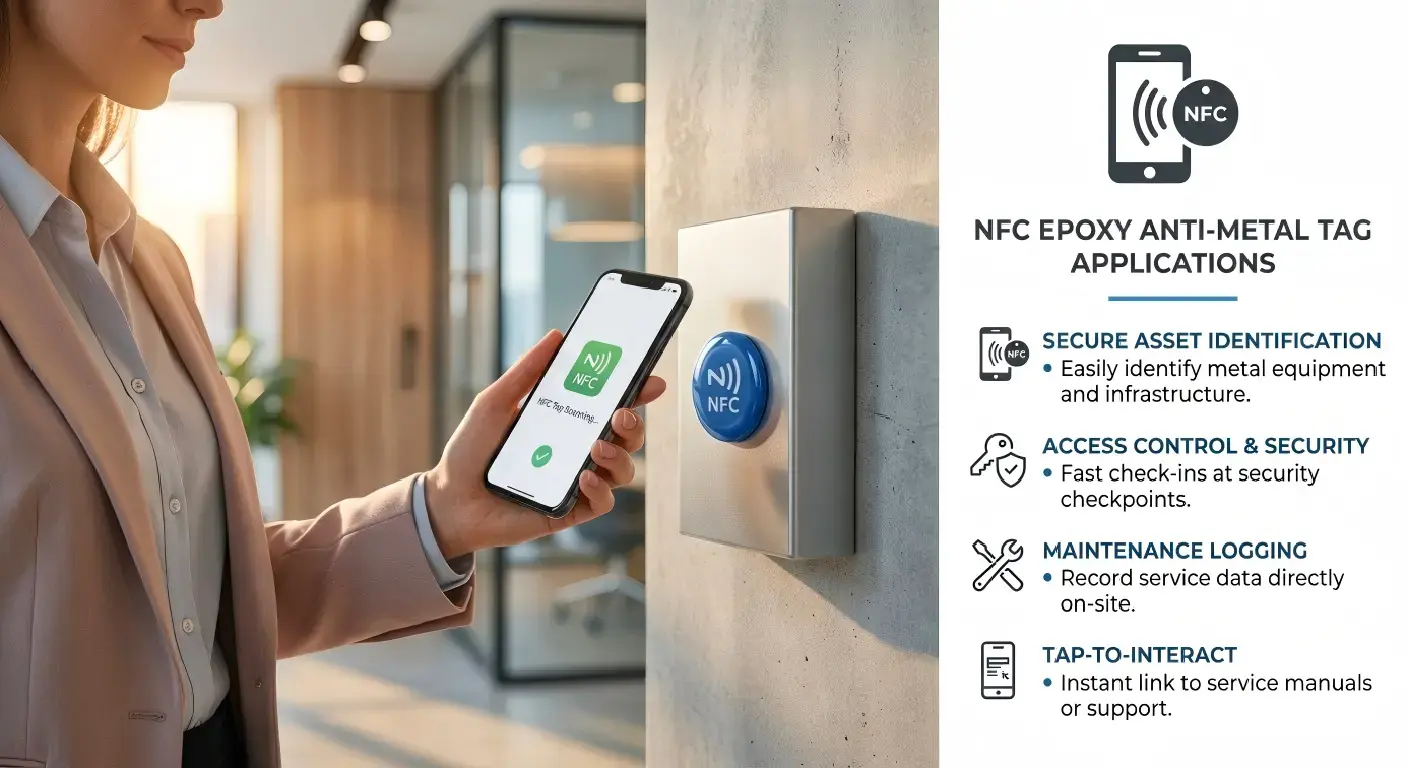
Key Industrial Applications of NFC Anti-Metal Epoxy Tags
Manufacturing and Asset Management
Production locations have pricey equipment that must be monitored carefully. CNC equipment, injection moulds, precise tools, and specialised fixtures are expensive. By adding an NFC anti-metal epoxy sticker, each object gets a lifetime digital identification.
A smartphone or portable reader can instantly display the tag's location history, maintenance records, calibration dates, and use statistics. This eliminates logbooks and spreadsheets. The technology immediately alerts maintenance personnel of tool issues. You know which assets are utilised, fixed, and usable.
Automakers use these identifiers on engine, frame, and quality control components. Each scan records the manufacturing process from raw materials to finished autos. Companies swiftly identify damaged quantities and components during recalls. This reduces their liability and consumer impact.
Logistics and Container Tracking
Metal shipping containers, chemical drums, gas cylinders, and industrial bins benefit from permanent identification. Adding an NFC anti-metal epoxy sticker to these objects enables you to rapidly count and locate them. Warehouse personnel scan products as they receive, store, and transport them to stay informed.
This software aids cold chain management. Tags protect refrigerated containers from temperature fluctuations and provide rapid access to product information, temperature records, and management directions. The IP68 rating ensures it functions in misty conditions.
E-commerce fulfilment centres place these identifiers on metal shelves, transport carts, and returnable packages. Automation systems scan tags and update inventory databases as items travel through the facility without human intervention. Staff expenses have lowered by 80%, and order accuracy has improved.
Electronics and Medical Equipment
Metal-cased consumer electronics must be traced from production to sale. Manufacturers may tag products with batch numbers, manufacturing dates, and quality checks using NFC anti metal epoxy tags. Retailers and service centres check the tag for authenticity, warranty information, and past repairs.
Medical tool tracking requires stricter criteria. Surgical tools are repeatedly sterilised at high temperatures. Tags must withstand these procedures while protecting data. These epoxy-covered tags can withstand varying temperatures and be utilised in healthcare settings where tool tracking is crucial for patient safety.
Hospital metal medical carts, IV poles, ventilators, and diagnostic gadgets are tagged. The staff checks gadgets while allocating rooms, transporting patients, and repairing. The strategy prevents tool loss, ensures correct sterilisation, and maximises asset utilisation across locations.
Installation Best Practices
Tags perform best when properly placed. Clean metal surfaces with isopropyl alcohol to remove oils, dust, and residues. Wait until the surface is completely dry before applying the tag. 3.M 300LSE or VHB glue clings nicely to metals with low surface energy and rough edges; therefore, most tags are attached.
Press firmly and evenly over the tag for 10–15 seconds. Before stressing or roughing up the tag, let the adhesive set for 24 hours. This healing period will strengthen the link. Instead of glue-only tags, use ones with screw-mounting holes for high-vibration conditions.
Make sure the read distance works after installation. Reader strength, metal thickness, and weather affect read range. Changing the reader or antenna location or orientation may help with challenging settings.
Comparing NFC Anti-Metal Epoxy Tags with Other Technologies
Standard NFC Tags vs. Anti-Metal Variants
Standard NFC tags are less expensive, but they don't work at all on metal. They can't be read because of electromagnetic interference, so they can't be used in industrial settings with metal assets. At first, you might save money, but when tags don't work right, the total cost of ownership goes through the roof.
The anti-metal versions have ferrite protection and special antenna designs that keep working on metal. The tags work in your setting, but they cost more per unit. This isn't a fancy extra—you have to have it in order to tag metal items. The slightly higher price gives you a lot more value because it works reliably.
Read range is also very different. Standard tags can read from 5 to 10 cm away from non-metal surfaces, but anti-metal tags can read from 1 to 10 cm away from steel or aluminum. When automating inventory tasks or connecting with mobile apps, this uniformity is important.
NFC vs. UHF RFID for Metal Applications
Ultra-high frequency RFID devices work at 860 to 960 MHz and have read ranges that are longer, sometimes more than a few meters. Because of this, UHF is a good choice for workplace tasks that need to scan a lot of items at once. But UHF systems need special readers and equipment, which makes them more expensive to set up.
NFC works at 13.56MHz and has lower read ranges, but it can be used with any device. These days, every smartphone has NFC built in, so you don't need any extra hardware. Employees use gadgets they already have on them to access information about assets, which cuts down on the need for training and the cost of tools.
Security concerns are also different. Because the read range for NFC is so small, someone has to be within inches of the tag in order to scan it. Because UHF has a longer range, it can be scanned by people who aren't supposed to. Even though it has a shorter range, NFC is better for applications that need secure entry or data security.
Both tools can be used in the right situations. UHF helps large stores keep track of boxes that are moved over long distances. NFC is more useful and cost-effective for factories that need to keep track of individual tools and machinery. The right choice is made when you know exactly what you need.
Durability and Cost Comparison
Most of the time, epoxy-encapsulated tags cost more than plastic-housed tags, but they last longer. Plastic housings crack, yellow, and peel off, but epoxy doesn't. The lower replacement rate more than makes up for the higher original investment over a 5–10 year run.
Leading manufacturers keep their defect rates below 0.3%, which ensures that the quality is always the same. WS-RFID's 10,000㎡ automated production plant makes more than 500 million pieces a year, which helps big orders by taking advantage of economies of scale. Compliance with RoHS, REACH, and CE standards and ISO 9001:2015 certification show that the products are made well and are good for the environment.
Buying price, installation work, repair frequency, and system downtime are all things that need to be compared in order to find the lowest total cost of ownership. It is better to buy an NFC anti metal epoxy tag that costs 20% more but lasts three times longer. Figure out what the most cost-effective option is by analyzing your individual usage habits and environmental conditions.
How to Choose the Best NFC Anti-Metal Epoxy Tag for Your Industry Needs
Critical Selection Factors
Different uses need different durability. Climate-controlled equipment is monitored differently from outside ones. Measure temperature, chemical exposure, physical impact, and moisture. Avoid premature breaking by matching tag standards to your toughest environments.
Read range affects task quality and system design. Maximum read distance is needed for hands-free applications. Smartphones can hand-scan small distances. Review specifications with hardware and scanning distance in mind. Practical read range varies on reader power, metal thickness, and atmosphere.
Merging works with system compatibility. The tags should support your chip technology and memory. NTAG213 contains 144 bytes for basic recognition; NTAG216 contains 888 for comprehensive records. Desfire chips improve vital safety. Your chip choice relies on data and security needs.
Budget issues lack unit price emphasis. Take ownership cost into account. Less expensive tags fail too quickly, forcing system shutdown and higher repair costs. Consider initial investment, lifespan, and replacement. For big deployments, volume reductions reduce unit costs.
Customization Capabilities
Size freedom is essential when classifying instruments. Large machines can handle tags with long scan ranges, but small parts must be reduced. Top manufacturers provide 8-mm normal and special sizes. Matching tag size to programme optimises speed and attractiveness.
Printing enables branding, sequential numbering, and legibility. Text and logos are silk-screened over adhesive. This protects photographs against chemicals and scratches. The environment can't remove laser etching. Variable data writing allows you to include serial numbers or QR codes for identification verification.
As tags are made, encoding services put your information on them to save time. Data may be protected, IDs added, and access limitations set by manufacturers. The service simplifies deployment and integration.
Company names and equipment types may be changed on tags. Epoxy is clear, but manufacturers may paint or print in full colour. Visual coding simplifies identification and unifies your brand across materials.
Manufacturer Evaluation
Supplier dependability impacts your business. Successful manufacturers reduce supply chain risks. Find companies with ISO certificates, enough space, and quality assurance. After 15 years with Fortune 500 companies, WS-RFID has shown its stability and business implementation skills.
Production sizes affect growth and lead times. Automated high-volume lines handle orders quickly and accurately. Customised goods ship in 10–12 days to meet unique needs, while standard items ship in 7–10 days for fast launch.
Good vendors and great partners provide different technical assistance. Field application specialists integrate SDKs, optimise systems, and test on-site for deployment success. It makes connecting tags to IT systems and addressing speed concerns easy.
Warranty and after-sales service protect your investment. Look for 1- to 2-year performance and production warranties. Replacement policies and expert assistance throughout a product's lifecycle contribute to customer success.
Procurement Insights: Buying NFC Anti-Metal Epoxy Tags
Sourcing Strategies for Global B2B Buyers
Search for reliable providers of NFC anti metal epoxy tags. Get compatibility samples before buying in large quantities. Real-world testing should include read range, adhesion, and durability. This ensures tags are suitable to prevent expensive mistakes.
Direct manufacturing cuts expenses and enhances communication. Dealer-marked prices are 15–30% more than factory-direct. We provide professional customisation that wholesalers cannot. WS-RFID's direct approach enables OEM/ODM agreements to ensure product quality.
Large price discounts may result from volume discussions. Price varies by manufacturer and quantity. Most units cost 10,000, 50,000, or 100,000. For the greatest savings, plan your yearly requirements and bundle purchases. Some services assist in monitoring and keeping things till release, increasing cash flow.
Quality Assurance and Testing Protocols
Reputable manufacturers check quality throughout manufacturing. Using network monitors to assess resonance frequency ensures 13.56MHz metal-linked tags. The accuracy provides order-wide read performance.
Range comparison tags on aluminium, steel, and copper should work. This test detects manufacturing flaws that may influence performance. Manufacturers should report batch-specific test results.
Environment stress testing confirms lifespan claims. The material is rust-resistant for marine or outdoor usage after 48–96 hours of salt spray testing. UV tests demonstrate epoxy retains brightness and mechanical properties. Thermal stability exists from -40°C to +100°C cycling temperatures. For these tests, get manufacturer test certifications.
Data integrity testing reads and writes tags 100,000 times for chip and EEPROM lifespan. Tag data must be valid to prevent safety or compliance concerns.
Long-Term Supplier Relationships
Maintaining order quality requires robust seller connections. Expectations, quality, and approval criteria should be stated in initial agreements. Remember these fundamentals to avoid buying blunders. Communication updates you on shifting demands.
To streamline supply chains, manufacturers manage stockpiles. Some suppliers save additional products for returning customers to fulfil urgent requests. This service is crucial when equipment malfunctions or the firm develops fast.
Releases boost performance reports. Reports tag failures, read speed, and integration issues. This intelligence helps cooperating manufacturers improve goods and processes.
Multiple suppliers for important jobs lessen risk. Although big providers handle most of the volume, verified backups maintain supply. This method requires more administrative effort but prevents production from pausing if one source fails.
Conclusion
To choose the best NFC anti metal epoxy tags for industrial use, you need to know about the technology, think about what you need, and work with manufacturers who have a history of producing high-quality products. Through anti-metal protection, durable epoxy encapsulation, and reliable NFC communication, these specialized tags solve the main problem of keeping track of metal assets in harsh settings. The right tags make operations run more smoothly, and data is more accurate whether you're keeping an eye on medical devices, transportation containers, or industrial equipment. When you focus on the total cost of ownership, check the supplier's skills, and make sure the system works with the product, you can make purchasing choices that will help you succeed in the long run.
FAQ
1. Why is the NFC anti-metal epoxy tag thicker than standard stickers?
The extra thickness comes from the ferrite shielding layer, which is usually between 0.1mm and 0.5mm thick and is put between the antenna and the adhesive backing. This layer moves magnetic fields away from metal objects. This keeps signals from being absorbed, which would make the tag useless otherwise. The epoxy coating adds only a small amount of thickness and protects against IP68, but the ferrite layer is what makes the profile bigger than paper-based NFC stickers.
2. Can these tags function on non-metal surfaces like plastic or wood?
Yes, NFC anti-metal epoxy tags can be used on any surface that isn't made of metal. The anti-metal shielding doesn't get in the way of normal operation; when mounted on metal, it just adds extra functionality. You can use the same tag on different types of assets without slowing them down. The epoxy coating actually makes them last longer than regular tags, no matter what surface they are mounted on. This makes them great choices even for non-metal uses that need tough protection.
3. What is the expected lifespan in harsh industrial environments?
When placed correctly, tags usually work for 5 to 10 years in harsh industrial circumstances. Normal tags break down in months when they are exposed to UV light, chemicals, or physical damage, but the epoxy glue lasts for years. The EEPROM memory can store data for decades without power, and the NFC chip doesn't have any moving parts. The actual lifespan depends on the surroundings, but these tags always last longer than alternatives, which means they don't need to be replaced as often and don't need as much upkeep.
4. Will these tags work with our existing asset management software?
NFC anti metal epoxy tags work with standard ISO/IEC 14443 protocols and NFC Forum Type 2/4/5 specifications, so they can be used with a lot of different devices. Most asset management systems that work with NFC tags can read and write to them without making any changes. The tags can be used with any smartphone that supports 13.56MHz HF NFC, as well as dedicated RFID readers and industrial scanning equipment that supports that frequency. Before you buy the tags, make sure that your system can handle the chip type (NTAG series or Desfire) that was mentioned.
Partner with WS-RFID for Your NFC Anti-Metal Epoxy Tag Requirements
WS-RFID offers enterprise-level NFC anti metal epoxy tag options that are made to be reliable in the workplace. Our 10,000㎡ ISO-certified factory makes more than 500 million units a year with a defect rate of less than 0.3%, so the quality of every order is the same. As a top NFC anti-metal epoxy tag maker, we can make any design you want, from 8mm designs that are very small to custom printing and programming. It takes 7–10 days to ship standard items, and 10–12 days to finish unique solutions. Our Field Application Engineers help with SDK integration, system optimization, and testing on-site to make sure that deployment goes smoothly. We've worked with Fortune 500 companies for over 15 years and have RoHS, REACH, and CE certifications, as well as contracts that last between one and two years. Get in touch with kenny@w-srfid.com right away to talk about your unique needs and get a price that is made to fit your industrial asset tracking needs.
References
1. International Organization for Standardization. (2016). ISO/IEC 14443: Identification cards — Contactless integrated circuit cards — Proximity cards. Geneva: ISO.
2. NFC Forum. (2021). NFC Forum Type 2/4/5 Tag Operation Specification: Technical Requirements for Near Field Communication Tag Platforms. Wakefield, MA: NFC Forum, Inc.
3. Finkenzeller, K. (2010). RFID Handbook: Fundamentals and Applications in Contactless Smart Cards, Radio Frequency Identification and Near-Field Communication (3rd ed.). Chichester: John Wiley & Sons.
4. Dobkin, D. M. (2013). The RF in RFID: UHF RFID in Practice (2nd ed.). Burlington: Newnes.
5. Want, R. (2006). An introduction to RFID technology. IEEE Pervasive Computing, 5(1), 25-33.
6. Weinstein, R. (2005). RFID: A technical overview and its application to the enterprise. IT Professional, 7(3), 27-33.
Learn about our latest products and discounts through SMS or email