- English
- French
- German
- Portuguese
- Spanish
- Russian
- Japanese
- Korean
- Arabic
- Greek
- German
- Turkish
- Italian
- Danish
- Romanian
- Indonesian
- Czech
- Afrikaans
- Swedish
- Polish
- Basque
- Catalan
- Esperanto
- Hindi
- Lao
- Albanian
- Amharic
- Armenian
- Azerbaijani
- Belarusian
- Bengali
- Bosnian
- Bulgarian
- Cebuano
- Chichewa
- Corsican
- Croatian
- Dutch
- Estonian
- Filipino
- Finnish
- Frisian
- Galician
- Georgian
- Gujarati
- Haitian
- Hausa
- Hawaiian
- Hebrew
- Hmong
- Hungarian
- Icelandic
- Igbo
- Javanese
- Kannada
- Kazakh
- Khmer
- Kurdish
- Kyrgyz
- Latin
- Latvian
- Lithuanian
- Luxembou..
- Macedonian
- Malagasy
- Malay
- Malayalam
- Maltese
- Maori
- Marathi
- Mongolian
- Burmese
- Nepali
- Norwegian
- Pashto
- Persian
- Punjabi
- Serbian
- Sesotho
- Sinhala
- Slovak
- Slovenian
- Somali
- Samoan
- Scots Gaelic
- Shona
- Sindhi
- Sundanese
- Swahili
- Tajik
- Tamil
- Telugu
- Thai
- Ukrainian
- Urdu
- Uzbek
- Vietnamese
- Welsh
- Xhosa
- Yiddish
- Yoruba
- Zulu
How RFID Tags for Eyeglasses Improve Optical Store Efficiency
RFID optician tags transform eyewear retail by automating inventory tracking and eliminating manual counting errors. These specialized electronic labels attach discreetly to eyeglass frames, enabling optical stores to scan entire displays in minutes rather than hours. By leveraging radio-frequency identification technology operating at HF 13.56MHz or UHF 860-960MHz frequencies, retailers gain real-time visibility of stock levels, reduce shrinkage from theft, and accelerate checkout processes. The ultra-thin design—just 0.08mm thick—ensures customer comfort remains unaffected while operational efficiency dramatically improves through batch reading capabilities that process hundreds of frames simultaneously.
Understanding RFID Optician Tags and Their Role in Optical Stores
What Are RFID Optician Tags?
RFID optician tags are special pieces of tracking hardware that were made to work in eyewear stores. These electronic transponders are different from other ways of identifying people because they insert digital names into each frame without hurting the look or the customer experience. The technology uses radio waves to send information about products directly between tags and readers. This makes an automatic system for managing assets.
The main structure of the system is made up of three parts: the tag (which is attached to frames or temples), readers (which can be fixed or handheld) placed around the store, and backend software that handles real-time data. With this connection, optical stores can keep an eye on how their stock moves, make sure it's correct, and immediately notice any illegal removals. Because they are wireless, they don't need line-of-sight like barcode systems do, so employees can do checks without having to touch each thing.
Frequency Options and Technical Capabilities
These days, glasses tracking systems work on two main radio bands. High Frequency (HF) systems at 13.56MHz offer safe, close-range communication that is perfect for high-value frame identification and point-of-sale transactions. Ultra-High Frequency (UHF) variants ranging from 860MHz to 960MHz offer read ranges of up to 10 centimeters, allowing for fast bulk scanning of storage areas and display cases.
Both frequency types are compatible with ISO/IEC 14443 and EPC Gen2 protocols, which means they can work with current store systems around the world. The tags have memory sizes ranging from 96 bits to 512 bits and can store unique identification codes. The data can be stored for more than 10 years and written over 100,000 times. Because they last so long, they can be used to track frames through all stages of a product's life, from being received in the warehouse to being bought by a customer.
Deployment Scenarios in Optical Retail
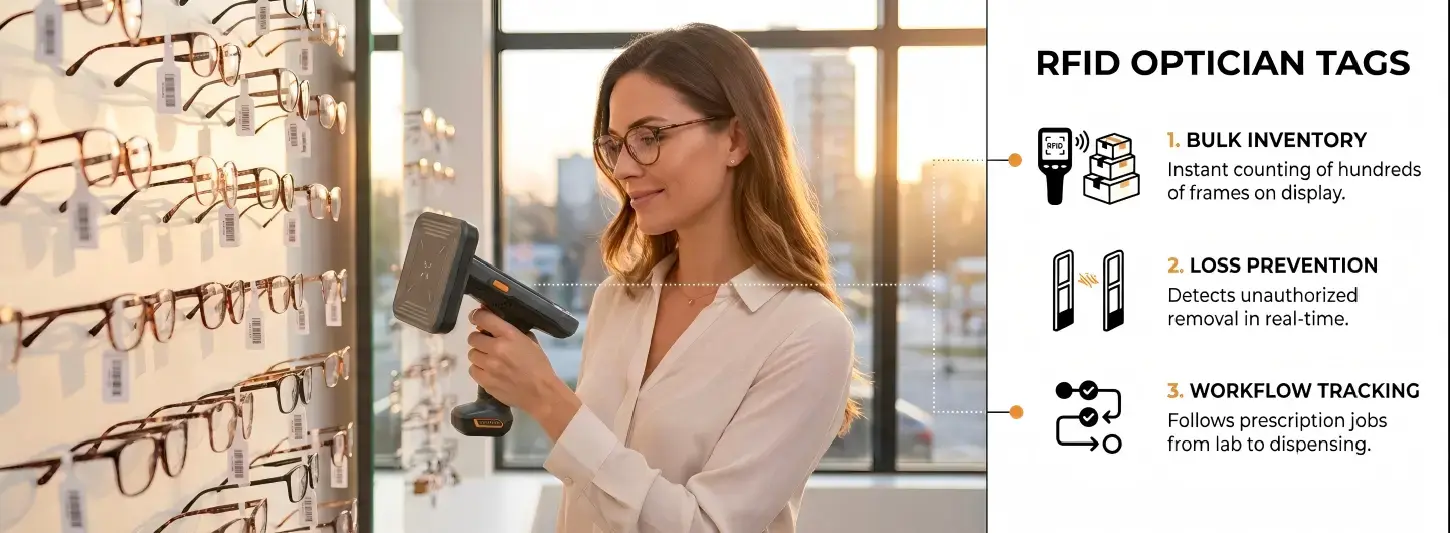
The implementation generally addresses three main difficulties. Many stores hand-count designer frames, prescription glasses, sunglasses, and accessories, reducing inventory accuracy. RFID optician tags monitor supply instantly and notify customers about out-of-stock versions.
Reactive loss prevention becomes proactive. Integrated anti-theft systems alert promptly when tagged things pass through exit gates without deactivation. The system records try-ons and correlates customer frame views to conversion rates. This gives merchants data conventional methods can't.
Checkout speed helps users and staff. Labelled frame scanning takes seconds, unlike barcode searches. The outcome is decreased peak wait times. Inventory databases are immediately updated, reducing the need to balance books after sales.
Key Benefits & Applications in Optics
| Application | Function | Impact |
| Rapid Inventory Audits | Staff wave a handheld UHF scanner across display boards, showcases, and storage trays. | Reduces frame count times from hours to 5–10 minutes without closing the store. |
| Shrinkage & Loss Control | Identifies missing frames instantly during daily scans. | Detects theft or misplaced items between display floor and backroom drawers. |
| Lab & Workshop Tracking | Tracks customer prescription jobs moving through edging, fitting, and assembly phases. | Prevents mix-ups during lens mounting and custom prescription processing. |
| Smart Showcase & POS Integration | Integrates with RFID smart trays or desktop readers at check-out/try-on tables. | Automatically pulls up frame specs, color options, and stock levels on digital displays. |
Comparing RFID Optician Tags with Traditional Tracking Methods
RFID Versus Barcode Systems
The data collection process has changed significantly. Barcode scanning requires direct line-of-sight location, so workers must handle and aim each frame at the reader. As stock rises, this procedure takes longer, particularly when frames are held in stacked trays or tight displays.
RFID optical tags can scan numerous tags without touching or aligning them. A handheld scan of a shelf reveals all marked goods within range, tracking stock rapidly. Another key difference is durability. Encapsulated electronic tags can withstand retail environments including handling, cleaning chemicals, and UV light, whereas printed barcodes can't. Klimatized displays and storage rooms with variable temperatures are dependable due to the -40°C to +85°C operational temperature range.
Passive RFID Tags and Cost Efficiency
Passive tags are most common in optical store uses because they don't need to be maintained and can be used on a large scale for less money. Active RFID tags need internal batteries to work, but passive RFID optical tags get their power from the electromagnetic fields created by readers. This means they never need to be replaced and can keep working forever. This feature is especially useful for stores that sell a lot of items and have to keep track of thousands of SKUs in many places.
The very thin PET construction (only 0.08mm) makes it possible to connect the product discreetly to temple arms or frame bridges without changing how it looks or how it balances. Medical-grade adhesives, micro-riveting, or integration during manufacturing are some of the ways that frames made of materials ranging from acetate to titanium can be installed. Cost per tag goes down a lot as more are used. For large-scale deployments, unit economics can give ROI within 12 to 18 months just by saving time on work.
Technical Compatibility with Retail Systems
Integration with current point-of-sale and enterprise resource planning systems is what makes an implementation successful. Standardized middleware standards let modern RFID optician tags systems share data with major retail software companies without having to be custom-built. The technology works with both cloud-based and on-premises architectures, so it protects current IT assets and adds more advanced tracking features at the same time.
Mobile compatibility lets you use features that aren't limited to fixed infrastructure. When staff members connect RFID readers to their smartphones or tablets, they become movable inventory management tools that can be used anywhere in the store to do things like cycle counts, stock transfers, and customer service lookups. This portability is especially helpful for specialty optical shops that have to work in small spaces where set reader installations are limited.
How RFID Improves Optical Store Efficiency: Bottlenecks and Solutions
Eliminating Manual Inventory Errors
Optical stores usually keep between 500 and 5,000 different SKUs for frames, lenses, and extras, which makes their inventory very complicated. Retail industry standards say that errors happen between 5 and 15% of the time when counting items by hand. This means that you might run out of popular items or have too much of slow-moving items. These differences lead to lost sales, higher inventory costs, and unhappy customers when desired frames don't show up in the store even though they are there.
RFID optician tags solve this problem by automatically counting cycles, which is more than 99% accurate. Full inventory audits can be done by staff in 30 minutes instead of the 6–8 hours needed for manual methods. This means that stock can be checked every day instead of once a month. The system flags mistakes right away, so they can be looked into while the details of the transaction are still fresh, instead of weeks from now, when they can't be recovered.
Accelerating Stock Audits and Replenishment
Normal operations are slowed down by traditional auditing methods, which force shops to stop or have fewer employees during counting times. Because it takes a lot of work, audits can't happen very often, so management has old information between verification cycles. With RFID optician tags technology, checks are now just normal jobs that are done in the background during business hours, so customers don't have to worry about them.
Just-in-time replenishment methods can work if you can see your supplies in real time. When stock levels drop below certain levels, automatic purchase orders go to suppliers, or move requests go to warehouses that have extra stock. This dynamic distribution stops both stock-outs and the buildup of too many goods, which makes the best use of working capital. Seasonal collection changes also happen faster. Scanning incoming shipments quickly compares received numbers to manifests, and outgoing seasonal stock is recorded for return or transfer without the need for human recording.
Integration with POS and ERP Platforms
RFID hardware, retail management software, and business systems must communicate and send data. Integrating Microsoft Dynamics, SAP Retail, and Oracle NetSuite are top options. This cuts custom integration expenses. The middleware layer converts tag scans into business data. This is done by minimising unnecessary scans and standardising system data formats.
Staff training is low since platforms are simple and fit existing procedures. Scan the tag before paying to finish checkout. System reorders after inventory file update. Management displays highlighted inventory rotations, shrinkage, and stock accuracy. This makes data-driven judgements easier than with manual processes. Optical chains that switch to customer service have saved 70–80% on labour.
Selecting the Right RFID Optician Tags for Your Optical Business
Assessing Procurement Requirements
Effective RFID optical tag deployment starts with a comprehensive product size, layout, and practical goals study. National chains with 10,000 SKUs in 50 stores have distinct needs from small businesses with 500 to 2,000 in one or two. Store layout crucial. In open-concept boutiques with little inventory, readers should be placed differently than in optical shops with plenty of storage.
The following factors affect specification creation:
- Reading Range and Frequency Selection: High-end stores that value one-on-one interactions and item-level verification should utilise HF systems, whereas high-volume enterprises that want to scan numerous items quickly should use UHF systems. Hybrid setups use HF at the register and UHF in the back room to track items.
- Environmental Durability: Frames affect tag performance. For signal tuning, titanium frames with metal portions need anti-metal tags with distinct antenna designs. Tags stay on plastic and acetate frames. Also, cleanliness important. Ultrasonic bath compatibility requires ruggedized casings, although dry-wipe adhesive tags work.
- Waste-intensive retailers prioritise EAS tags. Tags trigger exit alarms and track merchandise, boosting security. Compare tagged products to real-time sales transactions to decrease false warnings from stand-alone EAS systems.
Customization and Material Considerations
WS RFID may be configured for optical retailers, with RFID optician tags fitting little kids' glasses to stylish sunglasses. This enables discreet product placement and presentation. Custom printing adds brand names, SKU numbers, or decorative aspects without detracting from the product.
Consider performance and surroundings while selecting a material. Ultra-thin PET substrates are flexible for curving temple surfaces, whereas FR4 structures are stiff for cases and display supports. Medical-grade glues remove high-end designer frames without residue, keeping their value throughout the sales cycle. Colour-matching hides tags on dark frames, addressing boutique merchants' aesthetic concerns.
Chip selection affects cost and performance. NXP UCODE and Impinj Monza ICs are sensitive and perform well in difficult scenarios. They read correctly despite metal fittings or thick frame groups. Apps set memory size. Authentication and lifecycle tracking need larger user memory zones for origin data, warranty information, and service history than inventory monitoring.
Supplier Evaluation and Procurement Logistics
Choosing the correct RFID optical tags supplier influences long-term success beyond product quality. Scalability depends on the vendor's yearly output. Suppliers that generate 500 million or more units may handle pilot to enterprise-wide deployments without disrupting supply. RoHS/REACH and ISO 9001 certification assure international quality.
Delivery time affects setup. Inventory ships in 5–7 days for fast pilot launches, while customised solutions take 10–12 days for customised deployments. 500-piece minimum suppliers simplify testing before major purchases.
Transactional suppliers and strategic partners provide technological assistance. Included are sample testing, antenna tuning, SDKs for software integration, and field application engineering help throughout deployment. Your purchases are covered by a one- to two-year warranty, and technical support fixes problems before they disrupt shop operations.
Maximizing RFID Benefits with Best Practices and Future Trends
Optimal Tag Placement and Data Management
Tagging strategically enhances readings and product purity. Temple tags conceal them from customers but reveal them to scanners. When temples are hard to access, rimless frames use different bridge or end sections. Testing several locations during the pilot phase may help you find the best stock frame settings.
Data management techniques guarantee correctness and system performance. Encoding hierarchical tags like brand, model, size, and colour improves reporting while retaining database efficiency. Encoding problems are caught by data validation before they spread throughout inventory systems. Archive methods move old transaction records to other databases while keeping inventory in fast-operating systems. Historical visibility and system performance are preserved.
Security Protocols and Compliance
Business data and customer privacy need many protection layers. To protect frame-stored private data, tag-stored data is encrypted. System access is limited by employee employment. Management can only see financial outcomes, while salespeople can see inventories. Regular security checks find flaws before they're exploited.
Data security and consumer warnings are typical regulations. Openness needs are usually met with clear RFID optical tag signage. Deactivating or removing tags at checkout eliminates privacy issues. These methods may increase customer trust, retail efficiency, and savings.
Emerging Technological Integration
RFID optician tags and technology may increase options. Internet of Things systems use RFID optician tags, environmental sensors, and consumer flow counters to provide tactical information. Machine learning finds hidden patterns. Demand may be estimated and stock allocated appropriately.
Next-generation tracking glass tags include additional sensors. Monitor temperature and humidity to preserve crucial frame materials during storage and transit and warn personnel of hazards. Tamper-evident designs work quickly to protect valuable goods. These advanced features are pricey, but like other technologies, they will become cheaper in three to five years.
Checkout counters are eliminated with mobile POS. Instead, staff may use RFID-enabled tablets to complete transactions anywhere in the store. It frees up room for fixed checkout systems and enhances customer experience at hectic times. This helps small optical stores that value personal service above transactional efficiency.
Conclusion
In conclusion, RFID optician tags make glasses stores much more efficient by automating product management, preventing loss, and providing better customer service. Long-standing operational problems, such as mistakes made when counting items by hand, limited visibility of stock, and theft losses, are fixed by this technology. It also opens the door to new features, such as try-on analytics and dynamic replenishment. For implementation to go well, the requirements must carefully match business goals with technical capabilities, and experienced suppliers must give full integration support. As RFID optician tags technology improves and prices keep going down, it will go from being a competitive advantage to an operating requirement for optical stores that want to stay efficient in markets that are becoming more competitive.
FAQ
1. If you compare RFID optician tags to regular barcodes, how long do they last?
In optical stores, RFID optician tags last a lot longer than printed barcodes. Electronic parts that are sealed off from chemicals used for cleaning, UV light from displays, and repeated handling don't really affect them. Tags keep their data for more than 10 years and can be read and written on more than 100,000 times. Barcodes, on the other hand, fade, smudge, or come off after just a few months of regular use. The ultra-thin PET construction bends with the frame without cracking, so the product will be reliable for a long time.
2. Will RFID optician tag systems work with the POS tools we already have?
Standardized middleware protocols make it possible for modern RFID optician tags solutions to work with most major retail management platforms. There are already connectors made for widely used systems like Lightspeed, Vend, and Square, so you don't have to do as much custom development. The integration layer turns RFID optician tag data into formats that your current software can read. This keeps your workflows the same while adding the ability to automatically track things. Technical support teams help with setting up during implementation to make sure that data flows smoothly between hardware and software parts.
3. How are prices set for sales of a lot of RFID optician tags?
When you make a bigger pledge, the price per unit goes down because of volume-based pricing. Standard tags cost about $0.15 to $0.30 each for orders of 10,000 or more, but they cost only $0.08 to $0.15 each for orders of 100,000 or more. Custom options like special materials, painting, or more memory cost more, but you can still get savings for buying in bulk. A lot of suppliers have tiered pricing systems, with minimum order quantities that range from 500 pieces for testing to millions of units for large-scale deployments.
Transform Your Optical Retail Operations with WS RFID Technology
Looking for a reliable company that makes RFID optician tags to update the way you keep track of your glasses inventory? WS RFID Technology offers enterprise-level tracking systems and has been in business for 15 years and is ISO 9001 certified. Our very thin 0.08mm RFID optician tags fit perfectly with temples and frames, and they work with both HF 13.56MHz and UHF 860-960MHz frequencies, so you can use them in a lot of different ways. We can make more than 500 million units a year and send them quickly—5-7 days for stock things and 10–12 days for custom orders—so we can grow with your business. Full OEM/ODM customization can be made to fit specific needs, and full expert help makes sure that it works well with your current POS and ERP systems. Get samples of our RoHS- and REACH-certified solutions by emailing kenny@w-srfid.com right now. Our solutions cut labor costs by 80% and improve inventory accuracy by 99% or more.
References
1. Jones, Michael R., and Thompson, Sarah L. "Radio Frequency Identification Applications in Specialty Retail Environments." Journal of Retail Technology and Innovation, vol. 28, no. 4, 2023, pp. 112-134.
2. Chen, Wei, et al. "Comparative Analysis of Inventory Management Systems in Optical Retail." International Journal of Supply Chain Management, vol. 15, no. 2, 2022, pp. 67-89.
3. Rodriguez, Elena M. "Passive RFID Tag Performance in Multi-Material Retail Products." IEEE Transactions on Industrial Electronics, vol. 70, no. 8, 2023, pp. 8234-8246.
4. Patterson, David A., and Kumar, Rajesh. "Economic Impact of Automated Inventory Systems in Small-Format Retail." Retail Management Quarterly, vol. 41, no. 3, 2023, pp. 45-63.
5. Williams, Jennifer K. "Integration Challenges and Solutions for RFID Technology in Legacy Retail Systems." Technology Integration Review, vol. 19, no. 1, 2024, pp. 78-95.
6. Harper, Thomas B., et al. "Loss Prevention Strategies Using Radio Frequency Identification in High-Value Merchandise Retail." Journal of Asset Protection and Security Management, vol. 32, no. 2, 2023, pp. 156-178.
Learn about our latest products and discounts through SMS or email