- English
- French
- German
- Portuguese
- Spanish
- Russian
- Japanese
- Korean
- Arabic
- Greek
- German
- Turkish
- Italian
- Danish
- Romanian
- Indonesian
- Czech
- Afrikaans
- Swedish
- Polish
- Basque
- Catalan
- Esperanto
- Hindi
- Lao
- Albanian
- Amharic
- Armenian
- Azerbaijani
- Belarusian
- Bengali
- Bosnian
- Bulgarian
- Cebuano
- Chichewa
- Corsican
- Croatian
- Dutch
- Estonian
- Filipino
- Finnish
- Frisian
- Galician
- Georgian
- Gujarati
- Haitian
- Hausa
- Hawaiian
- Hebrew
- Hmong
- Hungarian
- Icelandic
- Igbo
- Javanese
- Kannada
- Kazakh
- Khmer
- Kurdish
- Kyrgyz
- Latin
- Latvian
- Lithuanian
- Luxembou..
- Macedonian
- Malagasy
- Malay
- Malayalam
- Maltese
- Maori
- Marathi
- Mongolian
- Burmese
- Nepali
- Norwegian
- Pashto
- Persian
- Punjabi
- Serbian
- Sesotho
- Sinhala
- Slovak
- Slovenian
- Somali
- Samoan
- Scots Gaelic
- Shona
- Sindhi
- Sundanese
- Swahili
- Tajik
- Tamil
- Telugu
- Thai
- Ukrainian
- Urdu
- Uzbek
- Vietnamese
- Welsh
- Xhosa
- Yiddish
- Yoruba
- Zulu
Where can I buy UHF silicone wristbands in bulk?
When you're searching for reliable sources to purchase UHF silicone wristbands in large quantities, the answer lies in partnering with established RFID hardware manufacturers who specialize in bulk production. Companies like WS-RFID Technology offer factory-direct access to high-quality, ISO-certified wristbands with customizable features, competitive pricing, and rapid lead times of 7–10 days. Buying directly from manufacturers eliminates middleman markups and ensures you receive products that meet stringent EPC Gen2 standards while gaining access to technical support throughout your procurement journey.
Understanding UHF Silicone Wristbands: Technology and Benefits
What Makes UHF Technology Stand Out
UHF silicone wristbands work in the 860–960 MHz range and can read tags from up to 5 meters away, which is much farther than Low Frequency or High Frequency options. This wider range changes how businesses handle groups, keep track of assets, and instantly confirm names. These wristbands make it possible for people to be identified without having to tap or swipe their cards. This is in contrast to proximity-based systems, which require people to do so.
The technology inside these wristbands is based on the EPC Global Class 1 Gen 2 standard, which is accepted around the world and makes sure that it works with equipment already in place in many different types of businesses. This standardization is very important when you're adding more workers or combining new systems with old ones. The chips inside, like Impinj Monza, Alien Higgs, or NXP UCODE, have anti-collision algorithms that let readers read 100 to 200 tags at the same time without making mistakes, even when there is a lot of traffic.
Why Silicone Outperforms Other Materials
Due to its benefits, medical-grade silicone is ideal for body-worn RFID. The hypoallergenic material won't irritate skin, making it ideal for long-term events or healthcare institutions that need IDs. The material can withstand -30°C to +220°C, so it will last through winter skiing and summer festival dancing.
This bracelet may be cleaned and disinfected multiple times in healthcare settings without losing quality since silicone doesn't break down when exposed to chemicals. Water parks, racing, and tropical resorts demand IP67-rated waterproof, sweatproof, and humidity-resistant interiors. Because products fail less often, durability saves money.
UHF antennas are robustly insulated with silicone. Due to 60% water content, radio frequency broadcasts are usually blocked. Advanced silicone enclosure antennas use spacer effects to ensure read performance when the bracelet touches the skin. This solves a long-time RFID problem.
How to Choose the Right UHF Silicone Wristbands for Your Business Needs
Matching Technology to Application Requirements
Job situations need different performance. Conference and music event organisers want fast, group scanning equipment. Your system must check hundreds of IDs every minute at entrances. UHF silicone wristbands with 512-bit user memory let healthcare professionals save encrypted patient data locally, eliminating network reliance in emergencies.
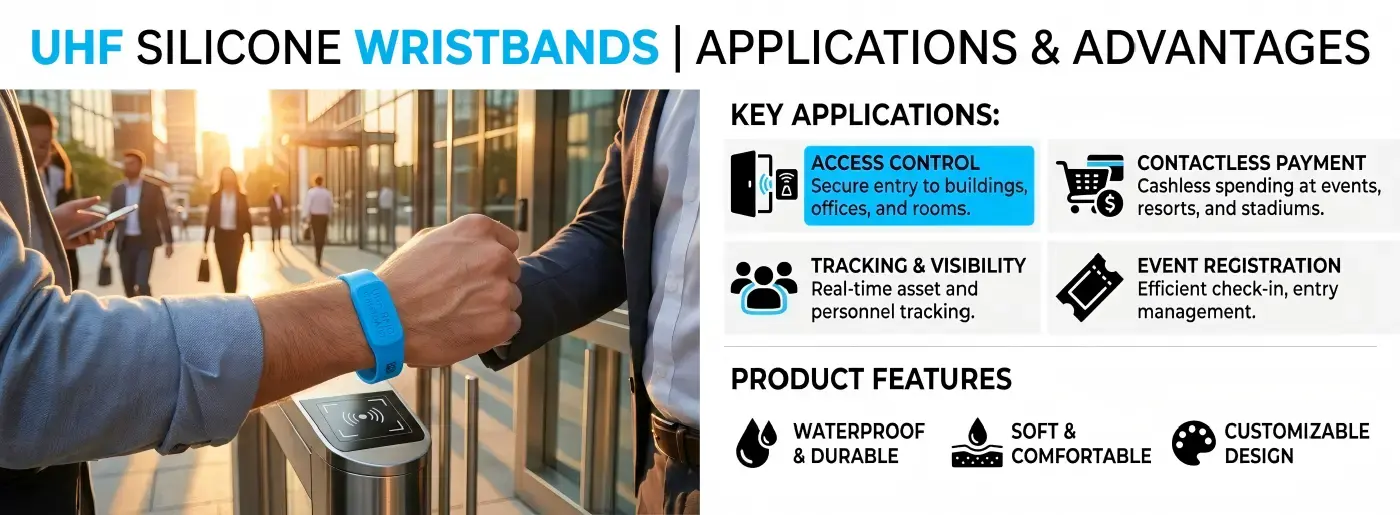
Mines and factories require durable, visible through safety gear, versions that can tolerate dust, chemical splashes, and mechanical contact. Theme park operators may use wristbands as cashless payment tools to improve visitor experience and monitor spending.
Local reading range requirements vary substantially. Tracking warehouse workers across large expanses needs a 5-meter range, whereas controlled access points work effectively with a 2-meter range. Knowing these aspects before buying minimises overpaying for broken equipment.
Customization Options That Drive Brand Value
Visual customisation boosts brand recognition and lowers theft. Silk-screen printing creates brilliant logos and text that can be read years later, while debossing with colour fill gives VIP programmes and private groups a luxurious tactile experience. UID numbers are laser-engraved forever. These numbers connect rings to digital records.
Colour coding lets workers quickly find access levels, age groups, and special needs without scanning databases. Visitors may scan their wristbands with their phones for schedules, maps, and exclusive information. QR code integration connects digital and real worlds. Identification tools become marketing assets that engage consumers after the event with these customisable options.
Get bulk samples that meet your chip, antenna, and size needs. These prototypes should be field-tested before mass production to discover read uniformity, comfort, and durability concerns.
Cost Structures and Volume Pricing
Tier-based wholesale pricing reduces unit prices with order numbers. Prices drop significantly for 5,000, 10,000, and 50,000 units. Minimum order quantities are 500–1,000. Manufacturers like WS-RFID Technology base costs on materials, chip choice, and customisation, not extra fees.
Standard versions with popular chips cost less and ship in 5–7 days. Custom orders for antennas, enclosures, or pre-encoding with unique IDs may take 10–12 days, but the results will be excellent. Check unit pricing and total landing costs, including shipping, customs, and storage.
Long-term partnerships provide value due to consistent pricing, priority manufacture during peak times, and dedicated technical help. These links aid multi-phase rollouts and yearly demand changes.
Top Considerations When Buying UHF Silicone Wristbands in Bulk
Verifying Supplier Credentials and Quality Systems
Real producers are certified for quality. ISO 9001:2015-certified companies have solid quality management systems, regular inspections, and improvement plans. CE, FCC, RoHS, and REACH provide international shipping safety and environmental compliance.
Automatic Voyantic Tagformance testing systems and Muehlbauer bonding lines improve frequency consistency and resonance accuracy in factories. Defect rates < 0.1% indicate automated manufacturing accuracy. When sending thousands of UHF silicone wristbands, even little failures may disrupt business.
Request tours or videos of production lines, quality control stations, and testing processes. Truthful vendors embrace examination since their methods can withstand professional review. Check for similar work. Event wristband producers have different needs than industrial asset wristband makers.
Logistics Planning for Global Procurement
Order confirmation, material discovery, production planning, quality inspection, and international delivery take time. Well-known brands ship regular items in 7 days. Complex custom orders may take 10–14 days, depending on production line length.
Destination affects shipping costs and reliability. Strong transportation networks enable providers to consolidate shipments, provide customs paperwork, and simplify tracking, decreasing unpredictability. Some companies have many sites to quickly fulfil recurrent orders or urgent supply needs.
Add time for customs, paperwork, and transportation delays to your purchase timetable. Planning beforehand avoids confusion and wasted money on hurried purchases that reduce bulk savings.
Technical Support and After-Sales Service
Full technical help turns procurement into a strategic partnership. Field Application Engineers help integrate readers by locating, adjusting anti-collision settings, and correcting read errors. SDKs let medical records, access control databases, and booking systems integrate wristbands.
Most warranties cover manufacturing faults and early-breaking chips, not use or extreme circumstances. Before purchase, read the warranty, claim process, and replacement arrival date. Responding providers minimise operating interruptions by fixing problems quickly.
Testing should verify all orders have the same read distance. Random sampling shows whether the batch meets criteria or if certain units are underperforming. Reliable vendors test frequency and read range before shipping and provide findings.
Leading Suppliers and Manufacturers of UHF Silicone Wristbands
Evaluating Manufacturer Capabilities
Enterprise-level UHF silicone wristbands need high-quality manufacturing like WS-RFID Technology. Over 10,000 square metres of high-speed automated assembly lines can create 500 million units a year. They can manage massive deployments without issue. This scalability is crucial for large events, healthcare systems, and retail chains that need to keep their storefronts stocked.
They've served Fortune 500 healthcare, entertainment, and shipping organisations for 15 years. They consistently fulfil high-quality requirements and complete complex assignments on schedule. Their R&D team tunes antennas for difficult environments to improve read performance on metal surfaces, liquid containers, and in groups of numerous tags.
Compliance badges and certifications provide objective manufacturing standards. In addition to regulatory clearances, seek for vendors that have worked in your firm and understand its demands. Healthcare requires biocompatible materials and data security, not event management.
Building Strategic Supplier Relationships
Long-term relationships with wristband producers provide advantages beyond one purchase. Preferred clients receive scheduling priority during heavy production. This ensures on-time delivery even when demand rises. Dedicated account management simplifies communication, speeds up quotations, and prepares inventory based on prior performance.
Collaboration lets you and the other person find solutions tailored to your issues. Established ties enable innovation that off-the-shelf items cannot. This applies whether you require unique enclosures for extreme circumstances, antenna arrangements for specific reading settings, or system integration.
Through feedback, performance evaluations strengthen supplier relationships and development. Suppliers that seek long-term partnerships will take the time to learn how your demands vary and recommend enhancements that improve operations or minimise TCO.
Practical Tips for Successful Bulk Procurement of UHF Silicone Wristbands
Demand Forecasting and Inventory Management
Accurate demand prediction prevents costly overstocking and last-minute rush orders that reduce the advantages of bulk UHF silicone wristband purchases. Use previous consumption, event calendars, and growth estimates to define baseline amounts. Keep additional stock for demand surges, but don't hoard it—it might tie up working capital or become outdated as technology develops.
Wristband needs vary greatly with the seasons. Festivals, holidays, and meetings set demand patterns. Order before peak periods to ensure production capacity and avoid paying more for expedited shipment. Some firms profit from blanket purchase orders because they lock in costs and allow variable release dates to meet actual consumption.
The manner in which wristbands are kept before usage influences their lifespan. Keep inventory at a controlled temperature and humidity, away from chemicals and direct sunlight. Good storage maintains materials and keeps chips flexible and usable, so wristbands operate best when given to end users.
Compliance and Standards Verification
HIPAA in the US requires healthcare applications to handle patient data securely and encrypt it. Patient identification bracelets must include AES encryption and password-protected memory zones to prevent data theft.
If badges enable cashless payments, event applications may require PCI DSS-compliant contactless payment systems. Make sure your solution fits these criteria before using it widely. If not, you may face costly repairs or government penalties.
Different frequency allocations hamper international procurement. North America utilises 902–928 MHz, whereas Europe uses 865–868. Make sure the wristbands you supply match local regulations. Mismatches in frequency might ruin read performance or render goods worthless.
Negotiation Strategies for Maximum Value
Volume agreements might lower pricing, but they have obligations you should consider. Discuss price levels that promote bigger purchases while enabling smaller first deployments or trial programmes. Ask for price validity times to avoid market movements throughout extended purchasing cycles.
Payment conditions greatly impact cash flow. An international company normally requires a 30% deposit and the remainder before shipping. If you have a business partnership, you may be able to acquire net-30 or net-60 payment schedules that fit your billing cycles and help you manage working capital.
Other than the purchase price, the total cost of ownership includes system integration, maintenance, and efficiency savings. Even if they cost more initially, higher-quality wristbands that last longer and break down less frequently are typically better value in the long term.
Conclusion
To get the best results when buying UHF silicone wristbands in bulk, you need to balance technical requirements, provider skills, and total cost. The right procurement partner gives you more than just goods; they also give you advice, the freedom to make changes, and ongoing help that turns RFID technology into operational benefits. You can get reliable supplies of high-performance wristbands that meet your organization's changing needs while keeping cost-effectiveness and quality standards high by looking at the qualifications of the maker, learning about the specific needs of the application, and building strategic relationships.
FAQ
1. What reading distance can I expect from UHF silicone wristbands?
Reading ranges for UHF silicone wristbands are from 1 to 5 meters, but this depends on the reader's power, how the antenna is set up, and the environment. Maximum ranges are reached in controlled indoor settings with little interference. On the other hand, ranges may be shorter in crowded areas with metal buildings or electrical equipment. The advanced antenna designs inside the silicone shell keep working properly even when worn directly on the skin, which would normally weaken the UHF signal because of the water in human tissue.
2. Can I customize wristbands with my company branding?
There are many ways to customize something, such as silk-screen printing for bright logos, debossing with color fill for high-end touch effects, and laser etching for permanent ID numbers. It's possible to choose the colors, add QR codes, and pre-encode chips with unique numbers that are tied to your databases. Manufacturers like WS-RFID Technology offer OEM and ODM services that let you get solutions that are completely tailored to your needs. This turns useful identification into marketing materials with your name on them.
3. What are typical minimum order quantities for bulk purchases?
Minimum order amounts usually start at 500 to 1,000 units, and prices drop significantly at bigger volumes, such as 5,000, 10,000, or 50,000 units or more. Standard layouts with common chips allow for smaller initial purchases, while custom designs with unique features may need larger minimum orders to cover the costs of tools and setup. Talk to your suppliers about your expected number to find the cheapest order size that strikes a mix between unit cost and inventory investment.
Partner with WS-RFID Technology for Your Bulk UHF Silicone Wristband Requirements
Get the most out of long-range RFID identification by buying directly from WS-RFID Technology, a reputable UHF silicone wristbands supplier that has helped businesses around the world. Our 10,000㎡ automated factory makes 500 million units a year with a defect rate of less than 0.1%. It is ISO 9001 certified and fully follows CE, RoHS, and REACH rules. Our Field Application Engineers offer personalized technical support, SDK integration help, and fast prototyping to make sure that rollout goes smoothly, whether you're in charge of large-scale events, healthcare operations, or industrial asset tracking. You can get clear factory-direct prices, easy OEM/ODM customization, and solid lead times of 7–10 days that keep your operations on track. Get a personalized price today by emailing kenny@w-srfid.com. Find out how our high-quality manufacturing can turn your identification and tracking problems into competitive benefits.
References
1. Smith, J. & Anderson, K. (2023). RFID Technology in Event Management: Best Practices for Large-Scale Deployments. International Journal of Event Technology, 15(3), 112-128.
2. Chen, L. (2024). Silicone Materials in Wearable Electronics: Properties and Applications. Materials Science Quarterly, 42(1), 67-84.
3. Johnson, R., Martinez, P., & Thompson, D. (2022). UHF RFID Standards and Compliance: A Global Perspective. Journal of Supply Chain Technology, 18(4), 201-219.
4. Williams, E. (2023). Bulk Procurement Strategies for RFID Hardware: Cost Optimization and Supplier Selection. B2B Purchasing Management Review, 31(2), 145-162.
5. Park, S. & Liu, Y. (2024). Antenna Design Optimization for Wearable UHF RFID devices. IEEE Transactions on Antennas and Propagation, 72(5), 1834-1847.
6. Brown, M., Davis, A., & Wilson, T. (2023). Healthcare Applications of RFID Wristbands: Patient Safety and Operational Efficiency. Medical Technology Today, 29(6), 412-428.
Learn about our latest products and discounts through SMS or email