- English
- French
- German
- Portuguese
- Spanish
- Russian
- Japanese
- Korean
- Arabic
- Greek
- German
- Turkish
- Italian
- Danish
- Romanian
- Indonesian
- Czech
- Afrikaans
- Swedish
- Polish
- Basque
- Catalan
- Esperanto
- Hindi
- Lao
- Albanian
- Amharic
- Armenian
- Azerbaijani
- Belarusian
- Bengali
- Bosnian
- Bulgarian
- Cebuano
- Chichewa
- Corsican
- Croatian
- Dutch
- Estonian
- Filipino
- Finnish
- Frisian
- Galician
- Georgian
- Gujarati
- Haitian
- Hausa
- Hawaiian
- Hebrew
- Hmong
- Hungarian
- Icelandic
- Igbo
- Javanese
- Kannada
- Kazakh
- Khmer
- Kurdish
- Kyrgyz
- Latin
- Latvian
- Lithuanian
- Luxembou..
- Macedonian
- Malagasy
- Malay
- Malayalam
- Maltese
- Maori
- Marathi
- Mongolian
- Burmese
- Nepali
- Norwegian
- Pashto
- Persian
- Punjabi
- Serbian
- Sesotho
- Sinhala
- Slovak
- Slovenian
- Somali
- Samoan
- Scots Gaelic
- Shona
- Sindhi
- Sundanese
- Swahili
- Tajik
- Tamil
- Telugu
- Thai
- Ukrainian
- Urdu
- Uzbek
- Vietnamese
- Welsh
- Xhosa
- Yiddish
- Yoruba
- Zulu
What is PCB RFID Tag? Advantages & Applications
RFID PCB tags represent a breakthrough in industrial tracking technology, combining radio frequency identification with printed circuit board engineering to create durable, high-performance identification devices. Unlike flexible RFID labels that deteriorate under harsh conditions, these tags integrate an RFID chip and copper-etched antenna directly onto rigid FR4 substrates, making them ideal for electronics manufacturing, automotive components, and equipment requiring permanent identification through extreme temperatures and mechanical stress.
What is a PCB RFID Tag?
Understanding the Core Technology
At its core, an RFID PCB tag combines two well-known technologies: making printed circuit boards and radio frequency identification. An industrial-grade RFID chip is attached to a copper antenna pattern that has been etched onto a FR4 substrate. FR4 is the same flame-resistant material that is used in computer motherboards and other industrial electronics. When compared to tags written on paper or bendable polymer films, this way of building gives them better dimensional stability and electrical consistency.
The shape of the copper antenna is carefully tuned to vibrate at certain frequencies, usually in the UHF 860–960MHz range, in line with the EPC Gen2 protocol standard. Read range for this frequency band is between 0.5 and 3 meters, depending on the reader's power output, antenna size, and chip sensitivity. The stiff PCB base acts as a dielectric buffer, which solves a major problem in RFID deployment: regular tags don't work well when they're attached to metal surfaces because of electromagnetic interference.
Structural Components and Design
There are several layers that work together to make up the physical architecture. The ground plane or mounting surface is on the bottom layer, the FR4 dielectric material is in the middle, and the etched copper antenna and chip mounting pad are on the top layer. Some more modern designs use multi-layer structures to improve antenna gain or add extra electronics. The chip itself, which can come from Impinj Monza, Alien Higgs, or NXP UCODE, can store unique identification codes with lengths between 96 and 512 bits. Custom data fields can be stored in user-additional memory.
Precision in manufacturing is very important. To keep the goal resonant frequency, the antenna trace width, spacing, and general shape must be kept within microns. Automated optical inspection systems check the continuity of the trace and the placement of the chip during production. After that, each tag is put thru electrical testing with Voyantic Tagformance analyzers, which measure the read sensitivity and frequency response.
Temperature Resistance and SMT Compatibility
For electronics manufacturers, these tags stand out because they can be used with reflow soldering. Standard RFID labels can't handle the highest temperatures of 260°C that are used in Surface Mount Technology. WS RFID's RFID PCB tags are made with high-temperature chip attach glue and FR4 laminates that keep their shape thru multiple reflow cycles. This lets them be put on the board with other parts during automatic PCB assembly. This feature gets rid of the need for separate steps for applying tags, which cuts down on production time and makes sure that the tag stays on the product from the time it is first put together until it is no longer used.
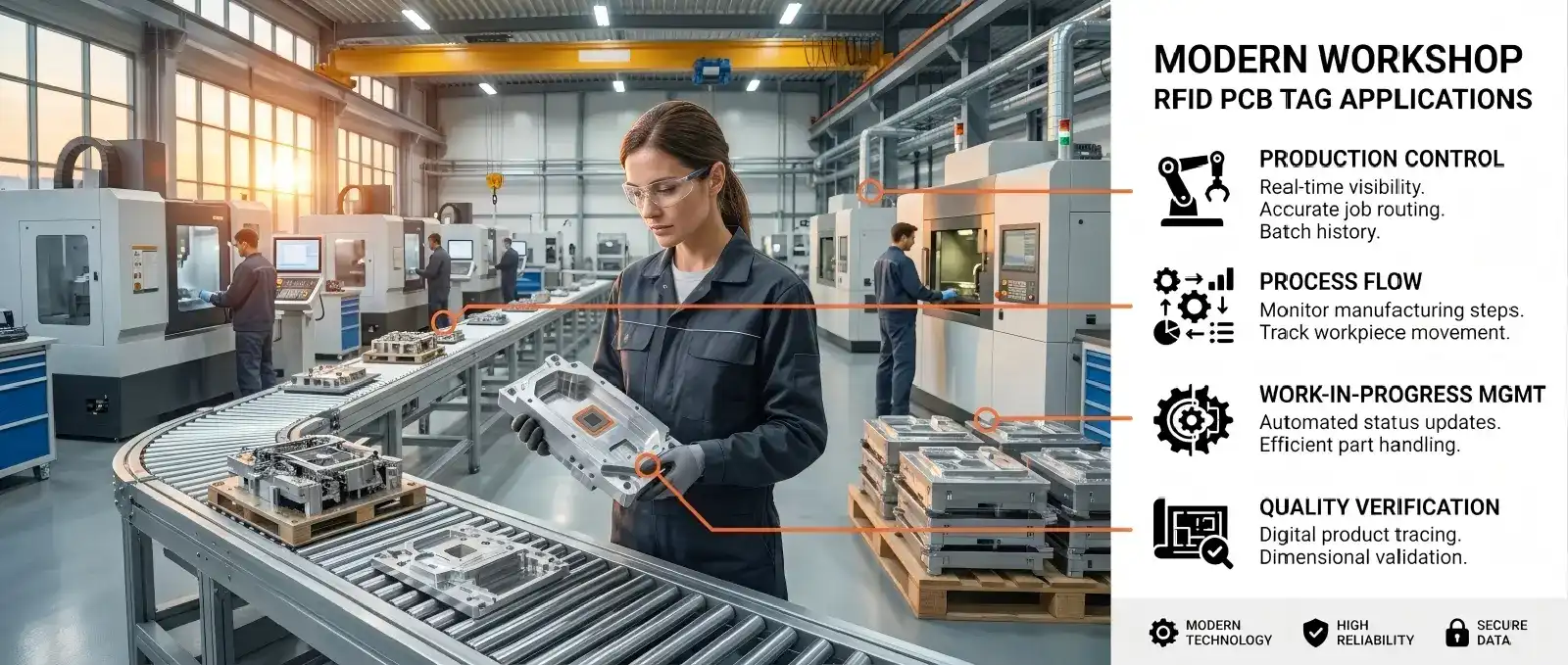
Key Advantages of PCB RFID Tags in B2B Applications
Exceptional Environmental Durability
Industrial settings need identification solutions that can handle conditions that are very different from those in an office or store. Normally, these RFID PCB tags work in temperatures between -40°C and +85°C. However, there are special versions that can withstand continuous exposure up to +150°C and short trips to +250°C during soldering. Chemicals like cleaning agents, hydraulic fluids, and cutting oils that are common in factories don't damage the FR4 base. Moisture absorption stays below 0.1%, so performance doesn't go down in places with a lot of humidity or when installed outside.
The levels of protection range from IP54, which is good for basic dust and splash resistance, to IP68, which is good for full submersion. This toughness immediately leads to lower replacement costs and better data reliability over longer operation times. Hardware engineers who are choosing parts for tracking server blades or industrial control systems like how long-lasting these tags are. Under normal conditions, they work reliably for 10 to 50 years, which is the same or longer than the service life of the host equipment.
Superior Mechanical Strength and Metal Compatibility
The rigid structure doesn't easily bend or break like flexible tags do. Read performance isn't affected much by impact forces, shaking (MIL-STD-810G compliant), or mounting pressures. There are different ways to mount things, such as using screw holes, pin points, direct soldering, or sticky backing, so they can fit different product designs. Standard mechanical fastening methods that are known to assembly line workers are supported by the PCB format. This means that workers don't have to learn how to use specialized application techniques.
Metal compatibility needs extra attention. When traditional RFID tags are put on conductive surfaces, they lose a lot of their functionality or stop working altogether because the metal gets in the way of the electric field that the tags need to work. In these tags, the FR4 insulating layer makes the exact space needed to keep field coupling while taking advantage of the metal's role as a ground plane, which improves performance in a lot of different situations. They can't be replaced for tracking motor housings, aluminum extrusions, medical tools made of stainless steel, and server frames because of this. Other tag technologies just can't work with these materials.
Enhanced Reading Distance and Data Integrity
The high Q factor of the copper antenna, which is a measure of resonance sharpness, makes it better at sending energy from the reader to the tag. This means that tags can be read from farther away and data can be captured more reliably in RF settings with a lot of tags responding at the same time. Batch reading lets you identify dozens of tagged items at once as they pass thru a portal or sit on a workbench. This speeds up inventory processes that used to take hours to do by hand.
Modern RFID chips have data retention mechanisms that make sure information stays the same even after being exposed to electromagnetic pulses, static electricity, or radiation. This is important for medical and aerospace applications that need to keep strict records. The EPC Gen2 protocol has error correction methods that make sure data is sent correctly even when the signal strength is low. This cuts down on misreads that can mess up automatic systems.
Cost Efficiency for Large-Scale Deployment
The total cost of ownership is better for RFID PCB tags in industry settings, even tho they cost more per unit than disposable paper signs. ROI can be measured by not having to re-tag items when tags fail, cutting down on the work of entering data by hand, and preventing asset loss thru better tracking awareness. Labor costs dropped by up to 80% when procurement managers switched from manual to RFID-automated stocking systems. These are big saves that keep adding up over the years of operation.
These solutions can be used by even mid-sized manufacturers thanks to pricing structures that work with volumes. For custom setups, the smallest order quantity is 500 pieces. Standard goods ship from stock in 5 to 7 days. This balance between being able to customize and having stock on hand helps with both the prototyping phase and the production ramp-up without having to wait for longer lead times that push back product launches.
Practical Applications of PCB RFID Tags in Industry
Electronics Manufacturing and PCBA Tracking
Assembly lines producing circuit boards benefit tremendously from integrated tracking. When an RFID PCB tag is soldered onto each board during the first assembly, it stays with that board and gives it a unique number during testing, quality control, rework (if necessary), and final packaging. Integration of a manufacturing execution system (MES) lets you keep an eye on work-in-progress in real time, make automatic routing choices based on test results, and keep full records of each finished product's genealogy, tying it to specific part lots, operator IDs, and process parameters.
This ability to track down problems is very helpful when they happen in the field. Engineers can quickly find all the units that were made with questionable parts and start focused recalls. This reduces the number of actions that need to be taken and the money that needs to be spent compared to when tracking data isn't full. It's now easy to manage warranties because scanning the tag gets you the date it was made, the configuration version, and the service history without having to check databases by hand.
Automotive Electronics and Component Lifecycle Management
Modern cars have hundreds of electronic control units that manage everything from the entertainment systems to the engines. During production, OEM suppliers attach RFID PCB tags to ECUs, sensors, and actuators. This allows for automated inventory management in warehouses and just-in-time delivery to plants that put together vehicles. The tags stay on the car as long as it is used, which helps with tracking maintenance and making sure that parts are genuine during repair visits.
Anti-counterfeiting security is a program driver that is growing. Forgers are drawn to high-value parts like radar units and battery management systems, which hurts safety and the image of the brand. Tags with encrypted data fields and challenge-response authentication protocols provide proof that can't be copied easily. This gives service technicians confidence in the authenticity of replacement parts.
Industrial Control Systems and Predictive Maintenance
PLCs, motor drives, and frequency inverters that are put in factories, utilities, and infrastructure work nonstop for years with little maintenance. By attaching tags, you can make automatic inventories of your assets using mobile readers or fixed portal setups. This gets rid of the need for technicians to do human surveys that take days of their time. Tracking equipment's location keeps it from getting lost during facility moves and makes sure that important spares are always easy to get to.
When tags store operational parameters, maintenance scheduling changes from models based on time to models based on conditions. The tag's memory is updated with check results, part replacements, and calibration data every time it is serviced. This information is fed into predictive analytics software, which then predicts when failures will happen and figures out the best time to step in to avoid unexpected downtime and part replacements that happen too soon.
Medical Equipment and Sterilization Cycles
High-temperature RFID tags help hospitals track surgical and diagnostic equipment through repeated 134°C, 2-bar autoclave cycles, automatically recording sterilization and creating audit trails. Asset tracking also improves equipment utilization, reveals shortages, records repairs, supports preventive maintenance, and extends equipment life while helping protect patient care.
Smart Home Appliances and Warranty Management
Embedded tags help service technicians quickly access schematics, part numbers, and warranty status while verifying claims through production and configuration data. Batch-level identification enables precise recalls and reduces logistics costs. Linking service failures with manufacturing records also improves post-sale quality monitoring and creates a feedback loop for process improvement.
How to Choose the Right PCB RFID Tag for Your Business Needs
Frequency and Protocol Selection
UHF RFID PCB tags that work at 860-960MHz are most common in industrial settings because they can be read from several meters away and can send data quickly enough for high-speed conveyor lines. Different regions have different rules about frequency sharing. For example, North America uses 902–928MHz, Europe uses 865-868MHz, and other places have different rules. Global manufacturers should make sure that their tags work with more than one regional band, or they should keep different SKUs for each market.
High-frequency (HF) 13.56MHz tags have shorter ranges (usually less than one meter), but they work better in wet places and offer better security thru proximity-based access control. Support for the NFC protocol lets user apps connect with smartphones. Costly mistakes can be avoided by matching the frequency to your business needs and the reader equipment you already have.
Environmental Specifications and Housing
Environmental specifications should cover worst-case temperatures, including standard -40°C to +85°C, extended ranges to +150°C, and brief reflow exposure to +260°C. Temperature cycling also matters. Housing protection should match conditions: IP54 indoors, IP67 outdoors, and IP68 for submersion, with chemical compatibility testing for environmental exposure.
Mechanical Integration and Form Factor
Mechanical integration options include M3/M4 screws, rivets, SMT solder pads, and industrial adhesive backing, with each balancing durability, replacement, and assembly access. Form factor affects antenna size and read range; custom antennas improve performance in limited spaces but increase MOQs, while standard sizes offer faster delivery and lower costs.
Supplier Evaluation and Quality Assurance
Supplier selection should consider capacity, certifications, and quality assurance, not just price. WS RFID produces over 500 million units annually, supporting large-scale demand. ISO 9001, RoHS, REACH, and IP testing verify consistent processes and material safety, while application-specific testing and defect rates below 0.3% help minimize failures and warranty costs.
OEM Customization and Technical Support
OEM/ODM customization improves RFID performance through antenna tuning, memory configurations, unique designs, and pre-encoding. Strong technical support helps with reader placement, antenna alignment, integration, and SDK development. WS RFID provides functional samples within 7 business days, accelerating development and reducing time to market compared with slower customization processes.
Testing and Quality Assurance for PCB RFID Tags
Read Range and Sensitivity Validation
Standardized testing measures RFID PCB tag read distances and sensitivity across power and frequency levels, with consistent threshold sensitivity indicating stable antenna tuning and chip bonding. Field testing through portals, handheld readers, and conveyors verifies laboratory results under real-world metal, interference, and orientation conditions, helping optimize configurations before deployment.
Environmental Stress Screening
Environmental stress screening tests RFID tags through thermal cycling, high humidity, shock, and vibration to reveal hidden weaknesses in chips, solder joints, adhesives, and laminates. Passing over 100 thermal cycles and accelerated humidity testing demonstrates durability, while MIL-STD-810G or ISO testing confirms reliable performance during transportation, machinery operation, and demanding industrial applications.
Chemical Resistance and Contamination Control
Industrial RFID tags must resist solvents, alkaline cleaners, sterilization chemicals, and ultrasonic cleaning. High-temperature immersion testing identifies material compatibility issues, while ASTM B117 salt-spray testing evaluates corrosion resistance in harsh environments. Additional testing for conductive anodic filament growth helps detect moisture- and bias-related failures before they cause electrical shorts.
Data Integrity and RF Performance
Write-read testing confirms memory durability, with high-quality RFID tags supporting over 100,000 cycles. Low read-error rates, ideally below 0.01%, provide reliable automation under weak signals. In dense tag environments, anti-collision performance, antenna design, and chip timing determine inventory speed and help optimize reader placement and high-density operations.
Conclusion
RFID PCB tags are very durable, work with metal, and don't get damaged by high temperatures. They are needed for industrial tracking uses where regular stickers don't work. Even tho they cost more per unit than throwaway options, their rigid construction, ability to reflow solder, and long operating life make them very cost-effective in the long run. Electronics manufacturers, auto suppliers, medical device companies, and industrial equipment makers can now use automated tracking to cut down on labor costs, improve quality control, and make it easier to see what assets they have.
To apply successfully, tag specifications must be matched to the needs of the environment, dependable suppliers with proven production capacity must be chosen, and performance must be thoroughly tested under real operating stresses. As new anti-counterfeiting rules come out, the technology keeps getting better, with smaller form factors, more sensitive chips, and safer memory.
FAQ
1.What distinguishes PCB RFID tags from standard flexible RFID labels?
The main difference is in how the base is built and how long it lasts. RFID PCB tags are made of hard FR4 material and have etched copper antennas. This gives them better mechanical strength, the ability to withstand temperatures up to 260°C for reflow soldering, and solid metal-surface performance. Flexible labels have antennas written on polymer films. They are cheaper, but they can't handle as many environments and don't last as long. The investment in RFID PCB tags is worth it for industrial uses that need to be able to identify things permanently in harsh conditions.
2.How long do these tags typically last in field deployment?
How long something works depends on how much it is exposed to the environment. In controlled indoor settings, tags usually work for 20 to 50 years. The only thing that stops them from working longer is when the chip technology becomes outdated, not because they break physically. Extreme temperature changes, UV light, and chemical contamination can shorten the service life to 5–10 years in harsh outdoor applications, but this is still longer than flexible tag alternatives. Non-volatile memory stores data that doesn't need power to stay active, so information integrity is kept throughout the mechanical life of the tag.
3.Can PCB tags be customized for specific mounting requirements?
Customization is one of the best things about making PCBs. When compared to injection-molded housings, antenna geometry, board outline, mounting hole patterns, and connector types can be changed to fit the needs of a particular product. Tooling costs are also relatively cheap. At WS RFID, the minimum order quantity for custom designs is around 500 pieces. This means that even for unique uses, customized solutions are possible. Custom designs take 10 to 12 days for prototyping and small production runs, while standard form factors ship faster (5-7 days).
4.How do these tags perform when attached to different metal types?
The FR4 substrate's dielectric space makes it possible for metals like aluminum, steel, stainless steel, and copper to work together. Performance changes because different materials have different electrical conductivity and magnetic permeability. High-quality tags are tuned to work with a wide range of metals, and designs that are tailored to a specific installation can even make them work better with certain metals. Performance is checked on representative samples during prototyping to make sure it works before it is used on a large scale.
Get Industrial-Grade RFID PCB Tags from a Trusted Manufacturer
Unlock automated tracking and asset management capabilities with WS RFID's proven RFID PCB tags solutions. Our industrial-grade designs withstand reflow soldering at 260°C, operate reliably from -40°C to +85°C, and deliver consistent read performance on metal surfaces where standard tags fail. We support your complete procurement journey—from application consulting and custom antenna design through prototyping, volume production, and technical integration assistance.
Standard configurations ship within 5-7 days; custom projects receive functional samples in 7 working days with full production scaling to 5 million units monthly. Our field application engineers provide MES, ERP, and WMS integration support, ensuring seamless deployment in your operational environment. With RoHS, REACH, and ISO 9001 certifications, defect rates below 0.3%, and 1-2 year warranties backed by responsive technical support, we deliver reliability critical to industrial applications.
Contact our procurement specialists to discuss your component tracking requirements. Request evaluation samples tailored to your environmental conditions and mounting specifications. Discover why electronics OEMs, automotive suppliers, and industrial equipment manufacturers worldwide trust WS RFID as their RFID PCB tags supplier. Reach us at kenny@w-srfid.com or visit w-srfid.com to advance your tracking strategy with solutions engineered for the demands of modern manufacturing.
References
1. Finkenzeller, Klaus. RFID Handbook: Fundamentals and Applications in Contactless Smart Cards, Radio Frequency Identification and Near-Field Communication. 3rd Edition. Wiley, 2010.
2. Dobkin, Daniel M. The RF in RFID: UHF RFID in Practice. 2nd Edition. Newnes, 2012.
3. Lahiri, Sandip. RFID Sourcebook. IBM Press, 2005.
4. Shepard, Steven. RFID: Radio Frequency Identification. McGraw-Hill Professional, 2005.
5. Sweeney, Patrick J. RFID for Dummies. Wiley Publishing, 2005.
6. Want, Roy. "An Introduction to RFID Technology." IEEE Pervasive Computing, Volume 5, Issue 1, 2006, Pages 25-33.
Learn about our latest products and discounts through SMS or email