- English
- French
- German
- Portuguese
- Spanish
- Russian
- Japanese
- Korean
- Arabic
- Greek
- German
- Turkish
- Italian
- Danish
- Romanian
- Indonesian
- Czech
- Afrikaans
- Swedish
- Polish
- Basque
- Catalan
- Esperanto
- Hindi
- Lao
- Albanian
- Amharic
- Armenian
- Azerbaijani
- Belarusian
- Bengali
- Bosnian
- Bulgarian
- Cebuano
- Chichewa
- Corsican
- Croatian
- Dutch
- Estonian
- Filipino
- Finnish
- Frisian
- Galician
- Georgian
- Gujarati
- Haitian
- Hausa
- Hawaiian
- Hebrew
- Hmong
- Hungarian
- Icelandic
- Igbo
- Javanese
- Kannada
- Kazakh
- Khmer
- Kurdish
- Kyrgyz
- Latin
- Latvian
- Lithuanian
- Luxembou..
- Macedonian
- Malagasy
- Malay
- Malayalam
- Maltese
- Maori
- Marathi
- Mongolian
- Burmese
- Nepali
- Norwegian
- Pashto
- Persian
- Punjabi
- Serbian
- Sesotho
- Sinhala
- Slovak
- Slovenian
- Somali
- Samoan
- Scots Gaelic
- Shona
- Sindhi
- Sundanese
- Swahili
- Tajik
- Tamil
- Telugu
- Thai
- Ukrainian
- Urdu
- Uzbek
- Vietnamese
- Welsh
- Xhosa
- Yiddish
- Yoruba
- Zulu
What Is NFC Loyalty Card and How Does It Work?
An NFC loyalty card is a contactless smart membership solution operating at 13.56MHz high frequency, utilizing Near Field Communication technology per the ISO/IEC 14443 Type A protocol. When a customer taps the card near a compatible reader or smartphone, encrypted data exchange occurs instantly within 1-10cm range, enabling seamless points accumulation, coupon redemption, and personalized rewards without physical contact. Unlike traditional magnetic stripe or barcode systems, this technology integrates secure chip elements with embedded antennas to provide encrypted transmission, protecting customer information while enabling real-time synchronization with CRM and POS systems for sophisticated membership marketing strategies.
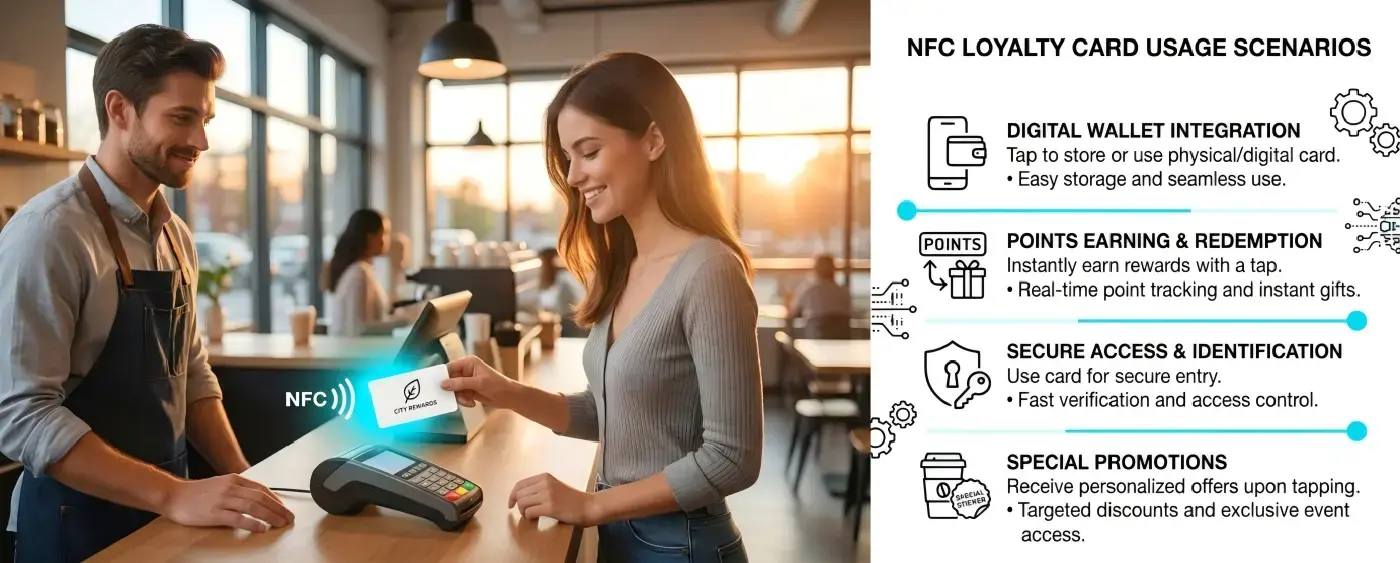
Understanding NFC Loyalty Cards: Definitions and Technology
What Makes NFC Technology Different?
The way that retail brands, coffee chains, fitness centers, and leisure companies interact with their customers is changing a lot because of Near Field Communication. The passive IC chip and finely tuned antenna of an NFC loyalty card are what make it work when it comes close to an active reader. Electromagnetic induction lets data move both ways, so identification and transaction recording can happen right away without using batteries. This wireless interaction gets rid of the bumps that come up when you swipe, scan, or enter your ID by hand. This cuts down on checkout time and makes the experience better for the user.
Technical Architecture Behind the Card
Each card has a memory or computer chip from a company like NXP SmartMX, Infineon SLE, or Huada Electronics, along with a copper or etched metal antenna loop. Unique identifiers (UIDs), encrypted membership credentials, point balances, and transactional metadata are stored on the chip. The memory sizes range from 1KB to 72KB EEPROM. The operating frequency is set at 13.56MHz to make sure that it works with all current infrastructure, such as iOS and Android apps that have built-in reading features. The antenna resonates at this exact frequency, which makes energy coupling work best and lets you read up to 10 cm away when conditions are perfect.
Security Protocols That Protect Customer Data
When procurement managers look at loyalty solutions, security is still the most important thing. Newer cards have chips that are approved by Common Criteria EAL4+ and use AES-128 or 3DES encryption methods. Mutual authentication protocols stop cloning or replay attacks that aren't supposed to happen, and write-protection mechanisms keep sensitive fields from being changed. For important loyalty programs or apps that accept payments, financial-grade security certifications make sure that they meet PCI standards. This means that these cards can be used in banking and airline mileage programs where data integrity is very important.
Benefits of NFC Loyalty Cards for Businesses
Accelerating Customer Engagement and Repeat Visits
Retailers that use NFC loyalty cards say that their customer retention rates go up in a measurable way. There is no denying the speed advantage—transactions are finished in less than half a second, whereas the old ways took 3–5 seconds. This speed cuts down on wait times during busy times, which is especially important for fast food and coffee chains where flow directly affects sales. In addition to being fast, the physical ease of a tap contact makes it easier for people to join a program. This means that casual visitors can become tracked members with little trouble.
Real-Time Data Integration with CRM Ecosystems
Beyond the point of sale, the strategic value goes further. When a customer uses their contactless membership card, information about the transaction is sent instantly to backend systems. This gives detailed information about how often customers visit, what items they like, and how often they buy them. Based on real-time behavior, marketing teams can automatically divide viewers into groups that can be sent personalized SMS or emails. Integration tools support RESTful APIs and middleware connectors, which makes it easy to share data with platforms like HubSpot, Salesforce, or your own retail management software.
Durability and Cost-Effectiveness for Multi-Year Deployments
All-in-all cost of ownership is what procurement teams look at first. High-quality PVC or PET cards that are 0.76-0.84 mm thick last a very long time. They can handle over 100,000 write cycles and keep their data intact for 10 years or more. Built-in environmental resilience—operating temperature ranges from -25°C to +70°C make sure that it works in all kinds of climates, from air-conditioned stores to outdoor festivals. Physical cards are an investment that only needs to be made once, but they will lose value over time, unlike throwaway paper coupons or app-based solutions that need constant server upkeep.
When you customize these useful tools, they become brand champions. Cards with full-color brand printing, raised text, and magnetic stripes can be used as both entry cards and payment tools. For chains with 10 to 500 locations, centralized card issuance makes things run more smoothly. Membership levels can be encoded, promotional balances can be preloaded, and cards can be sent out thru a single set of logistics channels. Pilot projects can use minimum order numbers as low as 500 units, and scalable production can handle rollouts of more than millions of units per year.
NFC Loyalty Card vs. Alternative Technologies: Making the Right Choice
Comparing Contactless Cards to QR Codes
QR-based loyalty programs became popular because they were easy to set up and didn't cost much. All you need is a smartphone camera and some printed codes. But gaps in usefulness show up in the real world. When codes are printed on receipts or are exposed to water, they break down, which makes scanning impossible. The lighting affects how well you can read, and scanning over and over again drains the battery. NFC loyalty cards get rid of these factors; they only need to be close to activate, so the camera doesn't have to be aligned or the lighting can be changed. Another difference is security. QR codes send data in plain text, which can be read by anyone, but encrypted chip communication can't be read by anyone.
Magnetic Stripe and Barcode Legacy Systems
A lot of well-known brands still use magnetic stripe or barcode loyalty cards, which are technologies that are decades old. Because stripe readers need to be touched, they cause mechanical wear and raise hygiene concerns that have grown since the pandemic. Barcodes need to be seen clearly, and they don't work well when they are bent or scratched. The costs of switching to contactless infrastructure are balanced by lower upkeep costs, since card readers don't need to be cleaned or worn-out swipe mechanisms replaced. More and more modern point-of-sale (POS) systems have contactless readers built in, which makes the switch process easier.
App-Only Programs and Adoption Barriers
Mobile apps offer rich digital experiences, but they are hard for people to use. Customers have to download software, make accounts, give rights, and keep their operating systems up to date, which can be hard for people who aren't good with technology. Smartphones that depend on batteries pose a reliability risk; if the phone dies, you can't get your loyalty benefits. As a backup, physical cards can be used with any reader because they don't depend on software. Hybrid tactics that combine the ease of use of apps with the accessibility of cards are the best way to reach people of all ages and levels of technology knowledge.
How to Procure NFC Loyalty Cards: A Buyer's Guide for B2B Clients
Defining Your Technical Requirements
Getting NFC loyalty cards starts with being clear on what is needed. Figure out how much memory you need based on how much data you store. For example, basic point counts can work with 1KB chips, but multi-tier programs that store transaction records may need 4KB or 8KB. Look at the needs of the surroundings. For example, outdoor event programs need tough constructions, while high-end store brands value slim looks. Choose chip types that balance cost and security. The NTAG series offers a wide range of connectivity for general use, while MIFARE DESFire provides financial-grade security for built-in payment functions.
Evaluating Supplier Credentials and Production Capacity
Partner choice depends on how reliable the manufacturing is. Check for ISO 9001:2015 quality certifications, RoHS and REACH environmental compliance, and a history of on-site audits with clients from around the world. Production capacity is important. Suppliers whose annual output is more than 500 million units show that they can handle a phased rollout. When looking at the quality of the bonding tools, make sure that the IC-to-antenna links are always the same. This is very important for read performance. Ask Voyantic for performance test reports that prove the accuracy of the resonance frequency across all production batches.
Customization, Encoding, and Fulfillment Logistics
Good suppliers offer full services that include design advice, pre-production samples, and bulk encoding. Workflows for encoding should be able to print variable data, such as assigning a unique UID, pre-loading membership tiers, and serializing multiple items at once for inventory control. Launch dates are affected by when products are delivered. Standard products can be shipped within 7–15 days, which allows for quick deployments, but custom security chip configurations can take up to 4 weeks. Ask about the minimum order quantities that balance inventory risk with unit economics. For example, 500-piece minimums work well for boutique brands, while enterprise buyers negotiate best prices at 50,000-unit or higher volumes.
Support after deployment tells the difference between capable vendors and transactional suppliers. Field application experts help calibrate readers, set up middleware, and fix problems with connectivity between different hardware environments. SDK packages and API instructions make it faster to integrate software, which shortens the time it takes to make new software. Warranty terms of one to two years cover problems with the way the product was made, and quick technical help channels keep operations running smoothly during important marketing campaigns.
Future Trends and Strategic Implications of NFC Loyalty Cards
Mobile Wallet Integration and Ecosystem Convergence
Adoption of Apple Pay and Google Pay changes how loyalty programs are set up. Next-generation NFC loyalty cards support host card emulation (HCE), which lets digital identities on smartphones work like real cards thru virtualization. Customers only need to take one device to access multiple reward programs, and brands can learn a lot from how customers use their phones. For this to happen, backend systems need to be able to handle both physical taps and virtual tokens. WS RFID's integration frameworks make this possible with flexible middleware layers.
IoT Connectivity and Sensor Enhancements
New designs include temperature or humidity monitors, which turn cards that were once passive into devices that can be used for tracking. Cold-chain shipping programs keep track of the conditions of products, and health club contracts use proximity detection to keep an eye on how the facilities are being used. Ultra-wideband (UWB) integration lets you track a device's position down to the centimeter level. This opens up uses like automatic check-ins and zone-based promotional triggers in retail places. With these improvements, contactless cards are now more like IoT endpoints that can do more than just make transactions possible.
AI-Driven Personalization and Predictive Analytics
Machine learning systems that look at tap patterns can predict which customers will leave, find the best award structures, and suggest changes to the inventory. During purchases, real-time data streams from card encounters feed recommendation engines, which change the offers that are shown on POS screens on the fly. Data infrastructure needs to be taken into account in procurement strategies. For example, cards with enough memory for edge computing or cloud syncing that works smoothly for centralized analytics platforms need to be chosen.
Pressures for sustainability drive material creativity. Biodegradable composites and recycled PET substrates leave less of an impact on the environment without lowering durability. Brands that want to attract eco-friendly customers use these options to set themselves apart, making sure that their loyalty programs are in line with their social responsibility obligations. When suppliers like WS RFID invest in plastic-free antenna technologies, they show that they are forward-thinking, which is appealing to buying groups that put ESG factors first.
Conclusion
Adopting contactless membership solutions is a turning point for retail brands, leisure groups, and service chains that want to update how they interact with customers. NFC loyalty cards offer real practical benefits, such as faster transactions, more accurate data collection, and strong security, while also allowing for easy customization that strengthens brand identity. Compared to other technologies, they are more reliable, work with all devices, and save money in the long run. When making purchases, companies should look for providers that have a track record of excellent manufacturing, full merger support, and the ability to produce more at a lower cost. As mobile wallet convergence and IoT improvements change the landscape, picking partners who are invested in new standards will make sure that implementations are future-proof and can adapt to changing market needs.
FAQ
1.How does an NFC loyalty card communicate with readers?
The card has a passive chip and antenna that turn on when it comes into contact with a 13.56MHz reader device's electromagnetic field. The reader gives the chip a short burst of power, which lets the data flow both ways thru electromagnetic induction. This process can happen anywhere from 1 to 10 cm away and is done in milliseconds. It sends encrypted membership information and transaction data to the server system without using batteries or touching anything.
2.Are these cards compatible with both iPhone and Android devices?
Modern smartphones with built-in features can read and write to chips that are properly set up, like NTAG213 or NTAG215 types that are designed to meet Forum Type 2 standards. iPhones with iOS 13 or later can read tags in the background, but Android devices usually need to have settings turned on or use specific apps. When choosing a seller, procurement teams should check to see if the chip models are compatible to make sure that all of their customers can use the product on multiple platforms.
3.What security measures prevent unauthorized duplication?
Hardware-based encryption using the AES-128 or 3DES algorithms is built into high-quality chips, and unique identifiers (UIDs) are encoded in the factory while the chips are being made. Before sending private information, mutual authentication protocols make sure the reader is who they say they are, and write protection locks important memory areas after the initial programming. Financial-grade solutions that meet Common Criteria EAL4+ standards go thru a lot of security testing to make sure they can't be copied or attacked thru side channels.
4.What is the typical lifespan of a loyalty card?
When made correctly, cards made from PVC or PET substrates that are 0.76-0.84 mm thick can hold data for more than 10 years and can handle more than 100,000 write/erase cycles. Physical longevity means that it can handle being handled every day, being exposed to extreme temperatures (-25°C to +70°C), water, and UV rays. The quality of the laminate has a direct effect on how long the cards last. Cards that meet ISO 7810 standards keep their structural stability and good looks throughout multi-year loyalty programs, giving buying budgets a predictable total cost of ownership.
Partner with WS RFID for Your Contactless Loyalty Solution
WS RFID has a wide range of contactless card options for the retail, hospitality, and service businesses that can help you make your memberships digital. Our factory makes more than 500 million units every year, and we have 15 years of experience in RFID engineering and are ISO 9001:2015 certified. We do everything for you, from designing the antenna and choosing the chip to bulk encoding and helping you integrate your CRM. Standard NFC loyalty card shipments arrive in 7–15 days, and our field application engineers offer ongoing technical support to make sure that the cards are easily set up in every location. Our flexible minimum order quantity (MOQ) policies and white-label customization options can be changed to fit the needs of your brand, whether you run 10 small shops or 500 franchised stores. Email our team at kenny@w-srfid.com to get samples, talk about customization options, or get a full quote from a reputable manufacturer that wants your reward program to succeed.
References
1. International Organization for Standardization. (2018). ISO/IEC 14443: Identification cards — Contactless integrated circuit cards — Proximity cards. Geneva: ISO Press.
2. NFC Forum Technical Specification. (2020). Type 2 Tag Operation Specification: Technical Specification for NFC Forum Devices. Wakefield, MA: NFC Forum Inc.
3. Coskun, V., Ozdenizci, B., & Ok, K. (2015). The Survey on Near Field Communication. Sensors Journal, 15(7), 13348-13405.
4. Kumar, V., & Reinartz, W. (2018). Customer Relationship Management: Concept, Strategy, and Tools (3rd ed.). Berlin: Springer-Verlag.
5. Finkenzeller, K. (2010). RFID Handbook: Fundamentals and Applications in Contactless Smart Cards, Radio Frequency Identification and Near-Field Communication (3rd ed.). Chichester: John Wiley & Sons.
6. Gandomi, A., & Haider, M. (2015). Beyond the hype: Big data concepts, methods, and analytics. International Journal of Information Management, 35(2), 137-144.
Learn about our latest products and discounts through SMS or email