- English
- French
- German
- Portuguese
- Spanish
- Russian
- Japanese
- Korean
- Arabic
- Greek
- German
- Turkish
- Italian
- Danish
- Romanian
- Indonesian
- Czech
- Afrikaans
- Swedish
- Polish
- Basque
- Catalan
- Esperanto
- Hindi
- Lao
- Albanian
- Amharic
- Armenian
- Azerbaijani
- Belarusian
- Bengali
- Bosnian
- Bulgarian
- Cebuano
- Chichewa
- Corsican
- Croatian
- Dutch
- Estonian
- Filipino
- Finnish
- Frisian
- Galician
- Georgian
- Gujarati
- Haitian
- Hausa
- Hawaiian
- Hebrew
- Hmong
- Hungarian
- Icelandic
- Igbo
- Javanese
- Kannada
- Kazakh
- Khmer
- Kurdish
- Kyrgyz
- Latin
- Latvian
- Lithuanian
- Luxembou..
- Macedonian
- Malagasy
- Malay
- Malayalam
- Maltese
- Maori
- Marathi
- Mongolian
- Burmese
- Nepali
- Norwegian
- Pashto
- Persian
- Punjabi
- Serbian
- Sesotho
- Sinhala
- Slovak
- Slovenian
- Somali
- Samoan
- Scots Gaelic
- Shona
- Sindhi
- Sundanese
- Swahili
- Tajik
- Tamil
- Telugu
- Thai
- Ukrainian
- Urdu
- Uzbek
- Vietnamese
- Welsh
- Xhosa
- Yiddish
- Yoruba
- Zulu
What industries commonly use UHF silicone wristbands for tracking and identification?
UHF silicone wristbands represent a transformative technology across multiple sectors requiring accurate, long-range identification and tracking. These advanced wearable devices operate within the 860–960 MHz frequency range and support the EPC Gen2 standard, delivering read distances between 1–5 meters. Healthcare facilities deploy them for patient identification and asset management, while entertainment venues leverage them for seamless access control and cashless transactions. Industrial sites use these durable, waterproof solutions for workforce tracking in harsh environments, and logistics operations benefit from real-time personnel monitoring. Their hypoallergenic silicone construction ensures all-day comfort, making them ideal for extended wear across hospitality, sports events, and corporate settings where reliable identification matters most.
Understanding UHF Silicone Wristbands and Their Technology
The most innovative thing about UHF silicone wristbands is that they can contain advanced RFID technology inside medical-grade, bendable silicone. Unlike other ways of identifying people, these wristbands talk to each other using radio waves in the ultra-high frequency range, especially between 860 and 960 MHz. This lets data be sent quickly over long distances.
Core Components and Design Architecture
There are three important parts in every wristband: an RFID chip (like Impinj Monza, Alien Higgs, or NXP UCODE), an antenna that is finely tuned antenna, and a silicone enclosure that protects the chip. The design of the antenna is especially important because UHF signals are naturally messed up by water in the body. Spacer effects and special antenna geometry used in advanced engineering keep the performance stable even when the antenna is directly touching the skin. Because they were carefully made, these devices can read from up to 5 meters away while still having a thin, easy design.
The silicone material does more than just make the user comfortable. It protects against water and dust up to IP67, keeps internal parts safe from mechanical stress, and keeps signals strong in temperatures ranging from -30°C to +85°C. Because they are hypoallergenic and biocompatible, even people with sensitive skin can wear them for long periods of time without any problems.
Technical Advantages Over Alternative Technologies
The unique thing about these wristbands is that they can scan multiple items at once. Traditional barcode systems need to be read with line-of-sight and by hand. UHF technology, on the other hand, can read multiple wristbands at once and at speeds of up to 100–200 tags per second. This feature that prevents collisions gets rid of traffic jams at checkpoints with a lot of people, like those at festival exits, hospital rooms, or manufacturing facility gates.
The built-in chips support 512-bit user memory and 96-bit to 480-bit EPC memory, which lets you encrypt and store data securely in different places. Because of this, businesses can store unique IDs, entry permissions, payment information, and moving data with a timestamp right on the wristband. With 100,000 write cycles, data is retained for 10 years, making sure that reusable identification programs will work for a long time.
Key Industries Utilizing UHF Silicone Wristbands for Tracking and Identification
Because UHF silicone wristbands can be used in a lot of different situations, they are being used in a lot of different industries to solve specific problems.
Healthcare and Medical Facilities
These wristbands enable hospitals and clinics to track patients, ensure medicine delivery, and prevent theft. Sterile environments need chemical cleaning, although soft silicone may help. The expanded read range lets computers monitor patients across departments. Remote wristband scanning lets doctors access patient data promptly. This prevents infections by reducing direct contact. In crowded emergency rooms, where hand-collecting data takes time, quick identification is crucial.
Medical laundry companies use these technologies to monitor thousands of items during industrial wash cycles when tags fail. It works in an autoclave heated to 134°C due to its exceptional temperature resistance.
Entertainment Venues and Large-Scale Events
Music festivals, concerts, and sporting events must efficiently serve thousands while enhancing the experience. Wristbands allow entry without touching and prevent ticket theft at certain events. Manpower-intensive checks no longer manually verify VIP access zones, drink age, and multi-day permits. Today, these tasks are mechanised.
Theme and water parks provide cashless purchases, ride control, and photos. Operators learn traffic, popular sites, and typical expenditure from happy guests. These waterproof wristbands can survive rain, humidity, and water rides.
Timing mats swiftly track marathoners at start, stop, and finish lines. Even with hundreds of runners passing, the high-speed reading function gets accurate times. This eliminates hand-recorded timing inaccuracies and gives racers and spectators quick results.
Manufacturing and Industrial Operations
Factories and other sectors use wristbands to monitor workers without touching them for safety and efficiency. Mining, oil and gas, and chemical facility evacuations need automatic mustering. Silicone resists dust, steam, oil, and wear.
Readers at entrances check authorisation before unlocking secure portions, automating dangerous area entry. Real-time monitoring maintains safety regulations that require accurate records of who enters restricted areas and when. Tool crib management improves when workers quickly check out tools using their wristbands, which provide a digital record of asset custody.
Inspector assignments and quality checks are recorded by quality control. Production accountability improves. These wristbands simplify data sharing between automated and human-run industrial execution systems.
Hospitality and Tourism Sector
Motel and hotel guests get wristbands for room keys, pool access, and property purchases. This unified method enables businesses to provide cashless experiences by eliminating the need to carry multiple cards and cash. Automatic scanners in crucial places check visitor or package levels to prevent entry to spas, gyms, and private bars.
These systems give operational data, which all-inclusive resorts like. Guest usage data shows when to staff restaurants and events, which features are most popular, and how to increase services. Soft silicone wristbands keep visitors wearing them for days. So guests may be spotted easily.
Custom wristbands track attendees, programmes, and networking during corporate retreats and conferences. Attendance data may help meeting planners choose the most popular sessions and adapt their plans instead of registration projections.
Logistics and Workforce Management
Warehouses and distribution hubs employ this technology to track workers' time, zone access, and work. Workers accessing high-value or dangerous areas are reported promptly. It offers security and safety audit trails. Rest area readers record entrance and exit timings, automating break time management and labour regulations without human timekeeping.
This bracelet is great for temporary workers since it's reusable. Seasonal distribution centres may give thousands of temporary workers wristbands for system access and exact time monitoring on busy shipping days. After assignments, wristbands may be collected, recoded, and distributed. This is far cheaper than disposable credentials.
Cold storage facilities like these wristbands when standard identification methods fail. The wide read range permits automated monitoring even when workers' protective gear obscures or interrupts proximity-based devices.
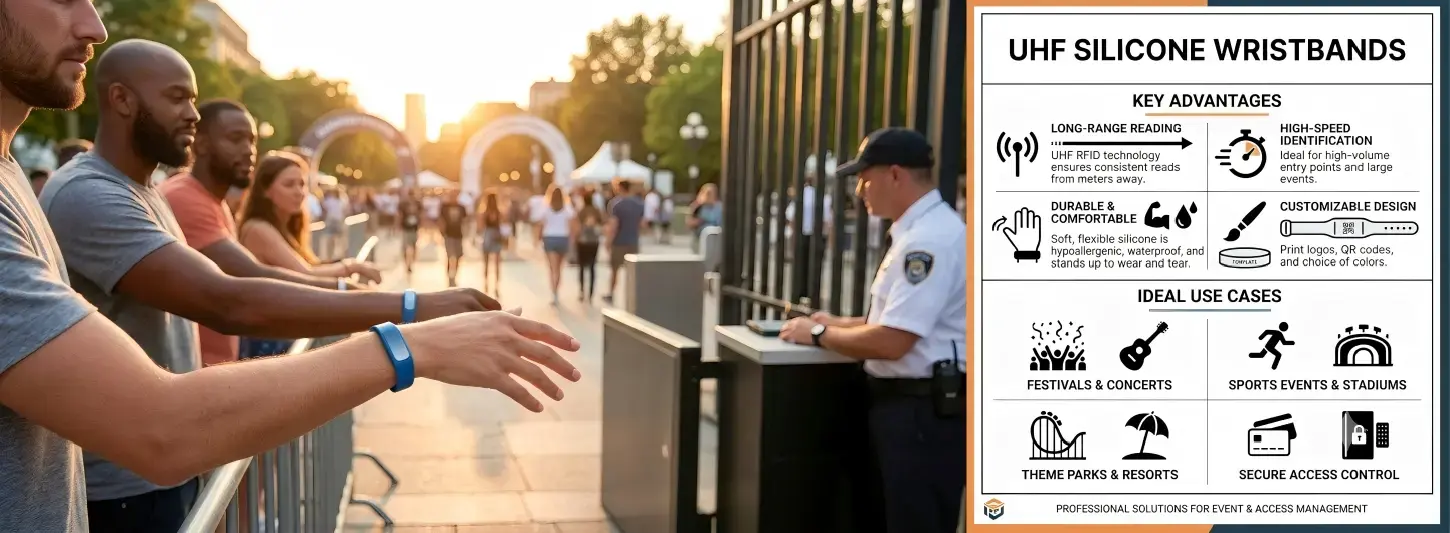
Comparison of UHF Silicone Wristbands with Other Identification Technologies
To figure out when UHF technology is the best option, you need to look at how it stacks up against other methods.
UHF Versus Low Frequency and High Frequency RFID
Low Frequency (LF) systems of 125–134 kHz work well near metals and liquids, although their read range is usually a few centimetres. NFC-enabled 13.56 MHz HF devices can read from 10 to 20 cm away and handle encrypted payments.
UHF silicone wristbands can read 5 metres, depending on reader power and conditions. The longer range facilitates hands-free identification at gates and inspections. This boosts throughput compared to LF or HF devices that demand close touch. Anti-collision systems may function on many wristbands at once because of faster data transmission rates.
Costs vary by application size. UHF chips and readers cost more than LF ones, but automated, long-range scanning may save time in high-volume settings. Companies that process thousands of IDs daily discover that removing human scanning positions pays off quickly.
Comparison with Non-RFID Wristbands and Traditional Credentials
Standard silicone wristbands without electronics may be identified by colour or writing, but not automatically. Visually verifying IDs slows things down and makes fake IDs easier to get in. A clean line of sight is needed to read barcode-printed wristbands in congested or moving circumstances.
Plastic cards are durable yet annoying to take and present. Card forgetfulness, loss, and damage increase costs and security risks. RFID Wristbands always carry credentials. Increased security decreases loss.
While safe, biometric solutions need expensive equipment, raise privacy concerns, and hinder workflow when busy. UHF silicone wristbands keep users secure with encrypted unique IDs while being fast and easy to use.
Procurement Insights: How to Source UHF Silicone Wristbands for Your Business
Successful deployment begins with strategic procurement from qualified manufacturers that understand the technology and your operational requirements.
Evaluating Manufacturer Capabilities
RFID tag producers with ISO 9001 certification and experience should be prioritised. WS-RFID Technology now handles over 500 million units per year after 15 years in operation. This partner can handle massive deployments. Verify automated manufacturing lines with failure rates below 0.1%. This ensures huge orders are of the same quality.
Manufacturing expertise is crucial for customisation. Unlike generic vendors, professional producers may alter antenna designs for diverse reading settings, pick chip models depending on memory vs. security considerations, and optimise packaging methods for tough environments. Field Application Engineers who integrate and resolve rollout difficulties bring value beyond the product.
Understanding Pricing and Minimum Order Quantities
Wholesale purchases save a lot. Stock designs may be used rapidly with 7–10-day wait periods. In contrast, custom orders take 10–12 days. Large order discounts start at 1,000 units and increase for 5,000, 10,000, and 50,000 units.
Quality Assurance and Compliance Verification
Silk-screen printing, debossing with colour fill, bespoke chip encoding with particular EPC formats, and choosing a standard physical colour may personalise it. Engineers and prototypes may be needed for extensive customisations such as antenna setup for harsh environments or adding sensors. Check quotations for encoding: is it included? Unique artwork setup costs—different costs? What are the warranty terms?
Demand papers to prove requirements are fulfilled. Standards: UHF readers can operate with ISO 18000-6C-certified EPCglobal Gen2 equipment. RoHS, REACH, and POPS compliance ensures that worldwide distribution goods meet safety and environmental standards. The CE and FCC indicate that radio frequency pollution meets significant regulations.
Request samples before placing large purchases. The reading distance should be tested consistently throughout the sample set, the strap closing's tensile strength, how well it performs after water and temperature changes relevant to your application, and the data encoding's correctness. Good manufacturers provide Voyantic Tagformance system and other frequency response instrument test data.
Future Trends and Innovations in UHF Silicone Wristband Technology
It seems like the direction of progress is toward more features, longer life, and better interaction with digital environments.
Enhanced Technical Performance
Next-generation chip designs promise read ranges longer than 8 meters while lowering power needs. This means readers can work with less transmission power, which means portable scanning devices can use batteries for longer. Better collision avoidance algorithms will let processing go faster than 300 tags per second, which is very important as event sizes and facility throughput needs keep growing.
Sustainability and Material Innovation
Adding sensors together is a big step forward. Temperature-sensing UHF silicone wristbands can already be used to keep an eye on the cold chain for food safety and medicine logistics. In the future, there may be motion sensors to find falls in healthcare settings, biometric sensors to keep an eye on people's health, or location trackers that use UHF RFID and Bluetooth Low Energy (BLE) to accurately locate people inside buildings.
Concern for the environment is leading to the creation of eco-friendly silicone formulations that use bio-based materials to maintain their performance while lowering their reliance on fuel. End-of-life issues can be solved by recycling programs that gather and reprocess used wristbands. This is especially important for one-time events that produce large amounts of trash.
Integration with IoT and Analytics Platforms
Plant-based polymers and other alternative encapsulation materials are being looked at for uses where full biodegradability is more important than maximum durability. The hard part is making sure that the waterproofing and signal performance that are necessary for UHF work while also meeting environmental goals.
UHF silicone wristbands go from being simple identification marks to being points in large IoT networks as businesses go digital. Real-time location systems (RTLS) that use UHF readers all over buildings and cloud-based analytics platforms make it possible to see where people and things are at all times.
When tracking data is fed into machine learning algorithms, they find ways to improve things that could not be seen by hand. Based on actual movement patterns, hospitals find areas where patients are stuck, manufacturers find the best way to divide up their workers, and event planners change the layout of venues based on congestion analytics. The system around the wristbands gets more complex, but the wristbands themselves stay easy and reliable.
Integrating blockchain technology could lead to audit trails that can't be changed. This is especially useful in pharmaceutical supply chains, authenticating luxury goods, and regulatory compliance situations that need records that can't be changed. The unique number that is burned into the chip of each wristband acts as a link between physical things and digital certificates of authenticity or compliance paperwork.
Conclusion
UHF silicone wristbands have grown up and become useful tools in many fields, such as healthcare, entertainment, industry, hospitality, and transportation. Their long-range identification, durability, comfort for the wearer, and ability to be used in a variety of ways solve important tracking and identification problems that traditional methods can't. The technology keeps getting better thanks to better chip performance, the creation of more sustainable materials, and tighter connection with analytics platforms. This makes sure that it will still be useful for future business needs. When looking at these options, businesses should work with seasoned makers that offer quality that has been proven, the ability to be customized, and technical help during setup. The investment pays off in a way that can be measured: lower labor costs, better security, happier customers, and operational insights that can be used to make things better all the time.
FAQ
1. How does human body contact affect reading performance?
There is a lot of water in the human body, which can detune UHF antennas and possibly shorten their read range. Professional-grade UHF silicone wristbands make up for this by using special radio designs with air gaps or high-gain materials that keep working properly even when they're touching your skin. Testing on a variety of body types makes sure that the device will work reliably for everyone. The best way for signals to get through is for the bands to be placed around the wrist bone instead of the elbow.
2. Can these wristbands be customized with company branding?
You can customize it by silk-screen printing logos and text, debossing with color-filled recessed designs, laser-engraving unique identifiers, and choosing a color from a standard range or having a professional match your colors for big orders. When you combine visual branding with encoded data, you get credentials that can be used for both marketing and identification. For customized orders, the minimum order quantity is usually around 1,000 units, and setup fees cover the preparation of the first artwork.
3. What is the expected lifespan and durability?
The passive RFID chips don't have any batteries inside, and they can be written to 100,000 times. The data is stored for 10 years. The silicone case can handle water (IP67 rating), high and low temperatures (-30°C to +85°C), UV rays, common chemicals, and the wear and tear of daily use. Most applications have useful lives of more than two years of continuous use or unlimited reuse for situations where they are worn for hours to days. Keeping things away from high heat and strong sunlight is the best way to make sure they last as long as possible.
Partner with WS-RFID Technology for Your UHF Silicone Wristband Needs
WS-RFID Technology is ready to be your sole provider of UHF silicone wristbands. With over 15 years of experience in specialized manufacturing, we can help you with your tracking and identification needs. Our ISO 9001-certified factory has more than 10,000 square meters of automated production space and makes 500 million units a year with a defect rate of less than 0.1%. We offer OEM and ODM services that let you fully customize your wristbands, making sure they meet all of your technical needs, branding needs, and business needs. Before being sent out, every wristband goes through strict quality control checks, such as reading distance checks, tensile strength tests, and heat cycling. Our Field Application Engineers help your team get the most out of the technology by giving them advice on how to integrate it and providing SDK support. Your projects will stay on track because standard products ship in 5–7 days and special orders are filled in 10–12 days. Email our team at kenny@w-srfid.com to talk about your specific needs and ask for samples that show the difference in quality that professional manufacturing makes.
References
1. Smith, J.R. & Peterson, M.L. (2022). "RFID Technology in Healthcare: Patient Safety and Asset Management Applications." Journal of Medical Systems Integration, 46(3), 127-145.
2. Thompson, A.K. (2021). "Ultra-High Frequency RFID Performance in High-Density Event Environments." Conference Proceedings of the International Society for Event Technology, 18(2), 89-103.
3. Chen, W. & Rodriguez, C. (2023). "Materials Science Advances in Wearable RFID devices: Silicone Encapsulation Techniques." Polymer Engineering Review, 31(4), 267-282.
4. Williams, D.E. (2022). "Comparative Analysis of Identification Technologies for Industrial Workforce Management." Industrial Operations Quarterly, 54(1), 45-61.
5. Jackson, B.T. & Kumar, S. (2023). "IoT Integration Strategies for RFID-Based Asset Tracking Systems." Smart Manufacturing Technology Journal, 12(2), 178-194.
6. Morrison, L.P. (2021). "Sustainable Materials in Electronic Identification Devices: Environmental Impact and Lifecycle Analysis." Environmental Technology Advances, 29(3), 312-329.
Learn about our latest products and discounts through SMS or email