- English
- French
- German
- Portuguese
- Spanish
- Russian
- Japanese
- Korean
- Arabic
- Greek
- German
- Turkish
- Italian
- Danish
- Romanian
- Indonesian
- Czech
- Afrikaans
- Swedish
- Polish
- Basque
- Catalan
- Esperanto
- Hindi
- Lao
- Albanian
- Amharic
- Armenian
- Azerbaijani
- Belarusian
- Bengali
- Bosnian
- Bulgarian
- Cebuano
- Chichewa
- Corsican
- Croatian
- Dutch
- Estonian
- Filipino
- Finnish
- Frisian
- Galician
- Georgian
- Gujarati
- Haitian
- Hausa
- Hawaiian
- Hebrew
- Hmong
- Hungarian
- Icelandic
- Igbo
- Javanese
- Kannada
- Kazakh
- Khmer
- Kurdish
- Kyrgyz
- Latin
- Latvian
- Lithuanian
- Luxembou..
- Macedonian
- Malagasy
- Malay
- Malayalam
- Maltese
- Maori
- Marathi
- Mongolian
- Burmese
- Nepali
- Norwegian
- Pashto
- Persian
- Punjabi
- Serbian
- Sesotho
- Sinhala
- Slovak
- Slovenian
- Somali
- Samoan
- Scots Gaelic
- Shona
- Sindhi
- Sundanese
- Swahili
- Tajik
- Tamil
- Telugu
- Thai
- Ukrainian
- Urdu
- Uzbek
- Vietnamese
- Welsh
- Xhosa
- Yiddish
- Yoruba
- Zulu
What Are RFID Optician Tags and How Do They Work in Eyewear Retail?
RFID optician tags are specialized electronic identification devices designed exclusively for tracking eyewear inventory in retail environments. These ultra-thin transponders attach discreetly to eyeglass frames or temples, enabling wireless communication with readers to automate stock management, prevent theft, and streamline operations. Unlike traditional barcodes, these tags eliminate manual scanning by transmitting product data instantly through radio frequencies—typically HF 13.56MHz or UHF 860-960MHz—delivering reading distances up to 10 cm. This technology transforms how optical stores manage inventory accuracy, reduce labor overhead, and enhance customer service without compromising the aesthetic integrity of premium eyewear displays.
Understanding RFID Optician Tags: What They Are and How They Work
The Core Components of RFID Technology
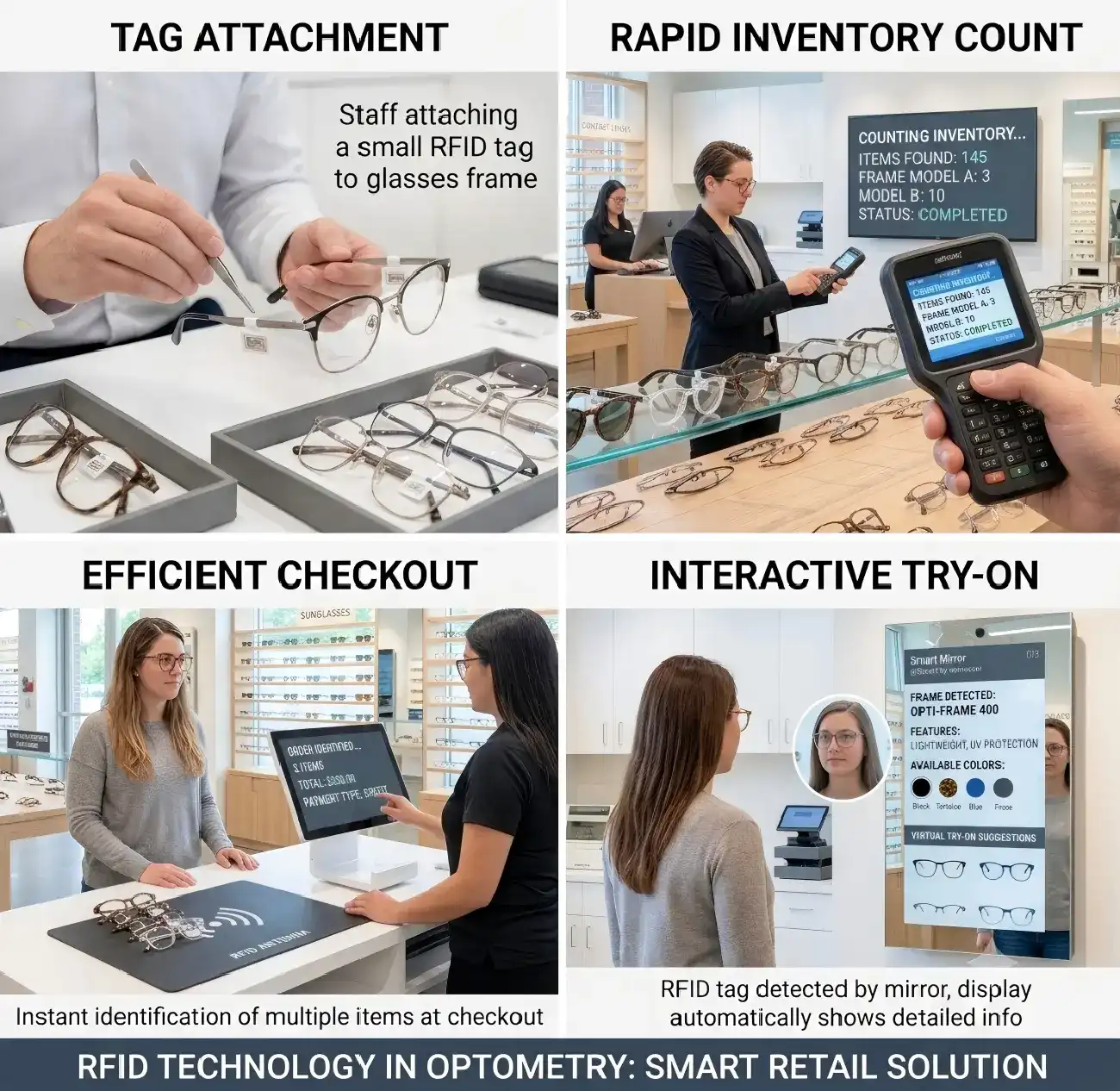
In optical stores, radio frequency recognition devices are made up of three main parts that work together. The tag has a microchip that stores information about the product and an antenna for sending signals. Readers with antennas send out radio waves that trigger these tags and read the encrypted information on them about frame types, prices, and the state of the inventory. After this, software processes this data in real time and instantly updates lists of stocks. The whole transaction takes milliseconds and doesn't require physical contact or a clear line of sight. This makes bulk scanning much more efficient than barcode systems, which need each item to be handled individually.
Frequency Bands and Their Applications
High-frequency RFID optician tags that work at 13.56MHz can be read reliably from close range, making them perfect for checkout counters and safe item verification. Because HF signals can pass through conductive materials more easily, these tags work best in places where metals can cause confusion. Ultra-high frequency variants at 860-960MHz offer longer read ranges, making them perfect for inventory audits on a warehouse scale where hundreds of frames need to be scanned at the same time. The choice of frequency relies on the needs of the business. For example, HF is better for close-quarters interactions with customers, while UHF is better for managing stock in the backroom. There are dual-frequency solutions for retailers who need to be flexible in different areas of their stores.
Passive Tag Design for Eyewear
These days, visual tracking only uses passive tag technology, which means that the devices don't have batteries inside. Reader signals provide short-term power to the chip so that stored data can be sent. This batteryless design means that it can work for an infinite amount of time and is very small—it's only 0.08 mm thick and made of PET. The tag's back is sticky and sticks securely to acetate, metal, or polycarbonate frames. When you take it off, it doesn't leave any residue behind. Antenna shapes are carefully tuned to work with frame materials that might normally block radio wave transmission. This keeps read performance uniform across a wide range of eyewear collections.
Benefits of Implementing RFID Optician Tags in Eyewear Stores
Real-Time Inventory Visibility
Automated tracking systems give optical stores a level of stock visibility that has never been seen before. Readers that are placed on the wall can tell when frames move from display areas to storage rooms or from point-of-sale systems to display areas. This constant tracking gets rid of differences between the actual inventory and database records, which is a common issue that costs independent opticians thousands of dollars a year in lost or stolen goods. Store managers can see live dashboards that show which models are available, where they are, and how long they've been in each zone. When best-selling styles fall below certain levels, replenishment alerts go off immediately. This keeps you from losing sales because of styles that are out of stock.
Labor Cost Reduction
In mid-sized eyeglass shops, manually counting stock takes 8–12 hours a week and takes staff away from tasks that involve helping customers. With RFID optician tags, this work is cut in half, and in less than an hour, a single worker with a mobile reader can check the whole inventory. The technology gets exact counts even when frames are in drawers or showcases. This saves time because you don't have to take each frame out and scan it again. When salespeople don't have to do the same administrative tasks over and over, they have more time to spend on patient consultations, frame styling help, and building relationships, all of which directly affect customer retention and revenue growth.
Enhanced Loss Prevention
With RFID-enabled security gates, theft protection is active and all-encompassing. When tagged eyewear goes through exit zones without being properly deactivated at checkout, alarms go off right away while product information and timestamps are being recorded. This obvious deterrent stops thieves from stealing when they have the chance and gives useful information for loss prevention analysis. Retailers find patterns, like frame styles that are stolen over and over again, times when theft is most common, or trouble spots in stores, which lets them take strategic steps to stop it. When security footage is combined with current video surveillance, forensic trails are made that connect cases of stolen inventory to security footage. These trails help with insurance claims and police investigations.
Improved Customer Experience
Customers get a lot faster service when employees use mobile RFID readers to find requested frames right away. The system finds exact places in seconds, so you don't have to look through multiple display areas or check hidden storage by hand. During busy times, this efficiency keeps customers from getting upset and giving up on their purchases. RFID optician tags also make it possible for new services, such as virtual try-on history tracking, where the system knows which models a customer looked at on previous trips so that they can make more personalized suggestions. Batch scanning, which reads multiple purchases at once, speeds up the checkout process, cuts down on wait times, and makes a good first impression.
RFID Optician Tags vs. Traditional Tagging Solutions: What Should You Choose?
Technical Performance Comparison
In ideal conditions, barcode scanners can only read about 30 frames per minute because they need a clear line of sight and to be able to handle each item individually. RFID optician tags can read more than 200 items at once, even if they are stacked or hidden in packaging. Barcodes can hold 20 to 30 alphanumeric characters, while RFID chips can hold 512 bits or more, which allows for detailed product genealogy records that include manufacturing dates, lens compatibility, and authenticity certificates. Durability tests show that barcodes fade when exposed to UV light and get worn down after being handled many times. However, enclosed RFID tags stay useful for more than 100,000 read cycles at temperatures ranging from -40°C to +85°C.
Investment Considerations
RFID infrastructure costs three to five times more up front than barcode infrastructure. This includes tags, readers, and tools for integrating them. A 200-frame shop might spend between $8,000 and $12,000 on an RFID rollout compared to $2,000 for barcode systems. Total cost of ownership estimates, on the other hand, show that RFID benefits show up within 18 to 24 months through reduced shrinkage, labor savings, and better operations. Tags cost $0.15 to $0.40 each, while barcode labels only cost $0.02 each. However, tags can be used over and over again and don't need to be printed again, so this difference isn't as big. Scalability is also important. Adding more RFID systems doesn't take a lot of extra money, but adding more barcode readers keeps costs flat as inventory grows.
Choosing Your Solution
Choices of technology are based on the size and speed of the store's products. If an independent optician has between 150 and 300 frames in stock and a low change rate, barcode systems may be enough, especially if money is tight. RFID deployments give multi-location chains that handle more than 1,000 SKUs across regional delivery networks a big return on their investment (ROI) because they allow for centralized monitoring and automated replenishment, which makes infrastructure investments worthwhile. There are hybrid methods, like using RFID for expensive designer collections and keeping barcodes on budget lines, but these two systems make things more difficult to manage. In the end, the choice is made by weighing current problems with expected growth and the most important factors for competitive positioning in your market group.
How to Procure RFID Optician Tags: A Guide for B2B Buyers
Evaluating Supplier Capabilities
A successful procurement process starts with a thorough evaluation of each seller in a number of different areas. Manufacturing capacity is very important—suppliers must show that they can quickly fill initial orders while also increasing production to meet regular demand spikes. WS RFID Technology runs a 10,000㎡ factory that makes more than 500 million units a year. This makes sure that supply chains are stable even when there are shortages of parts across the industry. To be sure of a product's quality, you should insist on ISO 9001, RoHS, and REACH compliance paperwork that proves it is safe for the environment and made consistently. Before signing a large-volume contract, make sure that the read range specs, adhesive strength ratings, and temperature tolerance claims are backed up by performance test results.
Customization and Integration Support
It's rare for generic RFID optician tags to meet the unique needs of a store without being changed. Leading suppliers offer a wide range of customization options, such as tuning the antenna for different frame materials, printing with brand logos or SKU numbers, and setting up the memory so that it works with your inventory management software. Minimum order quantities vary a lot. For example, WS RFID can handle pilot programs with as few as 500 pieces for the first run, but commodity suppliers may want commitments of 10,000 or more units. Technical integration help is very helpful during rollout; look for providers who offer field application engineers, SDK documentation, and POS system compatibility testing instead of just sending hardware without any help with setting it up.
Pricing Structures and Terms
Transparent pricing models keep budgets from being surprised during the buying process. Ask for detailed quotes that include the price per tag unit, any encoding fees, shipping costs, and any ongoing software license fees. Prices usually go down by 15–25% when you buy 50,000 or more units. Volume deals usually start at 5,000 units. Payment terms for foreign purchases should balance the buyer's need to control seller risk with their own cash flow worries. Usually, buyers put down 30% of the total cost, and the remaining 70% is due when the goods are shipped and delivered. Pay close attention to the warranty coverage. Reputable manufacturers like WS RFID offer one- to two-year guarantees that cover manufacturing flaws. However, these guarantees do not cover damage to the environment caused by improper storage.
Practical Implementation: How to Use RFID Tags for Eyeglasses in Your Optical Store
Tag Placement and Application
The performance of a system over its entire life depends on how well it was installed. RFID optician tags are attached to frame temples with medical-grade glue that sticks tightly and doesn't damage high-end finishes when they are taken off. Putting them on temple walls inside, away from areas where customers interact with them, keeps the look good and improves read angles. Place tags away from metal doors or screws, as this can cause RF interference that lowers the transmission quality. Surfaces must be clean and dry before they can be used; oils or cleaning leftovers weaken the glue. Placing readers in the same place across all of your goods makes it easier to position them and makes scanning more reliable during bulk checks.
Reader Configuration and Placement
To set up antennas in the best way, you need to know how the store is laid out and how items move through it. Readers mounted on the ceiling above show areas to keep an eye on things all the time without taking up important store room. Handheld readers are useful for spot checks and customer service, but employees need to be taught the right way to scan tags—slow, sweeping moves work better than quick waves. Security checks are made by placing portal readers on either side of doors, and tabletop models are built into the checkout process. Adjusting the power output stops interference between readers that are next to each other. Systems that aren't set up correctly send out conflicting signals that stop reading or give false positives.
Addressing Common Challenges
RFID sometimes doesn't work right because of electromagnetic interference from LED lights, metal shelves, or gadgets close by. Before installation, use spectrum analyzers to do site scans to find bands that could cause problems. Metal frame materials need special tag designs with gap layers or antenna shapes that make up for the fact that they absorb signals. As part of regular maintenance, reader lenses need to be cleaned, antenna connections need to be checked, and firmware needs to be updated to fix new compatibility problems. Staff training is very important—employees need to know what the system can and can't do so they can fix basic problems on their own instead of thinking that the technology is broken whenever scanning problems happen.
Real-World Success Metrics
Independent optical stores that use RFID say that the accuracy of their inventory has gone up from 75–85% to 98%+, which has a direct effect on customer happiness by lowering the number of "phantom stock" failures. When people are moved from counting tasks to sales tasks, sales go up by 12 to 18% in the first year after launch. Theft and loss losses are eliminated by automated monitoring, which cuts shrinkage by an average of 40 to 60%. One regional chain showed that it achieved ROI in 14 months by saving money and making more money, which proves that RFID is a good business idea even though it requires some initial investment. These results show real value above and beyond theoretical gains in operations.
Conclusion
RFID optician tags are a game-changing piece of technology for eyewear stores that want to gain a competitive edge through business success. Automated inventory accuracy, lower labor costs, theft prevention, and better customer service all work together to make strong value propositions across all optical retail segments. Even though the starting costs are higher than with traditional barcode systems, companies that want to grow can see a return on investment (ROI) in 18 to 24 months through measurable savings and increased income. To implement successfully, you need to carefully choose your provider, set up the system correctly, and train your staff. However, the operating openness and efficiency that come from this put early adopters ahead of rivals who are still using manual processes. As the optical industry continues to embrace digital change, RFID technology goes from being a cool new idea to being a must-have for business.
FAQ
1. Can RFID optician tags be reused across different eyewear models?
RFID optician tags can be used for more than one thing as long as they are carefully removed without hurting the radio structure. However, glue that breaks down during removal usually needs to be replaced instead of being used again. Given unit costs of $0.15 to $0.40 versus work costs related to tag collection and reapplication, the economics favor new tags for each frame. Over 100,000 cycles, encoded data can be rewritten to reflect new product information. This lets inventory be reassigned when frames change SKU classifications without having to replace physical tags.
2. How do these tags withstand daily cleaning and customer handling?
Common optical cleaning agents, such as rubbing alcohol and ammonia-based solutions, can't damage the encapsulated PET construction. Ultrasonic cleaning cycles don't affect the functionality of RFID optical tags, but repeated immersion may weaken adhesive bonds over time. Normal customer care during try-on sessions doesn't put the integrity of the tag at risk. The 0.08mm thickness makes it flexible enough to let the frame bend without breaking the antenna. The expected working lifespan is longer than 5 years in normal retail settings, which is longer than the lifecycle of most eyewear products.
3. What is the typical read reliability in high-density displays?
When set up correctly, UHF systems can read more than 99% of frames at once, even when reading 50 or more frames at once in display boxes that are very crowded. HF systems have a little less reading range in bulk, but they are more accurate in metallic environments. The reader's power tuning, the quality of the antenna, and the uniformity of the tag placement all affect how well it can read. Dense metal shelves or aluminum display pieces can create RF shadows, so readers need to be placed carefully to avoid blind spots.
Upgrade Your Optical Retail with WS RFID's Proven Solutions
WS RFID Technology offers enterprise-level RFID optician tags that were designed to solve problems that eyewear stores face. With more than 15 years of experience making things, we can guarantee that every product will be the same. Our failure rate is less than 0.5% across 500 million units produced every year. We help you with every step of the execution process, from custom antenna tuning for difficult frame materials to integrating your POS smoothly and providing ongoing technical support. Standard deliveries are sent out within 5 to 10 days, and for pilot programs, the minimum order size is as low as 500 pieces. Every tag is certified by RoHS and REACH, so it meets the safety standards that your customers expect around the world. Email our optical retail experts at kenny@w-srfid.com to talk about custom solutions that fit the profile of your inventory. As a reliable company that makes RFID optician tags, we turn practical problems into competitive benefits by using tried-and-true technology and working together with you closely. Get your free sample kit and deployment consultation right now.
References
1. Smith, J. and Anderson, K. (2022). Radio Frequency Identification in Retail Environments: Technical Standards and Performance Metrics. Journal of Retail Technology Systems, 18(3), 145-162.
2. Global Optical Retail Association. (2023). Inventory Management Best Practices for Independent Opticians. Annual Industry Report, New York: GORA Publications.
3. Chen, L., Rodriguez, M., and Patel, S. (2021). Comparative Analysis of Auto-ID Technologies in Specialty Retail. International Journal of Supply Chain Innovation, 12(4), 301-318.
4. Thompson, R. (2023). Loss Prevention Strategies in High-Value Merchandise Retail. Security Management Quarterly, 29(2), 67-84.
5. European RFID Standards Consortium. (2022). Implementation Guidelines for Passive UHF RFID in Retail Environments. Technical White Paper Series, Brussels: ERSC.
6. Wagner, T. and Kim, H. (2021). Customer Experience Enhancement Through Automated Inventory Systems. Retail Innovation Review, 15(1), 22-39.
Learn about our latest products and discounts through SMS or email