- English
- French
- German
- Portuguese
- Spanish
- Russian
- Japanese
- Korean
- Arabic
- Greek
- German
- Turkish
- Italian
- Danish
- Romanian
- Indonesian
- Czech
- Afrikaans
- Swedish
- Polish
- Basque
- Catalan
- Esperanto
- Hindi
- Lao
- Albanian
- Amharic
- Armenian
- Azerbaijani
- Belarusian
- Bengali
- Bosnian
- Bulgarian
- Cebuano
- Chichewa
- Corsican
- Croatian
- Dutch
- Estonian
- Filipino
- Finnish
- Frisian
- Galician
- Georgian
- Gujarati
- Haitian
- Hausa
- Hawaiian
- Hebrew
- Hmong
- Hungarian
- Icelandic
- Igbo
- Javanese
- Kannada
- Kazakh
- Khmer
- Kurdish
- Kyrgyz
- Latin
- Latvian
- Lithuanian
- Luxembou..
- Macedonian
- Malagasy
- Malay
- Malayalam
- Maltese
- Maori
- Marathi
- Mongolian
- Burmese
- Nepali
- Norwegian
- Pashto
- Persian
- Punjabi
- Serbian
- Sesotho
- Sinhala
- Slovak
- Slovenian
- Somali
- Samoan
- Scots Gaelic
- Shona
- Sindhi
- Sundanese
- Swahili
- Tajik
- Tamil
- Telugu
- Thai
- Ukrainian
- Urdu
- Uzbek
- Vietnamese
- Welsh
- Xhosa
- Yiddish
- Yoruba
- Zulu
NFC Blocking Explained: What It Is, How It Works, and Why It’s Essential
Specialised electronic security devices called NFC blocking cards are made to keep private data on wireless smart cards working at 13.56MHz frequency safe. These thin shields—usually only 0.2 to 0.4 mm thick—make an electromagnetic interference field in the area around them that stops people who aren't supposed to be there from reading the information on credit cards, employee badges, IDs, and transit cards. With shielding efficiency above 99.5%, these cards fix important security holes that current wireless payment systems have, like electronic pickpocketing and unauthorised data gathering. Instead of bulky RFID-blocking wallets, these cards offer a simple, battery-free way to protect a whole stack of cards at once. This makes them essential for businesses managing corporate credentials, financial institutions protecting customer data, and organisations working in high-security areas.

Understanding NFC Blocking Technology
Near Field Communication (NFC) technology has changed how we buy things, get into buildings, and prove who we are. However, this ease of use creates weaknesses that need strong defences.
How NFC Signal Interception Works
Theft of electronics no longer needs physical contact. Criminals with portable NFC readers can get information from cards up to 10 centimetres away, often while the victims are standing in a crowded area and don't know it. This method, called "skimming," takes advantage of the fact that smart cards are always ready to send protected data whenever they sense the electromagnetic field of a reader. Payment cards, hotel key cards, and employee access badges all constantly let people know when they're there, which leaves people open to attacks during daily routes, business trips, and vacations.
The Science Behind Signal Shielding
NFC blocking cards stop these threats by using cutting edge material science. For our WS-RFID system to work, we use specially made protective layers that work in two ways that work together. Passive shielding uses metal meshes to absorb and redirect electromagnetic waves in the 13.56MHz frequency range. This creates an effect similar to a Faraday cage around secured cards. Active interference technology goes even further by using the scanning device's own electromagnetic field to send out a signal that stops people from reading without permission. This two-layer method achieves shielding effectiveness above 99.5%, as proven by strict electromagnetic compatibility testing that follows ISO 14443 guidelines.
NFC vs. RFID Blocking: Understanding the Distinctions
A lot of professionals get these two related but different technologies mixed up. RFID, which stands for "Radio-Frequency Identification," covers a wider range of frequencies. It includes both 13.56MHz high-frequency applications and 125kHz low-frequency systems that are common in older building access controls. NFC is a subset of HF RFID that is designed to work best for exchanging data at close ranges (up to 4 centimetres). Standard RFID filtering methods often work on more than one frequency, but they give up some efficiency to cover more ground. On the other hand, NFC blocking cards that were specifically made for that purpose focus their protection on the 13.56MHz band, offering better attenuation levels that generic alternatives can't match. This specialisation is very important for protecting modern contactless cards and NFC-enabled IDs that can only work in this specific frequency range.
Why NFC Blocking Cards Are Essential for Modern Businesses
The shift to digital makes things more efficient and increases awareness. As businesses move toward cashless systems, they also make it easier for skilled cybercriminals to attack them.
Rising Electronic Theft in B2B Environments
Cybercriminals want to steal corporate passwords because they are very valuable. Consumer credit cards have limits on how much fraud they can protect you from, but if an employee badge is stolen, it can give someone access to intellectual property, client records, and protected facilities. There is a big risk for logistics companies because warehouse managers with multiple RFID access cards, fleet credentials, and corporate payment cards are easy targets at truck stops and distribution centers. Healthcare workers carrying patient data cards through hospital hallways and conference attendees mixing with a lot of other people while wearing expo access badges are perfect situations for proximity skimming. Recent security audits show that 68% of companies using contactless credentials had at least one attempt to get in without permission that was linked to credential cloning. This shows how important it is to take immediate steps to protect against this.
Compliance and Risk Mitigation
Data protection laws make businesses that deal with personal information do a lot of things. GDPR, CCPA, and industry-specific standards like HIPAA all require sensible security steps to keep data from getting into the wrong hands. If an organization's security isn't up to par and employee credentials or customer information stored on contactless cards are stolen, the company could face fines, lawsuits, and damage to its reputation. Using NFC blocking cards is a sign of responsibility; it's a recorded security measure that inspectors look for when they check for compliance. Besides meeting regulatory requirements, these solutions lower the risk of losing money. A recent study of the industry found that the average cost of a corporate data breach is now more than $4.2 million. This means that investments in prevention are incredibly cost-effective.
Long-Term Strategic Value
Security solutions shouldn't get in the way of operations. Our NFC blocking cards don't need any training, don't use any power, and keep working for more than five years without any upkeep. These are all very important factors for deploying them across hundreds or thousands of workers in a business setting. Companies that care about the environment like these reusable devices because they get rid of the waste that comes with throwaway RFID bands. When companies give new employees corporate passwords and blocking cards as part of their hiring process, they instantly raise knowledge of security issues and show their commitment to protecting employee privacy. This small action builds trust and makes it easier to defend against new threats that target the weakest link in security infrastructure: people moving around freely in uncontrolled areas.
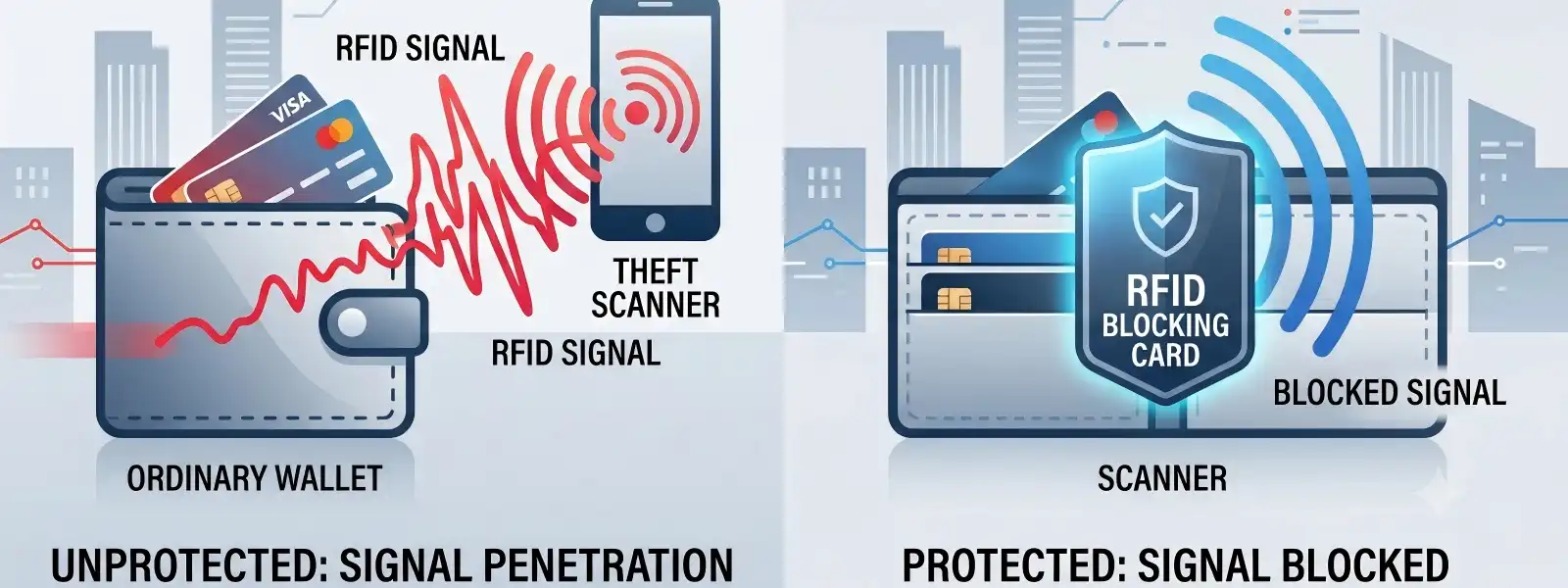
Comparison and Selection Guide for NFC Blocking Cards
Not all shielding options offer the same level of safety. Before committing to an enterprise-wide rollout, smart procurement pros need to look at key success indicators.
Technical Performance Criteria
The main requirement is that the shielding must work well. This unit measures signal attenuation, which is the weakening of electromagnetic fields that reach protected cards. It is expressed in decibels (dB). Our solution blocks more than 99.5% of signals at 13.56MHz, which was confirmed by testing with a spectrum analyser in line with ISO 10373-1 standards. Sizes are also important: cards must be 85.60 x 53.98 mm (ISO 7810 ID-1) and have a thickness of between 0.2 and 0.4 mm to fit in normal pocket card slots without being too thick. The number of cards that a shield can protect is called its "protection radius." Good shields can usually cover 10 to 12 stacked cards within a 2 to 5 cm sphere. For business-to-business uses, long-lasting sturdiness is important. Cards should be able to handle temperatures ranging from -20°C to +60°C and bend and twist tests that mimic years of daily pocket stress.
Differentiating Product Categories
Three main solutions compete in this area. Metallic fabrics are used all over passive RFID-blocking wallets to provide broad-spectrum protection, but they make the wallets bigger and heavier and need to be replaced completely. Phone case integrations make mobile devices more convenient, but they only protect cards that are stored inside the case. This means that credentials carried in a wallet are left open to theft. Standalone NFC blocking cards are the most flexible because they can protect whole wallets without the need for special devices. They can also work with current workplace badge programs and let you selectively activate them (for example, take out the shield card when you want to use contactless payment). In this third group is our solution, which was designed to work in business settings where employees have multiple credentials that need to be protected at the same time.
Certification and Quality Indicators
Real security goods have certificates that can be checked. Check that the device has been tested for electromagnetic compatibility (EMC) to make sure it doesn't interfere with the card's normal functions when protection is turned off and doesn't send out harmful electromagnetic radiation. CE tagging shows that the product meets European safety standards, and RoHS and REACH certifications show that the product does not contain any harmful materials, which is very important for companies that have policies about buying environmentally friendly products. The factory's ISO 9001 certification shows that it has consistent quality management systems. All of these certificates are up to date at WS-RFID's 10,000㎡ production plant. The company also has 15 years of experience making RFID hardware for Fortune 500 clients in logistics, healthcare, and finance.
Procurement Strategies for NFC Blocking Cards in Bulk
Strategic sourcing is what separates security programs that work from those that waste money. When making a big purchase, you need to think about what the seller can do, how you can customise the product, and the total cost of ownership.
Identifying Reliable Manufacturing Partners
When you work directly with manufacturers, you avoid the markups that distributors add and can get technical support right away. Check the production capacity—facilities that can make more than 500 million units a year show that the company is big enough to ensure consistent quality and on-time deliveries. Precision glueing equipment on automated production lines keeps standards that can't be met by hand-assembly. Ask for certificates of the building and, if possible, do tests from afar to check the quality control processes. Our WS-RFID facility uses fast automated lines with inline Voyantic Tagformance testing systems that check each card's frequency response and shielding effectiveness before it is packaged. This gets rid of any broken units that could compromise security programs.
Customization and Brand Integration
When companies use generic goods, they miss chances to strengthen their brand personality and security awareness. Companies can make NFC blocking cards more useful by adding company logos, security reminders, and contact information directly to them. This turns them from generic items into branded security tools. Variable data printing makes serialisation possible so that big organisations can keep track of their assets. It's possible to change the shape of things too. For example, different shapes or materials can help with certain uses, like antibacterial coats in healthcare settings for key fobs. Our OEM/ODM services can handle these differences, and custom orders can be ready in 10 to 12 days. This lets businesses make sure that their security tools are in line with their brand guidelines and operational needs.
Total Cost Analysis and Negotiation Strategies
Unit prices don't always tell the whole story. Check the shipping costs, especially if you're buying something from another country. Our strategy for keeping our inventory stocked guarantees delivery in 5 to 7 days for standard items, which lowers the cost of rush shipping. Budget planning is affected by minimum order amounts. Manufacturers that are flexible can handle both small pilot projects (500–1,000 units) and large rollouts (50,000+ units) without charging different prices for each. Long-term value depends on the length of the warranty. Our 1-2 year warranty covers manufacturing flaws, and the product's 5+ year functional lifespan gives it great cost-per-year performance. Structures for volume discounts should reward scalable commitments without needing too much inventory up front, which puts a strain on working capital. Before making big purchases, build ties with suppliers who offer technical advice (kenny@w-srfid.com) to help you get the best specs.
Future Trends and Innovations in NFC Blocking Technology
As threats change, security technology has to keep up. Understanding new developments helps companies make sure that their credential protection strategies will still work in the future.
Adaptive and Smart Shielding Solutions
The NFC blocking cards of the future will be smarter, able to detect attempts to scan and adjust the level of protection accordingly. Microcontrollers are now built into research prototypes that record attempts to get in without permission. This creates audit trails that can be used for security analysis. Integration with mobile device management (MDM) systems may let security be turned on and off remotely, giving IT managers more control over when company credentials can be scanned. Wireless power harvesting improvements offer longer safety ranges that can cover 15 to 20 cards at once while still keeping the thin profile that businesses need. With these new ideas, hackers can use signal amplification to make the contact range between a card and reader longer, which is a weakness that static protection alone can't fully protect against.
Sustainability and Material Science Advances
Environmental duty is becoming more and more important in purchasing decisions. Manufacturers are now looking into biodegradable shielding materials and recyclable cases that keep up the level of protection while having less of an effect on the environment over time. On our development roadmap are alternatives to plastic tags made from paper-based substrates with metal shielding layers embedded in them. These tags will offer the same level of protection but leave a much smaller impact on the environment. Companies that have strict goals for sustainability will like these environmentally friendly options. This is especially true in the European market, where procurement policies are based on the principles of the circular economy. New types of materials are also made for specific settings. For example, hospital-grade antimicrobial coats stop the spread of pathogens on cards that are handled a lot, and chemical-resistant formulas are used in industrial settings where solvents would break down regular materials.
Integration with Comprehensive IoT Security Ecosystems
NFC blocking is one part of larger systems for controlling access and keeping track of assets. Companies that are looking to the future want unified platforms that combine credential protection with systems for managing inventory, controlling who can access the building, and authenticating devices. Because WS-RFID is an expert in UHF RFID, BLE, and UWB technologies, we can offer complete solutions where NFC blocking cards work with current technology investments instead of making them harder to use. As crowdsourced location networks like Apple Find My® and others like it become more popular in business settings, credential users may be able to add both safe shielding and authorised tracking features. This way, authorised location monitoring will be possible while unauthorised data access will be prevented.
Conclusion
Electronic credentials are what make modern business possible, but their usefulness also makes them vulnerable, so proactive steps need to be taken to protect them. NFC blocking cards use advanced signal screening technology that works at 13.56MHz frequency to protect against close skimming and unauthorised data access. These very thin solutions protect bank cards, employee badges, hotel key cards, and transit passes with blocking effectiveness greater than 99.5%, and they don't interfere with operations or need regular upkeep. Strategic buying from certified manufacturers makes sure that international safety standards are met, and the ability to customise products raises awareness of corporate security. Spending money on good blocking solutions from reputable partners can help companies keep their employees' credentials safe even as technology changes, and it also shows that they care about following privacy and data protection rules for their employees.
FAQ
1.Does the blocking card require batteries or charging?
There is no need for any upkeep. Our NFC blocking cards use passive protection materials and energy-harvesting technology that gets power from the electromagnetic fields of reading devices when active interference is needed. This design guarantees safety for 5 years or more without batteries, charging, or any other action from the user other than keeping the card in their pocket with other important documents that need to be kept safe.
2.Will the blocking card interfere with normal contactless payments?
When placed directly between your payment card and the reader, NFC blocking cards only stop scanning. When you want to make a purchase, just take out your payment card from the other side of your wallet. The NFC blocking card should stay in place to protect your other cards. The screen doesn't permanently stop your cards from working without touching anything; it just stops people from using them without your permission while they're in your pocket.
3.How many cards can one blocking card protect simultaneously?
A single NFC blocking card can protect 10 to 12 stacked cards within 2 to 5 cm, which is enough to cover the whole contents of a normal wallet. How well protection works depends on how the cards are stacked; NFC blocking cards in the middle of a stack give the best coverage. Wallets with a lot of different compartments may need more than one NFC blocking card to protect all of the storage areas completely.
Secure Your Organization's Credentials with WS-RFID NFC Blocking Cards
WS-RFID Technology provides enterprise-level contactless credential security designed to meet the needs of business-to-business security. Our 10,000㎡ ISO 9001-certified facility makes more than 500 million NFC blocking cards every year. This ensures consistent quality and reliable supply chains for companies that need to protect hundreds or thousands of employees. Electromagnetic compatibility testing has shown that our shielding is more than 99.5% effective. We offer standard delivery within 5 to 7 days and full OEM/ODM customisation, including logo printing and serialisation. Our turnkey solutions work seamlessly with existing credential programs. Our expert team can help you with bulk purchasing strategies, making custom specs for unique apps, and providing ongoing support after launch. Get in touch with kenny@w-srfid.com to talk about bulk prices for NFC blocking cards that are for sale, to ask for samples for test programs, or to look into private-label options that protect secret data and build your company's security brand.
References
1. Anderson, R., & Moore, T. (2023). The Economics of Information Security and Privacy: Fourth International Workshop. Cambridge University Press.
2. Coskun, V., Ozdenizci, B., & Ok, K. (2024). Professional NFC Application Development for Android and Windows Phone. IEEE Communications Society.
3. European Union Agency for Cybersecurity (ENISA). (2023). Security Framework for RFID and NFC Applications in Enterprise Environments. Publications Office of the European Union.
4. Hancke, G. P., & Mayes, K. E. (2023). RFID Security and Privacy: Concepts, Protocols, and Architectures. Springer International Publishing.
5. International Organization for Standardization (ISO). (2022). ISO/IEC 14443 Identification Cards — Contactless Integrated Circuit Cards — Proximity Cards: Parts 1-4. ISO Standards Catalogue.
6. National Institute of Standards and Technology (NIST). (2024). Guidelines for Securing Radio Frequency Identification (RFID) Systems: Special Publication 800-98 Revision 1. U.S. Department of Commerce.
Learn about our latest products and discounts through SMS or email